A same-day alert prevents complete forgetting, but it does not give you time to post a card, order a gift, reserve a table, arrange travel, or coordinate a family celebration.
If you are deciding how early to set birthday reminders, work backwards from the action. A message may need no preparation. International delivery or a milestone event may need several weeks. For most birthdays, use one early reminder to prepare and one final reminder to act.
Use the action to choose the lead time
Relationship matters, but the intended action is usually the better timing signal.
You may be extremely close to someone who prefers a simple phone call. That birthday needs less preparation than a colleague’s milestone dinner involving a venue, guests, and travel.
Ask:
- What do I intend to do?
- What is the first real deadline?
- Does another person, delivery service, venue, or journey need to be coordinated?
Set the first reminder before that deadline, not at the last moment you could theoretically complete it.
A practical birthday reminder schedule
Use this table as a starting point:
| Intended action | First reminder | Final reminder |
|---|---|---|
| Message or short phone call | Same day or 1 day before | Birthday morning |
| Longer call across time zones | 2–3 days before | A few hours before the planned call |
| Local card or simple gift | 5–7 days before | 1 day before |
| Restaurant, activity, or online order | 7–14 days before | 2–3 days before |
| Personalized gift | 14–30 days before | 7 days before |
| International card or delivery | 21–30 days before | 7 days before |
| Travel, group event, or milestone birthday | 30–60 days before | 14 days and 1 day before |
Delivery times, local availability, mobility, family traditions, and budget can move these windows earlier or later. The schedule should reflect your real circumstances.
Same-day reminders: messages and quick calls
Use a same-day alert when the action is genuinely quick:
- Send a message.
- Make a short call.
- Share a photo or memory.
- Acknowledge a colleague.
- Send a digital card that needs no preparation.
Morning is usually more useful than midnight because it leaves the whole day to respond. Choose a time when you can act rather than when the date technically begins.
If the person lives in another time zone, schedule the alert in your own local time with their location in the note. “Call at 7pm my time / 9am their time” is more useful than relying on mental conversion.
Five to fourteen days: cards, gifts, and meals
Seven days is a strong default for ordinary preparation:
- Buy a local gift.
- Post a domestic card.
- Reserve a restaurant.
- Coordinate a family call.
- Help children prepare a drawing or video.
- Order an item with predictable delivery.
The first alert should identify the next step. “Birthday next week” still requires a decision. “Post the card by Friday” or “book the table today” gives the notification a job.
Keep a birthday-day alert as well. The preparation reminder helps you get ready; the final reminder helps you complete the gesture.
Twenty-one to sixty days: delivery, travel, and milestones
Use an earlier alert when availability or coordination can become a problem:
- International shipping.
- Personalized or handmade gifts.
- Flights, trains, hotels, or accessible transport.
- Group celebrations.
- Venue reservations.
- Milestone birthdays.
- Time off work or childcare.
The more people or services involved, the earlier the first reminder should arrive.
For complex plans, create separate alerts for real deadlines:
- Decide the plan.
- Book or order.
- Confirm details.
- Complete the birthday-day gesture.
These are not duplicate notifications. Each one represents a different action.
Use two alerts for most birthdays
Five identical notifications do not create better preparation. They teach you to dismiss alerts automatically.
Most birthdays need:
- A preparation alert early enough to take action.
- A final alert on the birthday or immediately before it.
Add a third only when there is a separate genuine deadline. A trip may need a booking alert, a packing alert, and a birthday-day alert. A simple phone call does not.
The birthday planning system explains how to organize those actions into remember, prepare, and celebrate stages.
Write the next action in the reminder
A reminder should reduce a decision, not create one.
Compare:
- “Mum’s birthday in 14 days.”
- “Ask Mum whether she wants lunch at home or a restaurant.”
The first statement provides information. The second helps the plan move forward.
Useful reminder wording includes:
- Order the photo book.
- Ask siblings about dinner.
- Post the card by Friday.
- Call after 6pm in their time zone.
- Confirm the accessible restaurant.
- Help the children record a message.
Apple Reminders supports dates, notes, links, and other details. A dedicated birthday app can keep those actions beside the birthday record, countdown, and recurring schedule.
Choose a useful time of day
The correct day with the wrong time can still be inconvenient.
For a birthday-day alert:
- Use morning for a message you can send at any point.
- Use a planned local time for an international call.
- Use the previous evening if mornings are rushed.
- Avoid midnight alerts unless you genuinely want to act at midnight.
For preparation alerts, choose a time when you can complete or schedule the action. A gift reminder during a meeting is easy to dismiss. The same reminder after work may be immediately useful.
Adjust reminders after the birthday
Take 30 seconds after an important birthday:
- Did the first alert arrive early enough?
- Was a card or delivery delayed?
- Was the final reminder at a useful time?
- Did the person prefer a different kind of celebration?
- Is next year a major milestone?
- Should the reminder become simpler?
Small adjustments make the system more personal and reliable each year.
If your birthday records are still scattered across profiles and message threads, first build a private list with the guide to remembering birthdays without social media.
Example reminder plans
A friend who prefers a message
- First alert: birthday morning.
- Note: “Send the photo from our last trip.”
A parent receiving a posted gift
- First alert: 14 days before.
- Second alert: 7 days before to check delivery.
- Final alert: birthday morning to call.
A relative living abroad
- First alert: 21–30 days before for an international card or gift.
- Final alert: scheduled in your local time with their time zone noted.
A milestone group celebration
- First alert: 60 days before to discuss the plan.
- Booking alert: 30 days before.
- Confirmation alert: 7 days before.
- Final alert: 1 day before.
Frequently asked questions
How many days before a birthday should I set a reminder?
Use 5–7 days for a card or simple gift, 7–14 days for a booking or online order, and 30–60 days for travel or a milestone. A message may only need a same-day alert.
Should I set a reminder on the birthday too?
Yes. Keep a final birthday-day or day-before alert even when you have an earlier planning reminder. The two alerts have different jobs.
Is 30 days too early?
Not when travel, personalized gifts, group coordination, or venue availability is involved. For a simple message, 30 days is unnecessarily early.
What time should a birthday reminder appear?
Choose a time when you can act. Morning works for most messages. Calls across time zones should be scheduled in your local time with the other person’s location noted.
Can reminders repeat every year?
Yes. Calendar and reminder tools can support recurring annual dates, while dedicated birthday apps are designed around yearly birthday records and flexible alerts.
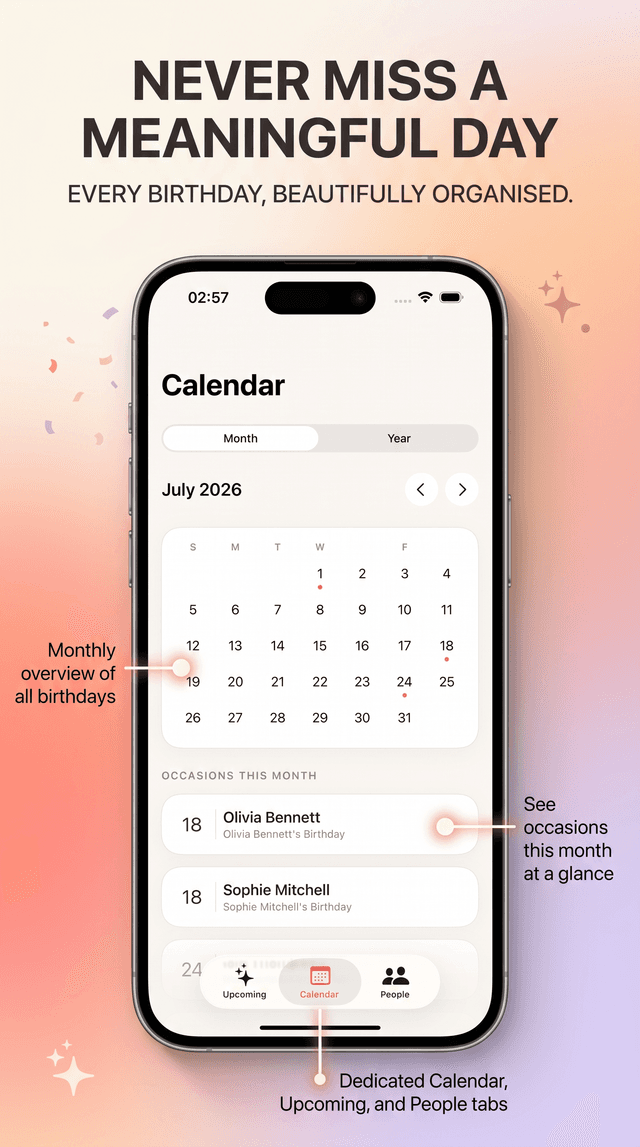
The Birthday Reminder app page shows how multiple alerts, countdowns, notes, widgets, and private organization can support these schedules. Browse all Birthday Reminder guides for the complete private planning workflow.