
When an empty birthday card makes your mind go blank, do not try to invent a polished paragraph all at once. Use this birthday message formula:
- Greet the person as you normally would.
- Name one true detail.
- Connect that detail to what it means.
- Wish them something that fits their life.
In shorthand:
Happy birthday, [name]. [True detail.] [What it shows or means.] [Relevant wish.]
This is a structure, not a script. You can use all four parts in separate sentences, combine two parts, or leave one out when the relationship calls for something brief.
Why the four parts work together
Each part answers a different question:
| Part | Question it answers |
|---|---|
| Greeting | How would I naturally address this person? |
| Detail | What makes this message specifically theirs? |
| Meaning | Why did I choose that detail? |
| Wish | What would genuinely suit them now? |
Emily Post describes a personal letter as having an opening, body, and ending, and notes that the ending depends on the recipient. A birthday card is much shorter, but separating its jobs still makes it easier to write.
The important addition here is meaning. A detail by itself can feel like a stray fact. Explaining what it shows turns the fact into appreciation.
This guide is for writing while the blank card or text box is already in front of you. If you want to collect prompts earlier in the year, use the separate guide to planning birthday messages without making them generic.
Step 1: Greet them in your normal voice
Start with the words you would use aloud:
- “Happy birthday, Priya.”
- “Hey, happy birthday!”
- “Happy birthday, you.”
- “Wishing you a very happy birthday.”
Hallmark advises writers to sound as they do when speaking and to let the relationship guide the wording. That is useful restraint. A formal opener can sound distant between close friends, while a pet name can be awkward in a work card.
Do not spend your effort making the greeting original. Its job is simply to open the message in your voice.
Step 2: Name one true detail
Choose something the recipient will recognize and that you know firsthand. Good sources include:
- Something they did that you appreciated.
- A shared moment, even a small one.
- A harmless habit or interest.
- A recent achievement they told you about.
- A real plan you have already arranged.
- An observable contribution at work or in a group.
A detail does not need to be dramatic:
- “You checked in after my interview.”
- “Your Friday playlists improve the last hour at work.”
- “You finally finished that evening photography course.”
- “I still laugh about the tent collapsing on our first camping trip.”
Concrete language helps because the reader can picture it. Research summarized by Wharton professor Jonah Berger found that concrete wording made service conversations feel more helpful and made information easier to understand. That research did not study birthday cards, so it does not prove that a specific memory creates a better greeting. It does illustrate the difference between an abstract label and an observable action.
Compare:
| Abstract label | Concrete detail |
|---|---|
| “You are supportive.” | “You called after my interview because you remembered I was nervous.” |
| “You are funny.” | “Your impression of the broken coffee machine still makes me laugh.” |
| “You work hard.” | “You finished the course after months of late shifts.” |
Use only details that are safe in the channel. A group card is not the place for private health news, family conflict, financial trouble, or an embarrassing story.
Step 3: Say what the detail means
Now explain why you chose the detail. This part can describe what it showed you, how it affected you, or what you value about the person.
- “You called after my interview because you remembered I was nervous. You make it easy to ask for support.”
- “Your Friday playlists improve the last hour at work. You make the team feel lighter without making a fuss about it.”
- “You finished the course after months of late shifts. I admire how you kept making time for something that mattered to you.”
Avoid turning meaning into exaggerated praise. “You are the kindest person who has ever lived” asks the sentence to prove too much. “You noticed I needed help and stayed” is both warmer and more credible.
For a casual relationship, the meaning can be light:
It has been good getting to know you during this project.
You do not need to manufacture an emotional revelation for someone you barely know.
Step 4: Make a wish that fits their life
Finish with something the person might actually want. Connect it to the detail when possible:
- Photography course: “I hope this year gives you more time to keep shooting.”
- Difficult project: “I hope the next project is calmer and much better staffed.”
- Shared breakfast ritual: “I hope today includes excellent coffee.”
- Busy parent: “I hope you get an unrushed afternoon to yourself.”
A fitting wish is better than the largest possible wish. “May every dream come true” can feel detached when the rest of the message is modest and conversational.
Do not disguise pressure as encouragement. Wishes about marriage, children, promotions, weight, health, or major life changes are risky unless the person has clearly said that outcome matters to them.
Assemble a message in one minute
When you are stuck, fill these four blanks without editing:
- Greeting: Happy birthday, ___.
- Detail: I remember / noticed / appreciate ___.
- Meaning: It showed me / I love that / You make ___.
- Wish: I hope this year / today gives you ___.
Then read the result once and remove anything that sounds unlike you.
Example 1: a close friend
Happy birthday, Noor. I still think about you arriving with soup during that awful week and staying without expecting me to be entertaining. You make being cared for feel easy. I hope this year gives some of that care back to you.
Example 2: a coworker
Happy birthday, Leo. Your Friday playlists make the last hour much easier. You bring good energy without turning it into a performance. Hope today includes a quiet inbox and much better music than the office usually allows.
Example 3: a relative you do not see often
Happy birthday, Aunt Mae. I loved hearing about the tomatoes taking over your garden again. You always make ordinary updates sound like good stories. I hope you get sunshine, cake, and at least one tomato-free meal today.
These are demonstrations, not scripts. Replace the invented facts rather than borrowing them.
For messages built around a particular relationship, the best-friend birthday wishes guide provides more focused examples.
Shorten the formula when information is limited
You do not have to force all four parts into every message.
If you know very little about the recipient, use a modest shared context:
Happy birthday, Sam. It has been good working with you on the launch this month. Hope you get a chance to celebrate today.
For a crowded group card, combine detail and meaning:
Happy birthday! Your calm answers have saved this team more than once. Hope you have a good one.
If no honest detail comes to mind, send a simple greeting rather than inventing intimacy:
Happy birthday. Hope today is a good one for you.
The formula is a tool, not a minimum standard of affection.
Run four checks before sending
Use this one-minute edit:
- Swap check: Could this go to somebody else unchanged? If yes, make the detail more specific.
- Voice check: Would you say these words aloud? If not, simplify them.
- Privacy check: Would the detail still be appropriate if somebody else saw it?
- Pressure check: Does the wish impose a plan, emotion, or life goal on the recipient?
Also remove promises you have not arranged. “We must finally get dinner” can sound warm in the moment but hollow if you have no intention of choosing a date.
If the birthday has already passed, acknowledge that before applying the rest of the structure. The guide to belated birthday wishes covers that variation in detail.
Keep one cue with the reminder
You do not need to save a finished message. One short cue is enough:
- “Ask about photography course.”
- “Mention Friday playlists.”
- “Camping tent story.”
- “Thank her for interview call.”
Apple confirms that Reminders on iPhone can include notes, dates, recurrence, and an Early Reminder. Apple also notes that some features depend on using updated Reminders in iCloud.
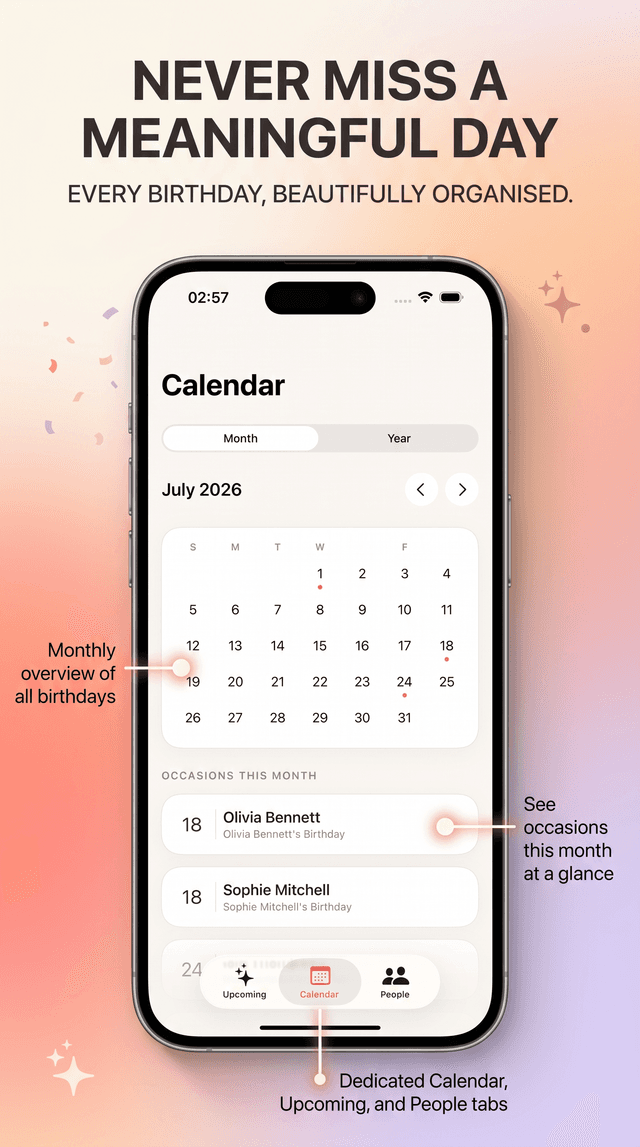
Birthday Reminder supports personal notes and customizable lead days and alert times for each occasion. A short, non-sensitive cue in the birthday record can give you material when the alert arrives without turning the record into a personal archive.
The guide to adding birthday notes and gift ideas on iPhone compares the available places to keep those cues. The Birthday Reminder app page shows how notes, countdowns, widgets, and flexible reminders fit together.
Frequently asked questions
Does every part need its own sentence?
No. A message may use two, three, or four sentences. You can combine the detail and meaning, especially in a text or group card.
What if I genuinely know nothing about the person?
Use a neutral greeting and a simple wish. Do not search for private information or repeat something you heard secondhand merely to appear personal.
Is “Happy birthday, hope you have a great day” bad?
No. It is appropriate when the relationship is casual or the gesture itself carries the meaning. Add a detail only when you have one that is honest and suitable.
How long should a personal birthday message be?
Usually two to four sentences. Length does not make a message personal; a recognizable detail does.
Can I reuse the same birthday message formula?
Yes. Reuse the structure, but change the detail, meaning, and wish. Those parts should come from the actual recipient.
What if the true detail is difficult or sad?
Use it only when the recipient would welcome the reference and the channel is private. Do not force optimism. A gentle wish such as “I hope this next year gives you more room to breathe” may fit better than “Everything happens for a reason.”
A blank birthday card does not require sudden inspiration. Greet the person, name something true, say why it matters, and make one fitting wish. That is enough to produce a message that sounds considered without pretending to be profound.
Browse the other Birthday Reminder guides for more help with message writing, timing, and planning.