
To plan personal birthday messages, do not write a polished greeting months in advance. Save one true detail about the person, then use it when the birthday approaches.
That detail might be a shared memory, something kind they did, a change in their life, or a plan you both recognize. Build the message in three parts: a direct opening, the specific detail, and a relevant wish or next step.
This method keeps the useful part of advance planning without making the final message sound scheduled or stale.
Why sincere birthday messages can still feel generic
Merriam-Webster includes “having no particularly distinctive quality or application” among the meanings of generic. For a birthday message, the practical test is simple:
Could I send this exact message to somebody else after changing only the name?
“Happy birthday, hope you have a brilliant day” may be sincere, but it contains no evidence that you were thinking about this recipient. It is not wrong, and a short greeting can be warm when the relationship or delivery supplies the meaning. It simply does less work than a message containing one recognizable detail.
A 2025 Psychology Today article, explicitly labeled a Personal Perspective, recommends replacing automatic birthday greetings with a shared memory or genuine expression of appreciation. Treat that as useful editorial guidance rather than proof that every short greeting fails.
The goal is not to eliminate “happy birthday.” It is to give the words something personal to carry.
Build a small bank of message prompts
Save raw material, not completed messages. A finished paragraph written eight months early may no longer fit. A five-word prompt can still bring the right moment back.
Useful prompts include:
- A shared moment: “Missed train in Lisbon.”
- An observed action: “Stayed late to help the new starter.”
- A quality with evidence: “Calm during the hospital wait.”
- A current interest: “Learning pottery on Saturdays.”
- A shared ritual: “Sunday morning voice notes.”
- A real future plan: “Dinner booked for the 14th.”
Avoid vague labels such as “kind,” “funny,” or “amazing” on their own. Record what made you think that. Evidence is easier to turn into a credible sentence.
Keep prompts respectful. Do not store diagnoses, arguments, financial problems, or private news merely because they could make a message more specific. If the underlying event is sensitive, use a safe clue such as “thank them for showing up in March.”
The guide to adding birthday notes and gift ideas on iPhone compares practical places to keep this information.
Choose one detail that can carry the message
When the birthday approaches, review your prompts and choose one. A useful detail passes four checks:
- True: You observed it or know it happened.
- Recognizable: The recipient will understand the reference.
- Relevant: It still fits their life and your relationship.
- Safe: It can be mentioned in the channel you plan to use.
Small details often work better than dramatic ones. Remembering the snack somebody always brings to a journey may sound more natural than trying to summarize their personality.
If no saved prompt fits, look at recent conversations. Ask what they have been learning, enjoying, handling, or anticipating. Do not manufacture intimacy to fill the gap. For someone you know less well, a modest observation such as “You made the new team members feel welcome” is enough.
Draft the message in three parts
Use a structure rather than a reusable script:
- Open directly. Say happy birthday in language you would normally use.
- Give the evidence. Mention the memory, action, habit, or change.
- Look forward. Add a relevant wish, question, or genuine plan.
For example:
Happy birthday, Lena. I still think about how you turned that four-hour train delay into the funniest part of our trip. I hope this year includes more adventures, with slightly better transport.
The middle sentence makes the message personal. The final sentence grows naturally from it instead of attaching a generic “best year ever.”
A wish does not always need to be ambitious. “I hope you get a quiet afternoon,” “I cannot wait for dinner on Friday,” or “Call me when you have time for the full recap” may fit better than predicting a transformative year.
Move from praise to evidence and meaning
When a draft sounds generic, improve its specificity one step at a time:
| Draft level | Example |
|---|---|
| Label | “You are such a supportive friend.” |
| Evidence | “You called after my interview because you remembered I was nervous.” |
| Meaning | “You called after my interview because you remembered I was nervous. You make it easier to ask for help.” |
You do not always need all three levels. Evidence alone may be enough for a short text. Add meaning when the relationship supports a more reflective message.
This approach also prevents exaggerated praise. “You are the most selfless person alive” is difficult to believe. One thing they actually did is warmer and more credible.
Edit for voice, pressure, and privacy
Read the draft once and apply four checks:
- Swap test: Could the message go to another person unchanged?
- Voice test: Would you say these words aloud?
- Pressure test: Does the wish tell them how they should live or feel?
- Privacy test: Would the detail still be appropriate if someone else saw it?
Remove borrowed quotations that do all the talking. Cut promises you have not arranged. Avoid turning a difficult year into forced optimism or using the birthday to demand a reply, reconciliation, or life update.
Choose the channel after checking the content. A private memory may belong in a direct message or card rather than a public post. A voice note may suit a story whose warmth depends on tone.
Plan ahead without removing spontaneity
Use two separate moments:
- Capture the prompt when it occurs.
- Write the message near the birthday.
A few days to a week is usually enough for a text or card draft. The right lead time depends on the action, so use the birthday reminder timing guide if the message accompanies a posted card, gift, call across time zones, or planned event.
Apple confirms that iPhone contact cards can include birthdays. Contacts can therefore hold the date, but it is not a message-writing workflow. Apple Reminders supports notes and an Early Reminder before a scheduled date and time, although Apple notes that some features depend on using updated Reminders in iCloud.
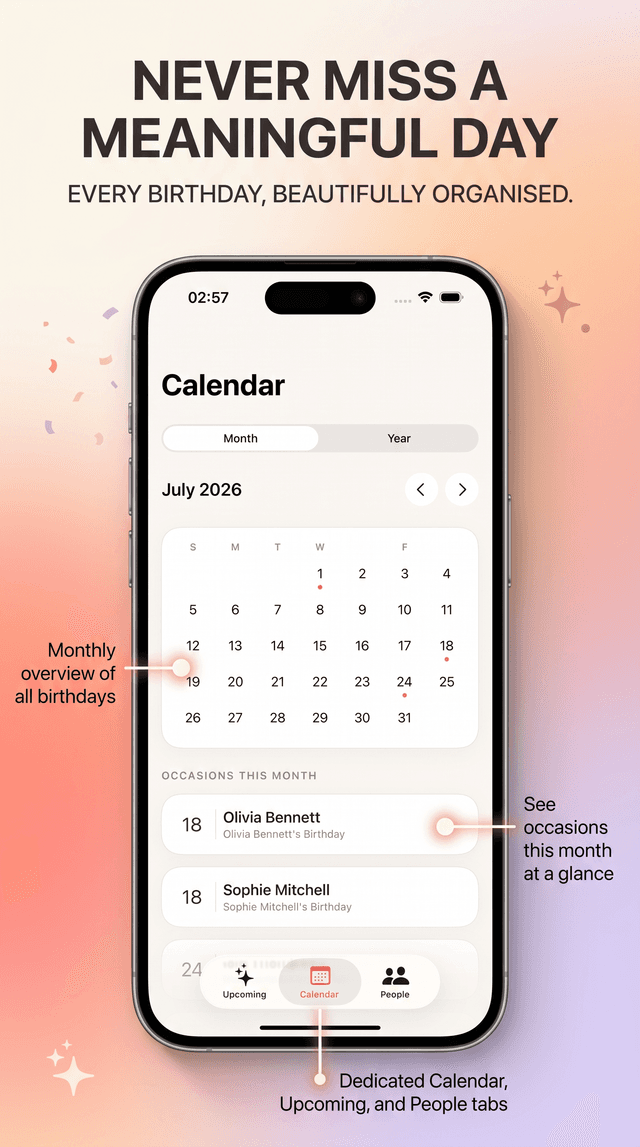
If you use Birthday Reminder, keep a short, non-sensitive prompt in the birthday record and choose an alert early enough to write. Notes and flexible reminders fit naturally into the wider remember, prepare, and celebrate system.
If your dates still depend on a social feed, first create a trusted list using the guide to remembering birthdays without social media.
See the method in three revisions
These examples show the editing process rather than providing text to copy unchanged.
Generic: “Happy birthday to an amazing person.”
Prompt: Brought soup during a difficult week.
Revised: “Happy birthday. I still remember you arriving with soup when I was having that awful week and staying without expecting me to be entertaining. You make care feel easy.”
Generic: “Hope all your dreams come true.”
Prompt: Finished the first evening photography course.
Revised: “Happy birthday. Finishing that photography course after so many late shifts was no small thing. I hope this year gives you more time to follow the interests that are already making you happy.”
Generic: “Have the best day ever.”
Prompt: Monthly breakfast tradition; next one booked.
Revised: “Happy birthday to my favourite breakfast critic. I hope today includes excellent coffee, and I will see you at our usual table on Saturday.”
For relationship-specific examples, use the best-friend birthday wishes guide. This article owns the planning method rather than duplicating those message collections.
What to avoid when planning messages
- Saving the same complete greeting for everyone.
- Recording private history that is unnecessary for the birthday.
- Choosing a detail only because it sounds dramatic.
- Using age jokes without knowing they are welcome.
- Mentioning a future plan that has not been arranged.
- Writing for a public audience instead of the recipient.
- Mistaking length for thoughtfulness.
A specific two-sentence message is usually stronger than a long paragraph built from stock praise.
Frequently asked questions
How far ahead should I plan a personal birthday message?
Save useful prompts whenever they occur. Draft the message a few days to a week before the birthday, unless a posted card or coordinated plan requires more time.
What if I cannot think of a personal detail?
Use a recent, modest observation rather than inventing intimacy. Mention something they handled well, a conversation you enjoyed, or a quality you have directly witnessed. If nothing honest comes to mind, send a warm short greeting.
Can I reuse the same message structure?
Yes. Reuse the opening-detail-wish structure, but change the evidence. The structure makes writing easier; the detail makes the message personal.
Does a personal birthday message need to be long?
No. One specific sentence plus a relevant wish can be enough. Add length only when you have something meaningful to say.
Can AI help draft a birthday message?
It can help organize facts or shorten a draft, but supply the real detail yourself and check every sentence. Do not let a tool invent memories, feelings, or plans, and avoid pasting sensitive personal information into a third-party service.
What should I save for next year?
Save one brief prompt that will still make sense later, such as a shared ritual, current interest, or preferred way to celebrate. Delete stale or sensitive details instead of building a personal archive.
A personal birthday message does not require perfect writing. It requires one true detail, enough notice to remember it, and a few sentences that sound like you.
See the Birthday Reminder app page for a focused way to keep dates, notes, countdowns, and reminders together, or browse the other Birthday Reminder guides.