A minimal birthday reminder system should answer three questions without creating another stream of social obligations: whose birthday matters to you, when do you need to notice it, and what will you do?
The simplest version has one short list, one calm signal, and one default gesture for each person. If that gesture is usually a message, you do not need a weekly planning session or several advance alerts.
“Introvert-friendly” does not mean that every introvert avoids calls, parties, or group plans. This system is for anyone who prefers fewer interruptions, more asynchronous communication, and less repeated decision-making.
Define minimal by the number of decisions
A system is not minimal merely because it uses one app. It is minimal when it removes decisions you would otherwise make repeatedly.
For each person, record only:
- A confirmed birthday.
- A default gesture, such as text, card, or call.
- One early reminder if that gesture requires preparation.
- One short note only when it changes what you will do.
That is intentionally narrower than a full remember, prepare, and celebrate workflow. If you regularly arrange gifts, travel, bookings, or group events, the simple birthday planning system is a better fit.
For everyone else, avoid adding categories, gift lists, or reminder stages merely because the tool permits them.
Step 1: Start with ten names, not your whole address book
Ten is a manageable setup batch, not a recommended limit or a measure of how social you should be. Begin there, test the system for a month, and add people whose absence feels noticeable.
Ask three questions about each name:
- Would I want to acknowledge this birthday without a social network prompting me?
- Do I expect to contact this person directly?
- Would missing the date bother me?
Keep the name when at least one answer is a clear yes. Leave out contacts added only through an old workplace, school group, or automatic import.
Do not import hundreds of records and promise to sort them later. A trusted list of ten is more useful than a noisy list of two hundred. The guide to building a birthday list that stays accurate covers date confirmation and cleanup in more detail.
If social media is currently your only source, use the separate process for remembering birthdays without social media before turning those notifications off.
Step 2: Choose the gesture before the alert arrives
The reminder should trigger an action, not a negotiation with yourself. Add one default beside each name:
| Preference or situation | Default gesture | Useful reminder |
|---|---|---|
| Asynchronous contact | Personal message | Birthday morning |
| Tangible but low-pressure gesture | Posted card | Before the local posting deadline |
| Voice contact is genuinely preferred | Short call | Day before to choose a time |
| Occasional in-person plan | Ask about availability | Only as early as scheduling requires |
Choose according to the relationship, not an assumption that closer people always require more elaborate plans. A close friend may prefer one thoughtful message. A relative may value a call. Someone else may not celebrate birthdays at all.
A short note can remove the remaining friction: “message,” “card,” “call after work,” or “does not celebrate” is enough. Avoid building a personal profile when one practical phrase will do.
For a message, use a repeatable shape rather than a saved generic greeting: acknowledge the birthday, mention one specific detail, and offer a warm wish without demanding an immediate reply.
Step 3: Keep every date in one private home
Apple lets you add a birthday directly to a contact card. Contacts is sufficient when you already maintain those records and need basic annual visibility. Remember that contact records may sync through iCloud, Google, Exchange, or another configured account, so this setup is not automatically device-only.
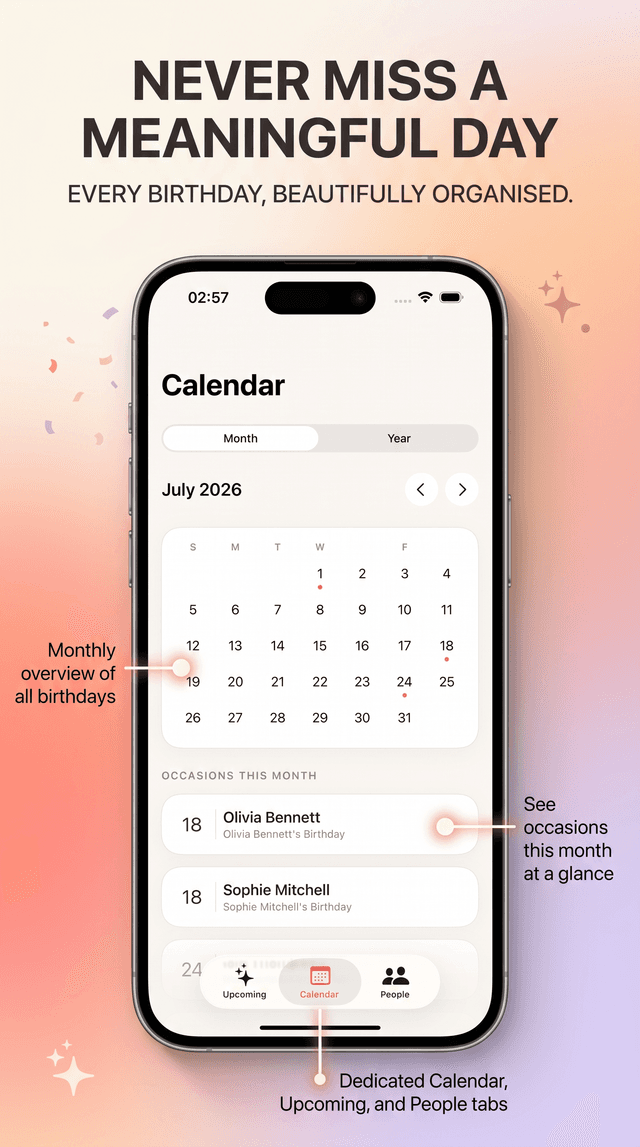
A dedicated app is useful when you want birthday-specific countdowns, flexible reminder schedules, notes, and widgets together. Birthday Reminder provides those features in an account-free experience without adding a social feed.
Whichever option you choose, make it the source of truth. Do not correct a date in one calendar while leaving an older version in another app.
If account requirements and storage are your main concern, compare them separately in birthday apps without accounts or social feeds.
Step 4: Pick one calm notification style
Do not enable every available notification control. Choose one primary way to notice birthdays.
Use a widget for glance-only awareness
Apple supports widgets on the Home Screen and Lock Screen so an app can show current information at a glance. A birthday countdown widget lets you notice the next date while using your phone, without adding a sound or banner.
This works best if you already look at the chosen screen daily. A widget hidden on a rarely visited Home Screen page is decoration, not a reminder.
Keep alerts in Notification Center
For a quiet but direct alert, open Settings > Notifications, select the birthday app, turn off sounds and banners, and retain Notification Center delivery. Control names can vary slightly by iOS version.
The alert remains available to review without appearing over your current task. Test the setup with a temporary reminder rather than assuming it works as intended.
Batch early reminders with Scheduled Summary
Apple’s Scheduled Summary groups notifications from selected apps and delivers them at times you choose. It can work well for early notices such as “birthday next week.”
Do not place an important same-day reminder in the summary unless its scheduled delivery is early enough for your intended action. A summary delivered in the evening is too late for a morning call or posted card.
Silence birthday alerts during a Focus
A Focus can silence notifications from selected apps or allow only the apps you choose. Use the Apps notification control inside the Focus if you do not want birthday alerts during work, sleep, or another protected period.
Focus filters are different: they control what information supported apps show while a Focus is active. They are not the setting used to silence an app’s notifications.
Step 5: Make complex birthdays exceptions
Your default system can remain small even when two or three birthdays need more work.
Add an early alert only when there is a real external deadline:
- A card must be posted.
- A gift needs delivery time.
- A restaurant or activity requires booking.
- Several people need to coordinate.
- Travel or time off must be arranged.
Write the first action in the alert, such as “ask about dinner dates” or “post card by Friday.” Do not create four generic countdown alerts.
The birthday reminder timing guide provides practical lead times for these exceptions. Once the exceptional birthday is over, return to the lighter default.
Set up the complete system in 15 minutes
Use this one-time setup:
- Choose the first ten people.
- Confirm each month and day instead of guessing.
- Add every date to one chosen home.
- Record one default gesture per person.
- Add an early reminder only where preparation is necessary.
- Choose one primary notification style.
- Test one alert and, if useful, place one widget where you will see it.
Stop when those steps are complete. Do not turn the first session into a full contact-database cleanup.
Maintain it without a weekly review
A minimal list does not need routine administration every Sunday.
Update it when something changes:
- Add a birthday when a new relationship becomes important.
- Correct a date as soon as you confirm it.
- Change “text” to “call” after learning what someone prefers.
- Remove a reminder when direct contact no longer makes sense.
Once a year, scan the list for wrong dates, duplicate records, and gestures that no longer fit. If that annual check becomes complicated, the system has probably grown beyond its minimal version.
Frequently asked questions
How many people belong in an introvert-friendly birthday list?
There is no universal number. Ten is simply a practical first batch. Add people deliberately after the system proves quiet and useful rather than importing everyone at once.
Does an introvert-friendly system mean avoiding phone calls?
No. It means deciding deliberately instead of treating a call as the default for every relationship. Record “call” for people who value it and choose asynchronous gestures where those fit better.
Should birthday reminders go into Scheduled Summary?
Early preparation reminders can. Keep a time-sensitive birthday-day alert outside the summary unless you know the summary will arrive before you need to act.
Can I use iPhone Contacts instead of a dedicated app?
Yes. Contacts can store a birthday directly on a person’s card. A dedicated birthday app becomes useful when you want focused countdowns, flexible alerts, notes, or Home and Lock Screen widgets.
What if several birthdays require gifts or group plans?
Keep those birthdays as exceptions with action-specific early alerts. If complex preparation becomes the norm, move to the fuller planning workflow rather than adding more rules to the minimal one.
A minimal system should make thoughtful contact easier, not make your relationships feel like a queue. Keep the list selective, choose gestures in advance, and let one calm signal tell you when to act.
Browse the other Birthday Reminder guides when a particular birthday needs more planning. Our editorial policy explains how product and platform claims in these guides are checked.