
A six-week birthday planning routine turns one looming date into six short, manageable steps instead of one stressful final week. Starting six weeks out gives you enough time to confirm the date, decide what the birthday needs, order or book anything with a lead time, and still leave room to adjust before the day arrives.
The routine below is built around a simple idea: each week has one job. You are not managing an open-ended project for six weeks. You are making one decision or finishing one task, then leaving the rest alone until the next check-in.
Why six weeks is a useful planning window
Six weeks is long enough to absorb most of the delays and lead times that actually derail birthday plans, without becoming a full event-planning schedule for every birthday on your list.
A few reference points explain why:
- USPS Priority Mail typically delivers domestic packages within 2-3 days, so even a delayed order placed a few weeks out still has room to arrive.
- USPS Priority Mail International lists a delivery window of 6-10 business days to most of the roughly 180 countries it serves, which fits inside a six-week window with margin for customs delays.
- Etiquette guidance from Emily Post suggests sending invitations for events like anniversary parties or formal dinners three to six weeks in advance, so starting at six weeks keeps you inside the recommended range rather than at the edge of it.
Put together, six weeks covers ordinary gifts, most international shipping, and standard invitation timing in one window. That is why it works as a default rather than an arbitrary round number.
This routine is a companion to two other guides on this site: the three-stage birthday planning system explains the remember-prepare-celebrate framework this routine runs inside, and the birthday reminder timing guide breaks lead times down by specific action if you need more detail than the weekly view below.
Decide what this birthday actually needs
Before starting the six-week clock, decide how much preparation this particular birthday requires. Not every birthday needs six weeks of attention.
Use three quick categories:
| Planning level | Typical situation | Suggested routine |
|---|---|---|
| Simple | A message, card, or short call | Skip most of the routine; use only the birthday-week checklist |
| Thoughtful | A gift, meal, or local celebration | Start around weeks four to three |
| Planned | Travel, a group event, or a milestone birthday | Use the full six-week routine |
If your list of birthdays is still scattered across contacts, message threads, or a social feed, build a private list first using the guide to remembering birthdays without social media. A six-week routine only works if the underlying date is confirmed and visible in the first place.
Weeks six and five: confirm the date and choose the celebration
Week six has one job: confirm you have the right date and decide the planning level from the table above. If the date is uncertain, ask the person or check a source you trust rather than guessing. If the year is unknown, keep the month and day and leave the age unguessed.
Week five is where you decide what the celebration actually looks like. A phone call needs no further planning. A dinner, party, or trip needs a decision now, because two things depend on it:
- If you are hosting anything with guests, this is when invitations should go out. Etiquette guidance places most party invitations in the three-to-six-week range, so sending them now keeps you comfortably inside that window rather than rushing a group scheduling problem later.
- If the celebration involves travel, this is when to check availability rather than assume it will still be open in a month.
Write down one sentence describing the plan. "Dinner at home with the family" is enough. You do not need a detailed itinerary yet.
Weeks four and three: order, book, and invite
These two weeks handle anything with a real delivery or availability deadline.
Week four:
- Order personalized, handmade, or international gifts now. With roughly four weeks left, USPS Priority Mail International's 6-10 business day window still leaves buffer even if the item ships slightly late.
- Reserve a restaurant, venue, or activity if the celebration needs one.
- Confirm any travel arrangements decided in week five.
Week three:
- Send invitations if you have not already, and start noting who has responded.
- Check that any gift ordered in week four has a tracked shipping confirmation.
- If a group is coordinating (siblings splitting a gift, colleagues planning a lunch), have that conversation now rather than during the final week.
These two weeks carry most of the actual workload. Everything after week three is confirmation, not new decisions.
Weeks two and one: confirm details and finish preparation
Week two is a check-in, not a new task list:
- Confirm gifts have shipped or arrived. Domestic Priority Mail's 2-3 day window means there is still time to order a backup if something has not moved.
- Follow up with anyone who has not responded to an invitation.
- Buy or write the card.
Week one finalizes everything:
- Confirm the venue, reservation, or guest count one last time.
- Wrap any gift that has arrived.
- Set the two reminders described in the timing guide: one preparation alert and one for the birthday itself. Apple's Reminders app lets you set a specific due date and time for each one, and you can add either directly from the Calendar app.
If anything is still missing at this point, week one is for a quick fix, not a redesign of the plan.
Birthday week: the short list that actually matters
By the time the birthday arrives, the routine should have already done its work. The final list is short:
- Confirm the timing of the celebration or the best time to call or message.
- Deliver the gesture: the call, the card, the gift, or the event itself.
- Note anything worth remembering for next year, such as a delivery that ran late or a time that worked better than planned.
That third step is easy to skip, but it is what makes next year's six-week routine faster than this year's.
Turn the routine into something that repeats itself
The value of a six-week routine comes from reusing it, not from redesigning it every time a birthday approaches. Once you know the pattern works for you, set it up so it runs with minimal effort:
- Use recurring reminders for the two fixed points in the timing guide: the preparation alert and the birthday-day alert.
- Keep the current celebration's plan, budget, and any notes with the person's record rather than in a separate message thread.
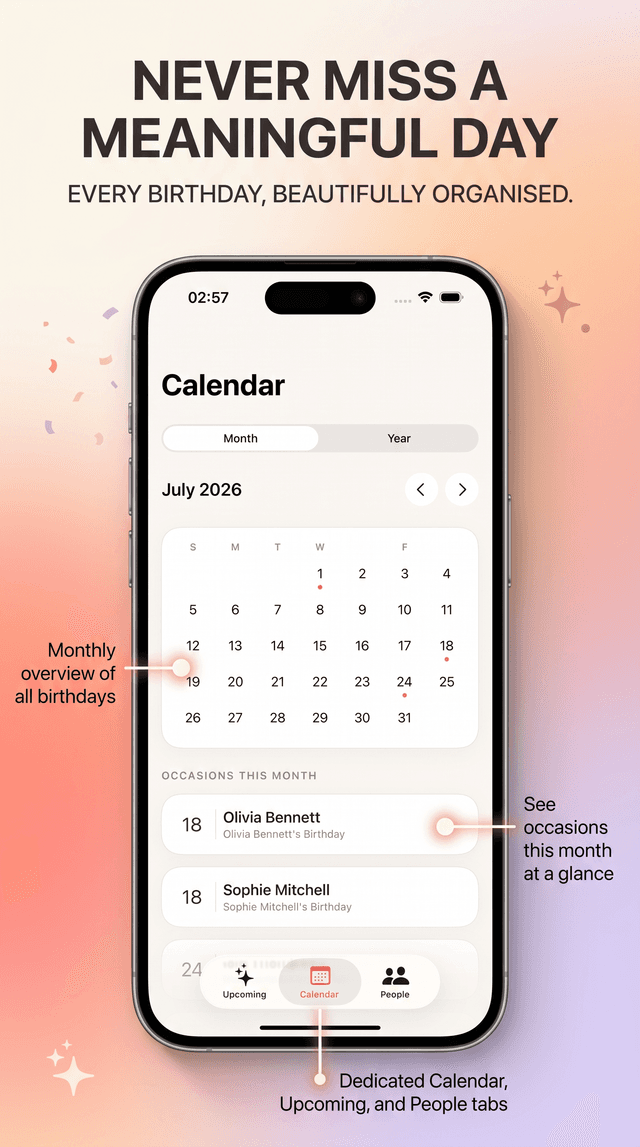
- If you use a dedicated app, its widgets and countdowns can show how many weeks remain without you needing to check a separate calendar.
The Birthday Reminder app keeps a birthday's countdown, flexible reminder schedule, and notes together in one private, account-free place, which is useful if you would rather see "5 weeks away" on a widget than recalculate it from a date each time.
When six weeks is too long or too short
The routine is a default, not a rule. Adjust it when the situation calls for it:
- For a milestone birthday or a group trip, start earlier than six weeks. The timing guide recommends 30-60 days for travel and major milestones, and a large event can justify starting at eight weeks instead of six.
- For a simple birthday, skip straight to the birthday-week checklist. Running a six-week routine for a quick phone call adds effort without adding value.
- If you discover a birthday with less than six weeks left, compress the routine: combine weeks six and five into a single confirm-and-decide session, then follow the remaining weeks as written.
The goal is a routine that fits the birthday, not a birthday that fits the routine.
Frequently asked questions
Does every birthday need a six-week routine?
No. Use the full routine for birthdays involving a gift, invitation, travel, or booking. A birthday that only needs a message or short call can use just the birthday-week checklist.
What if I only have three or four weeks left?
Compress the earlier stages. Confirm the date and decide the celebration in one session, then move directly into ordering, inviting, and confirming. The timing guide has lead times for specific actions if you need to prioritize what still fits.
Can I reuse the same routine every year for the same person?
Yes. Once you know a birthday's planning level and typical celebration, the six-week routine becomes a checklist you repeat with small adjustments rather than a plan you rebuild from scratch.
Should invitations always go out by week five?
Week five is a comfortable default based on general etiquette guidance for parties and dinners, which places most invitations three to six weeks ahead. A very casual gathering can go out later; a larger or more formal event may need the invitation closer to six weeks out.
What if a gift or delivery is running late by week two?
Check tracking and, if there is genuine doubt, order a backup or a local alternative. Domestic delivery windows are typically only a few days, so there is usually still time to recover if you catch the issue in week two rather than week one.
A six-week routine is not about planning further ahead for its own sake. It is about spreading a handful of decisions across six short check-ins so that none of them land in the same rushed week. Browse the other Birthday Reminder guides for the timing table, the private list setup, and the full planning system this routine builds on.