In a birthday reminder app vs Apple Calendar comparison, the main difference is control. Apple Calendar can collect birthdays from Contacts and apply one default alert choice to the Birthdays category. Birthday Reminder gives each occasion its own lead days and alert time, then adds countdowns, notes, gift ideas, favourites, and a focused Home Screen widget.
Apple’s built-in approach is simpler. The dedicated app is more useful when different people require different amounts of preparation.
This article compares Birthday Reminder directly with Apple’s Contacts-powered Birthdays calendar. For additional alternatives, see the broader birthday reminder apps for iPhone comparison.
Quick verdict
Choose Apple Calendar if:
- You already keep accurate birthdays in Contacts.
- One shared default birthday alert works for everyone.
- You want birthdays beside your other calendar events.
- You do not want to maintain another app.
Choose Birthday Reminder if:
- One person needs two weeks of notice while another needs a same-day alert.
- You want a running countdown to upcoming birthdays.
- You want notes and gift ideas beside each occasion.
- You prefer a Home Screen widget focused on upcoming birthdays.
- You want an account-free app with optional contact import.
Neither option is universally better. The right choice depends on whether you only need the date and a standard alert, or also need preparation tools.
What Apple Calendar does with birthdays
Apple’s birthday workflow starts in Contacts. Open a person’s contact card, tap Edit, and add or update the birthday. The date can then appear in Calendar when you open the Calendars list and select Birthdays.
Apple provides a separate default alert setting for this category:
Settings > Apps > Calendar > Default Alert Times > Birthdays
That setting is efficient because you configure it once. Its limitation is that the selected timing applies at the Birthdays-category level rather than providing a different Contacts-birthday schedule for every person.
If a shared alert is sufficient, Apple’s workflow requires little maintenance beyond keeping Contacts accurate. Our step-by-step guide explains how to add birthdays to iPhone Calendar and enable reminders.
This comparison concerns the automatic Birthdays calendar. It does not mean Calendar cannot hold ordinary events that you create and maintain manually.
What Birthday Reminder adds
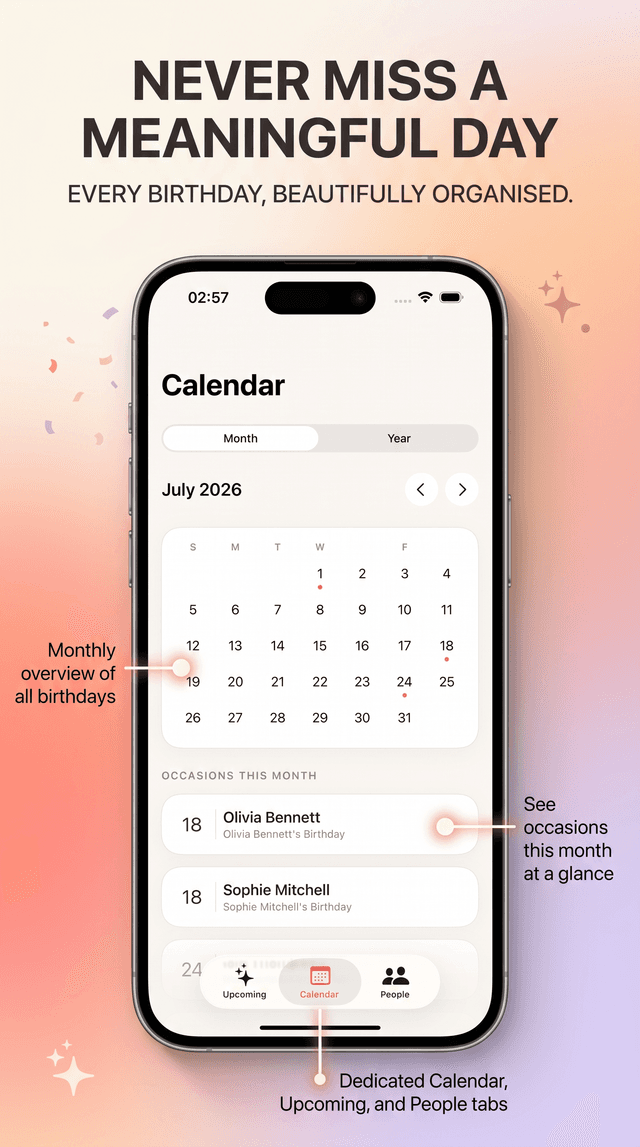
Birthday Reminder: Tracker is organized around people and occasions instead of a general event calendar.
Its current App Store listing confirms:
- Custom lead days and alert time for each occasion.
- Countdowns for upcoming birthdays and other occasions.
- Personal notes and gift ideas.
- Favourites.
- Optional importing from Contacts.
- A Home Screen widget.
- No required account.
This structure matters when birthdays require different actions. A parent’s birthday might need an early reminder for ordering a gift, while a colleague’s birthday may only need a same-day message. The app lets those occasions use different timing without changing a setting that affects everyone else.
Disclosure: Daily Life Apps publishes Birthday Reminder. Product claims here were checked against its public App Store listing, and Apple claims were checked against Apple Support. Our editorial policy explains how we review comparisons involving our apps.
Side-by-side comparison
| Capability | Apple Contacts and Calendar | Birthday Reminder |
|---|---|---|
| Adding dates | Add the birthday to a contact card | Add manually or import selected contacts |
| Alert control | One default alert selection for the Birthdays category | Lead days and alert time set per occasion |
| Countdown | No dedicated birthday countdown documented in the checked Apple guidance | Countdown for upcoming occasions |
| Widget | General widgets can show information such as upcoming calendar events | Home Screen widget for upcoming birthdays |
| Notes | Contact details remain on the contact card; no birthday-planning workflow is documented | Personal notes and gift ideas beside the occasion |
| Favourites | Not part of Apple’s documented Birthdays calendar workflow | Mark important people as favourites |
| Account | No separate Calendar account solely for birthdays; syncing depends on your configured accounts | No Birthday Reminder account required |
| Contact access | Birthdays originate in Contacts | Optional and used when you choose to import |
| Main advantage | Minimal setup inside built-in apps | More control and birthday-specific visibility |
The comparison deliberately distinguishes between a feature not being documented and proving that no workaround exists. For example, Apple’s widget guidance describes general Calendar information but does not identify a dedicated birthday countdown widget.
Which setup is faster to maintain?
Apple Calendar usually requires less ongoing work when your Contacts are already accurate. Add or correct a birthday once, show the Birthdays calendar, choose the default alert, and leave the system alone.
Birthday Reminder requires an initial list, either entered manually or imported from Contacts. That extra setup earns more control afterward because each occasion can carry its own timing and context.
A useful test is to ask what you do when an alert arrives:
- If you normally send a message or make a quick call, Apple’s shared alert may be enough.
- If you order gifts, post cards, reserve tables, or coordinate travel, different lead times become more valuable.
- If birthdays get buried among meetings, a focused countdown and widget may make the next occasion easier to notice.
The birthday reminder timing guide can help you choose lead times based on the action rather than the relationship alone.
When Apple Calendar is the better choice
Use Apple Calendar when simplicity is the priority.
A strong Apple-only setup looks like this:
- Keep confirmed birthdays in Contacts.
- Select the Birthdays calendar.
- Choose a default alert time that suits most birthdays.
- Check that Calendar notifications are allowed.
- Review the list occasionally for incorrect or duplicate contacts.
This works particularly well for a short list where most birthdays receive the same response. It also avoids adding another place where dates could become outdated.
Do not switch systems merely because a dedicated app has more features. A feature is only useful if it solves a problem you actually have.
When Birthday Reminder is the better choice
Use a dedicated birthday app when the uniform Calendar workflow creates compromises.
The clearest signs are:
- Important birthdays need different preparation windows.
- You want to see how many days remain.
- You keep gift ideas or short planning notes.
- You want to mark a smaller group as favourites.
- You want upcoming birthdays separated from work and appointment calendars.
Start with two or three people rather than importing an entire address book. Set realistic alert timing, add the widget, and confirm that the workflow is useful before expanding the list.
The simple birthday planning system offers a practical way to separate remembering, preparing, and celebrating.
Can you use both without creating a mess?
Yes, but decide which system controls alerts and where corrections are made.
A restrained combined setup is:
- Keep confirmed birth dates in Contacts.
- Import only the people you actively plan for.
- Use Birthday Reminder for per-occasion timing, countdowns, and notes.
- Disable one source of alerts if duplicate notifications become distracting.
- Correct changed dates in every place that stores a separate copy.
The App Store listing confirms optional contact import, but it does not promise continuous synchronization after import. Treat importing as a setup feature unless the app explicitly confirms otherwise. If a birthday changes in Contacts, verify the app’s copy too.
This distinction prevents a common failure: two records that begin with the same date but later drift apart.
If your records are currently spread across social media, contacts, and messages, first build the private list described in how to remember birthdays without social media.
Privacy and account differences
Birthday information is personal, so privacy claims need careful wording.
Apple’s documentation shows that Calendar can use accounts including iCloud, Google, Exchange, and Yahoo. The checked sources do not support a blanket claim that every Apple Calendar birthday is stored in iCloud or that one approach is inherently more private.
Birthday Reminder’s listing states that:
- No account is required.
- Birthday information stays on the device.
- Contact access is optional.
- The developer declares that no data is collected.
Apple explicitly notes that App Store privacy declarations come from the developer and have not been verified by Apple. Read the current privacy information before installing any app, and avoid storing sensitive notes that are unnecessary for birthday planning.
Frequently asked questions
Does Apple Calendar send birthday reminders automatically?
It can send birthday alerts after the birthday is stored in Contacts, the Birthdays calendar and alert settings are configured, and Calendar is allowed to send notifications. The alert timing comes from the shared Default Alert Times setting for Birthdays.
Can Apple Calendar use a different alert for each contact birthday?
Apple’s documented Contacts-birthday workflow provides one default alert selection for the Birthdays category. It does not document separate lead times for individual birthdays inside that automatic calendar.
Does Apple Calendar have a birthday countdown widget?
Apple’s checked widget guidance describes general widgets and uses upcoming calendar events as an example. It does not identify a dedicated birthday countdown widget. Birthday Reminder explicitly lists a Home Screen widget and birthday countdowns.
Does Birthday Reminder require access to every contact?
No. Its listing describes contact access as optional and used when you choose to import someone. You can add occasions manually instead.
Will imported birthdays stay synchronized with Contacts?
The public listing confirms importing but does not promise ongoing synchronization. Verify later changes in both places unless the app explicitly confirms a live sync feature.
Is Birthday Reminder more private than Apple Calendar?
That conclusion cannot be made from the checked sources alone. Birthday Reminder has an account-free design and a developer-declared Data Not Collected label, while Apple Calendar can work with several configured account providers. Review the terms that apply to your chosen setup.
Should I use Apple Calendar and Birthday Reminder together?
You can. Keep dates consistent, decide which system should send active alerts, and check imported records when a contact birthday changes.
Apple Calendar is the better minimalist choice when one shared alert is enough. Birthday Reminder is the stronger fit when birthdays need individual timing, countdowns, planning notes, favourites, or a focused widget.
Visit the Birthday Reminder app page to review its current features, or browse all Birthday Reminder guides for setup and planning advice.