A birthday reminder app contact import feature can save substantial setup time when your iPhone Contacts already contain accurate birthdays. It can also expose more of your address book than the task requires, create a separate copy that later becomes stale, or place personal dates inside an app whose broader data practices do not suit you.
The practical answer is selective: import when the source records are useful and the permission boundary is clear. Enter birthdays manually when the list is short, the dates are not already in Contacts, or you do not want to grant contact access.
Disclosure: Daily Life Apps publishes Birthday Reminder: Tracker, one of the examples below. Product claims were checked against current App Store listings and privacy policies on 2026-09-02. Our editorial policy explains how we review comparisons involving our own apps.
Quick verdict
| Situation | Better choice | Why |
|---|---|---|
| Many confirmed birthdays already exist in Contacts | Selective import | Faster and less prone to typing errors |
| Only a few people need reminders | Manual entry | Avoids contact permission entirely |
| Your address book mixes personal and work contacts | Limited Access, then selective import | Narrows what the app can inspect |
| You expect later Contact edits to appear automatically | Verify explicit synchronization documentation | Import alone does not promise continuing updates |
| The app has advertising or tracking disclosures | Read the label and policy before deciding | Those practices may concern the whole app, not the contact fields specifically |
For a broader ranking of alerts, widgets, notes, and price, use the birthday reminder apps for iPhone comparison. This article focuses only on contact import and its consequences.
Contact import can mean different things
Apps do not all use the term import in the same way.
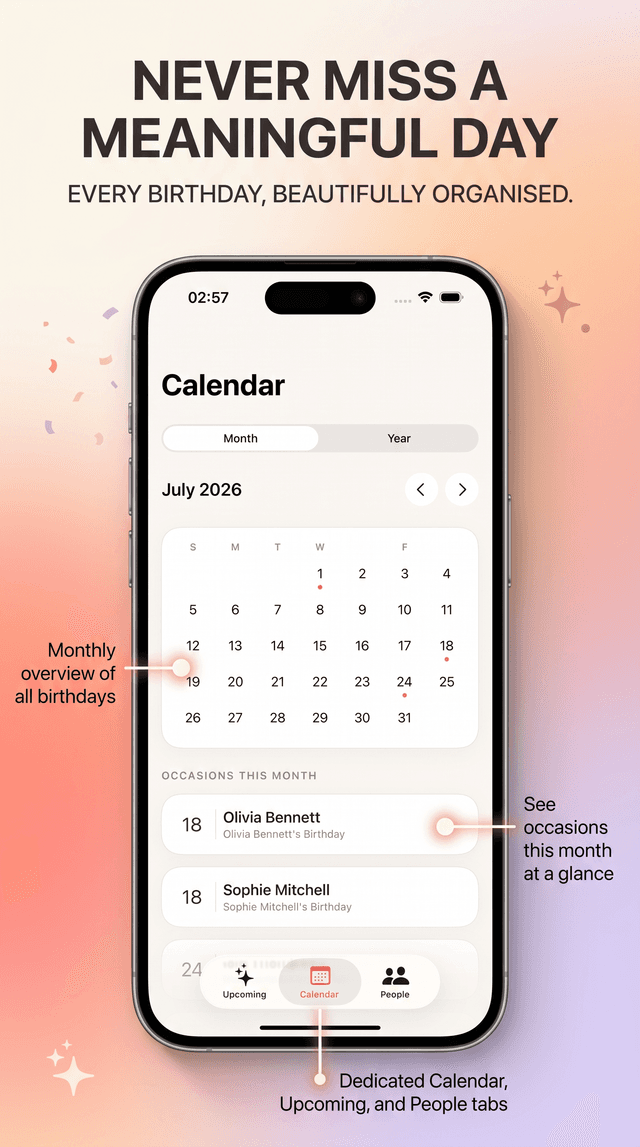
A selective copy reads accessible contacts, presents candidates, and saves only the people you choose. Birthday Reminder: Tracker uses this model: contact access is optional, and its support information tells users to review available birthdays and select the people they want to add.
An app may instead advertise automatic importing. That wording can mean less manual selection, but it still does not establish whether later changes in Contacts continue to update the app.
Device sync is another separate feature. An app may synchronize its own birthday records between an iPhone and iPad through iCloud without maintaining a live relationship with the original contact cards.
Unless current documentation explicitly promises ongoing contact synchronization, treat an imported birthday as a separate record. If the date changes later, check both places.
The real benefits of importing
Contact import solves three practical problems:
- Faster setup: Several existing birthdays can be added without recreating each person.
- Fewer transcription mistakes: The app reads a structured birthday field instead of asking you to retype the date.
- Easier migration: Contacts can provide a starting point when moving away from a paper list, spreadsheet, or social network.
Import does not verify a birthday. It faithfully copies an incorrect date just as easily as a correct one. It also cannot decide which acquaintances belong in your active reminder list.
If the source list is uncurated, follow the separate guide to importing birthdays without creating clutter. If dates are still scattered across profiles and messages, begin with remembering birthdays without social media.
The risks to check before granting access
The permission may be broader than the final import
Contact permission and final selection are separate controls. With Full Access, the address book is available to the app under the permission even if you ultimately save only three birthdays.
That does not prove the app reads every available field. The app's policy should state what it uses. Birthday Reminder's policy, for example, says its import process reads accessible names, birthdays, photos, phone numbers, email addresses, and contact identifiers so candidates can be reviewed.
An imported copy can drift
If import creates a separate record, changing a birthday in Contacts may not update the reminder app. The reverse is also true.
This can produce two plausible-looking dates with no obvious source of truth. Record which system owns future corrections, especially for birthdays that exist in both Contacts and a dedicated app.
Import can create clutter or duplicates
An address book is designed for communication, not birthday planning. Importing everyone with a birthday field can add former colleagues, businesses, distant acquaintances, and people already entered manually.
A larger list is not automatically a better reminder system. Select people according to whether you would actually call, message, send something, or plan for them.
The app may have a wider privacy footprint
Contact handling is only one part of an app's privacy profile. Advertising, identifiers, analytics, diagnostics, location use, accounts, backup, and third-party services may matter even when contacts remain on the device.
Read the App Store label as a screening tool, not an independent audit. Apple says privacy information is reported by developers and is not verified by Apple.
Two current apps illustrate the difference
Birthday Reminder: Tracker's current listing says contact access is optional, importing occurs when the user chooses it, no account is required, and birthday information stays on the device. Its App Privacy section currently shows Data Not Collected. The more detailed Daily Life Apps privacy policy says selected contact information is stored locally and is not sent to Daily Life Apps.
A Data Not Collected label does not mean the app never accesses local contacts. In this case, the listing and policy explicitly describe local contact access for the optional import workflow.
Birthday Reminder & Countdown also advertises contact importing. Its listing separately offers Pro iCloud sync for birthday records across devices. The listing does not clearly establish that every later edit in Contacts remains synchronized, so those features should not be treated as equivalent.
Its current App Privacy label lists Location, Identifiers, Usage Data, and Diagnostics as data that may be used to track users. Its privacy policy's plain-language summary says contacts remain on the device and are not available to its advertising network.
That distinction matters: the label shows a broader advertising and analytics footprint, but it does not establish that imported contact names or birthdays are used for tracking. Compare the whole app without attributing one disclosed data practice to another.
How to import with less exposure
On current iPhone software, Apple lets you restrict an app to selected contacts:
- When the app requests contact access, choose Limited Access rather than Full Access.
- To review the setting later, open Settings > Privacy & Security > Contacts.
- Select the app.
- Under Limited Access, tap Edit Selected Contacts.
- Choose only the people relevant to your birthday list.
Apple's current guide documents Limited Access for iOS 18 and later. If the option does not appear on your device, manual entry remains the narrowest alternative.
Then test the app with a small group:
- Confirm the birthday fields in Contacts.
- Allow access only to several intended people.
- Review the app's import candidates.
- Select one or two birthdays.
- Inspect the saved names and dates.
- Check whether reminders are enabled automatically or require separate setup.
- Look for duplicates before importing more.
Revoking Contacts permission afterward stops future access, but it does not necessarily delete information already copied into the app. Remove unwanted imported records inside the app as well.
Apple's App Privacy Report, under Settings > Privacy & Security, can show how apps use granted permissions and which network domains they contact. Enable it before testing and review it later. Network activity alone does not reveal the contents of every transmission, so use the report alongside the privacy label and policy rather than as conclusive proof.
When manual entry is the better choice
Choose manual entry when:
- You need reminders for only a few people.
- Important birthdays are not already saved in Contacts.
- You want to avoid exposing unrelated contact fields.
- Limited Access is unavailable on your device.
- You prefer one clearly maintained record rather than another imported copy.
Manual entry costs more time per person but removes the contact-permission question. Selective import is more efficient when the source dates are accurate and numerous. Neither approach is inherently correct for every list.
After adding the dates, use the birthday reminder timing guide to choose alerts based on messages, cards, gifts, bookings, or travel.
Frequently asked questions
Does contact import upload my address book?
Not necessarily. An app can process accessible contacts locally, but another app may use a different architecture. Check both the current privacy label and the developer's policy for statements about transmission, storage, and third parties.
Does Data Not Collected mean an app cannot read Contacts?
No. Birthday Reminder, for example, declares Data Not Collected while documenting optional local contact access for importing. Permission to read local data and collection by the developer are different questions.
Is Limited Access enough on its own?
It is a strong first boundary because it limits which contacts the app can access. You must still review which records are saved, read the app's privacy information, and remove imported records you no longer want.
Will imported birthdays update when Contacts changes?
Do not assume so. Import, device-to-device sync, and continuing synchronization with Contacts are separate capabilities. Look for an explicit current promise from the developer.
Is an app with a tracking label using my contacts for advertising?
The label alone does not prove that. Check which data categories are listed and read the privacy policy. A tracking disclosure for identifiers or usage data should not be described as contact tracking without supporting evidence.
Should I revoke contact permission after importing?
You can if you do not expect to import again. Remember that revocation does not necessarily erase birthdays or other fields already saved inside the app; delete those records separately when needed.
Contact import should be a controlled setup tool, not permission to copy an address book indiscriminately. Narrow the accessible contacts, test a small group, understand whether the result is a separate copy, and judge the app's complete privacy footprint.
Visit the Birthday Reminder app page to review its optional local import workflow, or browse all Birthday Reminder guides for related setup and privacy help.