
The best birthday wishes for a family friend occupy a particular middle ground. They are usually warmer than a message for an acquaintance, but they do not need the intensity of a note for your closest personal friend. The right words depend on how your families are connected and how well you know the person yourself.
Use the examples below as starting points, not finished scripts. Replace at least one detail with something real: a shared holiday, an old nickname, a familiar habit, or the role this person has played in your family.
What makes a family friend a distinct relationship
Merriam-Webster defines a family friend as “a person who has known and spent time with one's family.” That broad definition includes several different relationships:
- A friend of your parents who has attended holidays and milestones for decades.
- A neighbor or colleague your household grew close to more recently.
- Someone near your age because your parents were friends first.
- A person you genuinely call an honorary aunt, uncle, or grandparent.
Each version calls for a different tone. Someone who has known you since childhood can receive a message about your shared history. A family friend you have met only a few times deserves warmth without manufactured intimacy.
Ask two questions before writing: what has this person meant to the family, and what relationship do I personally have with them? If they are now primarily your own close friend, the guide to birthday wishes for your best friend may fit better.
Decide whether the message comes from you or the whole family
Family-friend cards often become vague because the writer shifts between “I” and “we.” Choose the sender before choosing the words.
Use I when you are sharing your own memory or appreciation:
Happy birthday, Maria. I still remember how welcome you made me feel when I first moved home after college. I hope you know how much that kindness meant to me.
Use we when the card genuinely represents the household or family:
Happy birthday from all of us. You have brought warmth and laughter to our family gatherings for years, and we are very lucky to have you in our lives.
Do not speak for relatives who have not contributed to the message. If several people are signing, a short shared opening followed by individual notes often feels more genuine than one grand statement attributed to everyone.
Build the message with a simple formula
A dependable family-friend message has three parts:
- A shared detail: Choose something tied to your families or your own interactions.
- A genuine quality: Say what that detail reveals about the person.
- A relevant wish: Connect the ending to their life now or your next meeting.
A useful structure is:
Happy birthday. I still think about [shared detail], because it shows how [specific quality]. I hope this year brings you [relevant wish].
For example:
Happy birthday, Linda. I still think about how you brought the folding chairs to every one of our family barbecues, rain or not. You have shown up for every version of this family for thirty years, and that loyalty has never gone unnoticed. I hope this year brings you more of the rest you have earned.
Hallmark recommends writing as you naturally speak so the recipient can hear your voice in the message. It also advises naming a family relationship or using the title you normally call the person when the card does not make that connection clear. Here, that might mean “honorary aunt,” “our oldest family friend,” or simply the familiar name you have always used.
Match the warmth to the real relationship
| Relationship context | Lead with | Avoid |
|---|---|---|
| Longtime friend who feels like extended family | Their role across years or milestones | A generic label that understates the bond |
| Friend near your own age | A shared childhood event or current joke | Pretending you remain close if contact has faded |
| Friend of your parents whom you see occasionally | Appreciation for what they mean to the family | Claiming a personal intimacy you do not share |
| Older family friend | Respect, steadiness, and shared history | Uninvited jokes about age or health |
| Friend having a difficult year | Quiet care and a low-pressure wish | Forced positivity or private details in public |
An “honorary” family title should reflect language the relationship already uses. Do not suddenly call someone Auntie or Uncle merely to make the message sound warmer.
Heartfelt wishes for someone who feels like family
These messages suit a relationship that has genuinely earned an extended-family description.
Happy birthday to the person who has been at graduations, holidays, and more than a few disasters in this family's history. We got lucky when you decided to stay for all of it.
Thank you for treating our family like your own for so many years. Happy birthday to someone this house would feel different without.
You have never acted like a guest, and we have never thought of you as one. Happy birthday to a friend who became part of the family a long time ago.
Respectful messages for an older family friend
Lead with their influence or presence rather than their age.
Happy birthday. You knew me before I knew myself, and you always made me feel worth listening to. I hope today carries some of the warmth you have given our family.
Some of my favorite childhood memories have you in them, quietly making everything feel calmer. Happy birthday to someone whose steady presence has meant more than I can properly say.
I still remember your advice more clearly than most of the lessons I learned at school. Thank you for being part of how I grew up. Happy birthday.
Playful wishes for a family friend near your age
When your parents' friendship created one of your own, a lighter tone may fit.
Happy birthday to the person who survived every awkward family gathering standing beside me. I am glad our parents' friendship gave us one of our own.
We did not choose the introduction, our families did, but somehow it worked out. Happy birthday to one of my favorite accidental friendships.
From arguing over the last seat in the car to choosing to spend time together as adults, we have made impressive progress. Happy birthday.
Keep the joke focused on a shared situation. Avoid turning private family history or somebody else's behavior into the punchline.
Short birthday texts that still feel personal
A brief message works when you usually communicate casually or plan to see the person soon.
- “Happy birthday! Hope your day is as easy and warm as you have always made our home feel.”
- “Happy birthday to one of the family's honorary members. See you at the next get-together.”
- “Thinking of you today. Thank you for being part of this family's story.”
- “Happy birthday. Save me one of your famous barbecue stories for Sunday.”
Replace the gathering, story, food, or tradition with one the recipient will recognize.
Wishes for a milestone or difficult year
For a milestone, reflect on what the years have built rather than treating the number as the joke.
Happy 70th birthday. The way you have shown up for this family across the decades has taught me a great deal about loyalty.
For a difficult year, keep the message caring and proportionate:
I know this year has asked a lot of you. I hope your birthday gives you room to be celebrated without needing to explain or organize anything.
If the difficult circumstances are private, send the message directly rather than placing the detail in a group card or public post.
What to avoid in a family friend's birthday card
A sincere message can still feel uncomfortable when it includes:
- Generic praise without evidence: Replace “You're the best” with one thing they have done.
- Overstated closeness: Appreciate what is real rather than inventing a stronger bond.
- The wrong sender perspective: Do not use “we” for feelings that are only yours.
- An unfamiliar family title: Use Auntie, Uncle, or another title only if it is already natural.
- Private family history: A birthday card is not permission to retell sensitive stories.
- An untouched example: Change at least one detail to make the message specific.
Read the result aloud. If it sounds unlike anything you would normally say, simplify it.
Choose how and when to send it
Use the channel that matches your normal relationship: a handwritten card for someone who keeps correspondence, a direct text for casual contact, a call for someone who values conversation, or a group card when the message genuinely comes from the family.
Plan early if the card needs to be bought, signed by several people, or posted. The birthday reminder timing guide covers useful lead times for cards, calls, gifts, and gatherings. Apple also confirms that Reminders can hold a short note with practical details until you are ready to act.
Save one respectful prompt for next year
A good birthday exchange may reveal something worth remembering: a story they enjoyed, a preference for a quiet call, or a family event they hope to attend. Save a short prompt rather than a transcript of anything private.
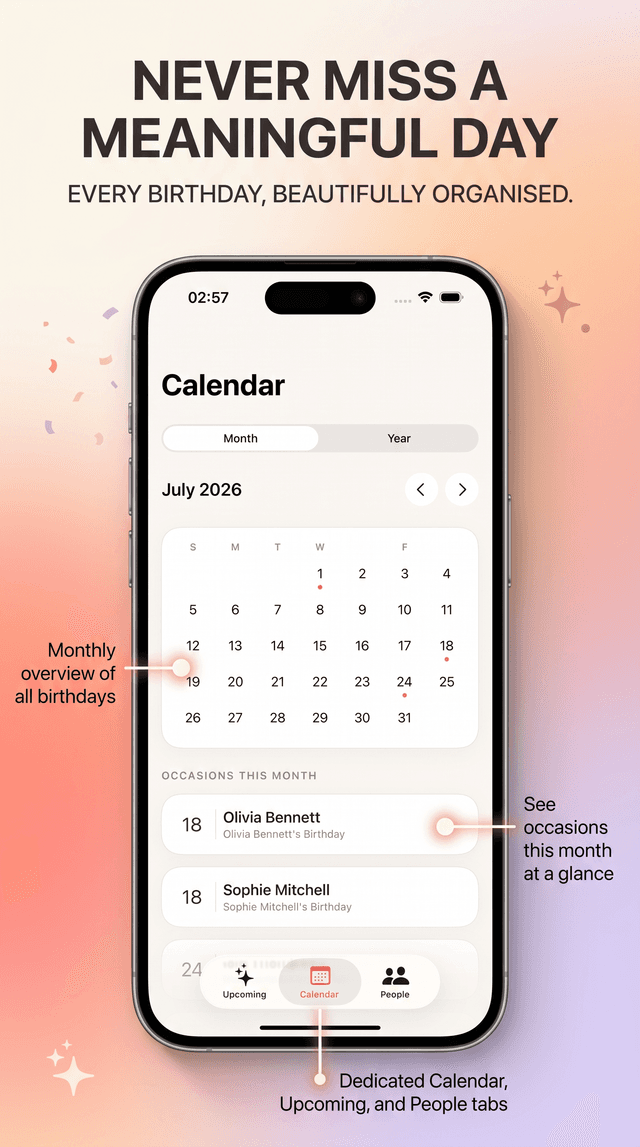
Birthday Reminder: Tracker supports personal notes and gift ideas, birthday countdowns, customizable reminder lead days and alert times, and a Home Screen widget without requiring an account. A note such as “mention the rainy barbecue” or “prefers a call after dinner” can give next year's message a genuine starting point.
The guide to adding useful context to birthday reminders explains what is worth recording. The birthday planning system shows how to use those notes without creating clutter. If the date itself is easy to lose, start with remembering birthdays without social media.
Frequently asked questions
What should I write in a birthday card for a family friend?
Mention one real detail from your families' shared history, explain what it shows about the person, and end with a relevant wish. If the card does not identify the relationship, use the title or description you naturally use for them.
How formal should the message be?
Match the tone to your personal contact with the recipient. Someone who feels like extended family can receive a warm message. A friend of your parents whom you rarely see is better served by sincere but less intimate wording.
What if I do not know the person very well?
Focus on what they have meant to your family rather than claiming personal closeness. “Thank you for being such a good friend to my parents” is specific, honest, and warm.
Should the card say “I” or “we”?
Use “I” for your own memory or opinion. Use “we” only when the message genuinely represents the family members signing it.
Can I use one of these messages exactly as written?
Use it as a structure, then replace at least one detail with a real memory, habit, title, or plan. That specific change is what makes the message personal.
Is it appropriate to call a family friend an aunt or uncle?
Yes, if that is an established and welcome part of the relationship. Do not introduce an honorary title solely to make a birthday message sound closer than the relationship is.
A family friend's birthday message does not need elaborate language. It needs one clear sign that you understand how this particular person fits into your family's life.
Visit the Birthday Reminder app page to see how notes and flexible reminders can help you prepare, or browse the other Birthday Reminder guides. Our editorial policy explains how advice and product claims are reviewed.