
A new friend's birthday can be harder to write for than a lifelong friend's. You want to sound warm and genuine, not like you copied a card from a rack, but you also don't want to invent a closeness the friendship hasn't earned yet.
The most thoughtful birthday wishes for a new friend rely on something you actually know: how you met, a recent conversation, or an interest you have already discovered you share. Leave out the nostalgia and the inside jokes you don't have, and let the message match the friendship exactly as it is right now.
Use the examples below as starting points. Replace at least one detail with something true before you send anything.
Why a new friendship needs a different kind of birthday message
Research by University of Kansas communication researcher Jeffrey Hall helps explain why a new friendship can be difficult to label. In two studies, more time together was associated with greater friendship closeness, but the research described broad patterns rather than a timetable every relationship follows. Someone can know another person for years without becoming close or form a strong friendship within weeks.
That makes the calendar a poor guide to tone. Base your message on the conversations, trust, and time you have actually shared, not simply the number of months since you met.
There is also evidence that people may be more receptive to warmth than we assume. Research summarized by the American Psychological Association found that people tended to underestimate how much new acquaintances liked them, a pattern known as the “liking gap.” A separate experiment summarized by the APA found that people told to assume they were liked behaved more warmly toward others.
That does not guarantee that every message will be welcomed. It does suggest that you do not need to compensate for uncertainty with exaggerated affection. A plain, sincere message is usually enough.
Match the message to how new the friendship actually is
Not every new friendship looks the same. Decide honestly where you stand before choosing your words.
| How well you know them | What to emphasize | What to avoid |
|---|---|---|
| Met within the last few months | One detail from how you met or an early conversation | Implying a history or routine you don't share |
| Getting closer through regular contact | A recent shared moment, plan, or running topic | Overstating how close you already are |
| A friend of a friend or a new coworker | A specific, low-pressure detail about them | Using something you only heard secondhand |
| New friend within a group, class, or team | Something particular to this one person | A generic line that could apply to anyone in the group |
If this person has become one of your closest friends despite the short timeline, the examples in birthday wishes for your best friend may fit better. This guide focuses on friendships that are still genuinely forming.
Build the message with one detail and a low-pressure close
A birthday message for a newer friend has three jobs:
- Open warmly: Say happy birthday in language you would normally use.
- Add one true detail: Mention how you met, a recent conversation, or something you have done together.
- Close without pressure: Wish them a good day or refer to a real plan without assigning the friendship a status.
A simple structure is:
Happy birthday! I'm glad we met through [specific context]. I hope you get plenty of [something they enjoy] today.
For example:
Happy birthday! I'm glad trivia night introduced me to the only person who knew every answer about 90s music. Hope today includes good food and an equally impressive playlist.
The detail does not need to be profound. It only needs to be true and recognizable.
If you are stuck, ask:
- How did we actually meet?
- What have they mentioned recently?
- What have we done together, even once?
- What are they currently planning or excited about?
- What small preference do I know, such as a coffee order, hobby, or favorite kind of music?
Don't borrow a memory that isn't yours. Borrow the method instead.
Warm, simple messages for a friend you're just getting to know
These work when the friendship is a few weeks or months old and you want to sound genuine without overstating things.
Happy birthday! I'm really glad our paths crossed this year. Hope today is full of good food and zero chores.
Happy birthday to someone who's made this year noticeably better. Looking forward to more [coffee runs / hikes / game nights] with you.
I don't have years of history to draw on yet, but I already know you deserve a great birthday. Hope it's a good one.
Each works because it says something true about the present rather than making a stretch about the past.
Messages for a friend you met through work, class, or an activity
Context-based friendships have a natural, low-pressure detail built in: the setting where you met.
Happy birthday to the person who makes Monday meetings genuinely better. Hope your day is far more fun than a status update.
We started as lab partners and somehow ended up actual friends. Happy birthday. Hope this year brings you something better than a group project deadline.
Happy birthday! I'm glad the gym schedule lined up enough for us to become friends and not just nodding acquaintances.
Reference the setting honestly, but avoid making the whole message about it. A workplace, class, or gym is where you met, not the entire relationship.
For a coworker, also consider who might see the message. Keep personal details out of a group card or team chat unless you know the person is comfortable sharing them.
Playful and short options that don't overreach
A short message can still feel personal if it includes one real detail. Keep the humor aimed at the situation, not at the person's age, appearance, or personal life you don't know well yet.
- “Happy birthday to my newest favorite lunch companion.”
- “We've known each other a few months and I already can't imagine the group chat without you. Happy birthday.”
- “Happy birthday! Consider this an official welcome to being someone I actually plan things around now.”
- “New friend, same enthusiasm. Happy birthday!”
Add one real reference, such as a shared class, team, or genuine running joke, and the short version stops sounding generic.
What to avoid when writing to a newer friend
Before sending anything, remove:
- Nicknames, pet names, or “inside jokes” that don't actually exist between you yet.
- Claims of best-friend status the relationship hasn't reached.
- Personal details you learned only from someone else's story or social media.
- Promises of plans, trips, or traditions you don't intend to arrange.
- Humor about age, relationships, health, money, or appearance.
- A message so generic it could be sent to anyone after changing the name.
A message that slightly undersells the friendship reads as modest. One that oversells it can feel presumptuous, even when it is well-intentioned.
Choose a channel that fits the friendship
Newer friendships usually don't call for an elaborate gesture. Match the channel to how you already communicate.
- Text or chat app: the natural choice if that's how you normally talk.
- A short card: appropriate for a coworker, neighbor, or someone you see regularly.
- A direct message: suitable for a lighter acquaintance when that platform is already part of your contact.
- A public comment: fine for casual recognition, but keep personal details private.
Hallmark recommends referencing a shared inside joke in a friend's birthday card when one genuinely exists. For a newer friendship, you may have only one recognizable moment to draw from. Use it if it will make sense to both of you, but do not force a joke simply to make the message appear closer.
If you use iMessage, Apple's Send Later feature can schedule a message up to 14 days ahead. Apple says the recipient may use any device and will not be told that the message was scheduled. That is useful for timing, but it is not a substitute for writing something specific.
Save one detail for next year
The easiest way to write a better message next year is to save one small, respectful detail now while it is fresh.
Useful things to note include:
- How you met.
- An interest, show, or hobby they mentioned.
- A moment that made you both laugh.
- How they prefer to celebrate, if you know.
- A real plan you expect to share before their next birthday.
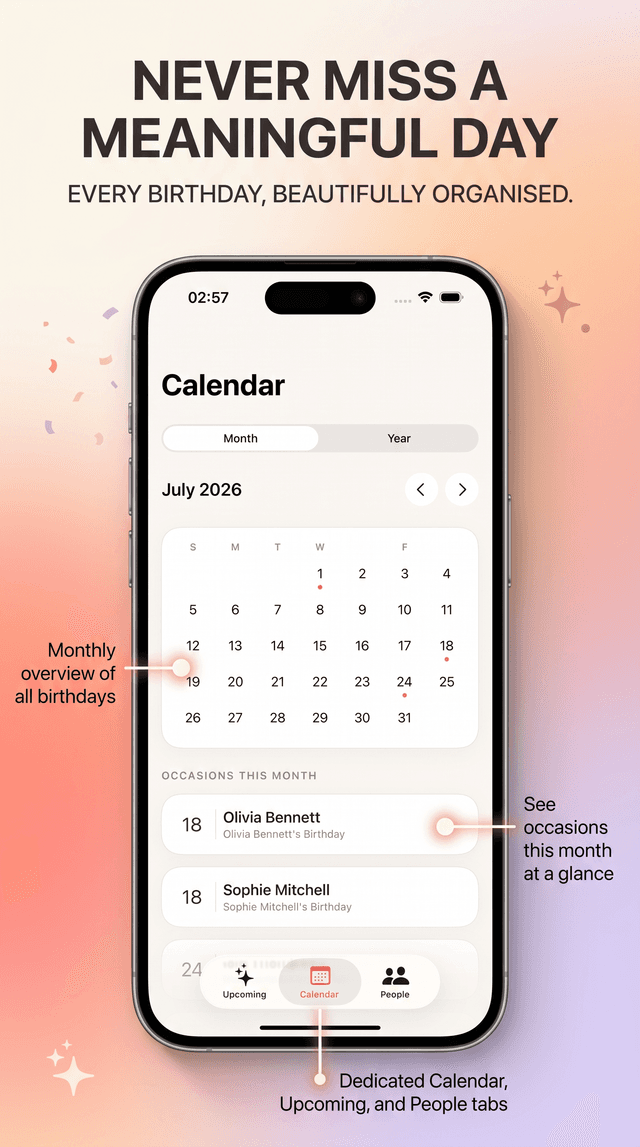
Apple's Contacts app lets you add a birthday while editing someone's contact details. Birthday Reminder can keep the date, a personal note, and customizable reminder lead days and alert times together. Its current App Store listing also confirms countdowns, contact import, gift ideas, and a Home Screen widget.
The guide to adding useful context to birthday reminders explains what is worth saving and what to leave out. The simple birthday planning system can help if this friendship is starting to need more than a same-day message.
If your other birthdays still depend on a social feed, the guide to remembering birthdays without social media explains how to build a private list you control. If you want enough notice for a card or small gift, when to set birthday reminders covers useful lead times.
Frequently asked questions
What should I write in a birthday card for someone I just met?
Mention one real detail: how you met, something they told you recently, or a shared interest. A short, specific message reads as more genuine than a longer one built from generic praise.
Is it too soon to call them a close friend in the message?
If you're unsure, it probably is. Use language such as “I'm glad we met” or “I've enjoyed getting to know you” instead of claiming a status the friendship may not have reached.
What if I don't know them well enough to personalize the message?
Use whatever you do know, even if it is small: the setting where you met, one conversation, or a shared activity. If you truly know nothing personal yet, keep the message short and warm rather than inventing a detail.
Should I send a message if we've only spent time together a few times?
Yes. A short, genuine message is a normal, low-pressure way to acknowledge a new friendship. It does not need to match the effort you would put into a message for someone you have known for years.
How do I add humor without misjudging the relationship?
Keep the joke about a situation you share, such as how you met or a running topic between you. Avoid their age, appearance, relationships, health, or finances. If you are unsure whether the joke will land, use a warm, straightforward line instead.
A birthday message for a new friend doesn't need borrowed history to feel personal. It needs one true detail and a tone that matches the friendship you actually have.
Visit the Birthday Reminder app page to see how notes and flexible reminders can help you remember the right details as a new friendship grows, or browse the other Birthday Reminder guides. Our editorial policy explains how product and source claims on this site are reviewed.