Setting up birthday reminders for different time zones is easier when you stop asking one alert to do two jobs. The birthday belongs to the person celebrating, while the notification belongs to the person receiving it.
Keep the recipient's birthday on their local calendar date. Set an early alert when you have time to prepare, save their city in the note, and check World Clock close to the birthday before making a live call. This avoids relying on a fixed time difference that may be wrong after a daylight saving change or a trip.
Separate the birthday date from the alert time
Two clocks matter:
- Their clock determines the birthday date and a considerate time to contact them.
- Your clock determines when an alert will be useful to you.
Suppose a friend in Tokyo celebrates on September 12. Keep September 12 as the birthday even if that date starts while it is still September 11 where you live. Do not move the stored birthday to your local date.
The alert time is a different decision. A preparation reminder might appear during your afternoon because that is when you can order a gift. A second prompt might tell you to check Tokyo's current time before calling.
This distinction also prevents cannibalizing the broader question of lead time. For cards, gifts, bookings, and travel, use the schedules in the birthday reminder timing guide. Time zones affect when you contact someone, not how long a parcel or reservation needs.
Use this two-alert setup
A reliable setup for someone abroad has two stages.
1. Set a preparation alert
Choose a time in your own day when you can act. This alert can arrive several days before the birthday and say something specific:
- Confirm the delivery address.
- Order the gift.
- Ask when they are free for a call.
- Check the time difference before making plans.
- Post the card by Friday.
This reminder does not need to match the recipient's local clock. Its job is to give you enough time to prepare.
2. Set a contact-time prompt
For a call, video chat, or time-sensitive message, add a closer prompt. Write the intended local window in the note, such as:
Call while it is between 6 p.m. and 8 p.m. in Auckland. Check World Clock first.
A window is safer than saving “Auckland is 17 hours ahead.” The offset can change, while the preferred evening window remains understandable.
If the person prefers an ordinary message rather than a live conversation, a separate contact-time prompt may be unnecessary. Send it when their birthday is clearly underway and they are likely to be awake.
Check World Clock at the right time
Apple's Clock app can show the current local time for cities around the world:
- Open Clock.
- Tap World Clock.
- Tap the Add button.
- Search for the recipient's city and add it.
- Check that city before calling or sending a time-sensitive message.
World Clock is most useful close to the birthday because it shows the current local time. A conversion made months earlier may no longer apply on the birthday.
If World Clock does not list the exact town, choose a nearby city that follows the same time-zone rules. Include the country when the city name could be ambiguous.
Save the city with the birthday record so you do not have to search for it each year. The guide to adding birthday notes and gift ideas on iPhone compares practical places to store that information.
Account for a different calendar date
A large time-zone difference can put you and the recipient on different dates. Near midnight, your “today” may be their yesterday or tomorrow.
Use the recipient's local date as the test:
- Open World Clock.
- Check both their time and the day shown for their city.
- Confirm that their birthday has started.
- Leave enough of their day remaining for the intended gesture.
This matters most when you are trying to send the first message of the day or call near midnight. Unless midnight is an established tradition, a comfortable waking hour is usually more useful than hitting the date boundary exactly.
It is also why a morning alert on your birthday date is not universally reliable. For someone far behind you, their birthday may not have started. For someone far ahead, much of it may already have passed.
Do not store a permanent hour difference
Daylight saving changes do not happen everywhere, and places that use them do not all change clocks on the same dates. Some locations use offsets that include 30 or 45 minutes rather than a whole number of hours.
Store this:
Adelaide, Australia. Usually available after 6 p.m. local time.
Avoid treating this as permanent:
Adelaide is 14 hours 30 minutes ahead.
The first note gives you a durable instruction to check. The second can quietly become wrong.
Review the city if the person moves. Recheck it before a milestone birthday, international delivery, or planned group call. This is the same minimal-note approach used in how to remember birthdays without social media: save only the context that helps you act.
Handle travel without guessing
Apple says iPhone normally sets its time zone automatically. You can inspect or change that behavior under Settings > General > Date & Time. Turning off Set Automatically lets you select a zone manually, but changing the device clock merely to control one birthday reminder is usually more disruptive than helpful.
Do not assume every type of alert responds to travel in the same way. Apple Reminders, Calendar, and third-party apps have separate settings and scheduling behavior.
Before or after changing time zones:
- Confirm that Settings > General > Date & Time shows the zone you expect.
- Open the app containing the reminder.
- Review the birthday date and next alert time.
- Adjust the alert if it is no longer useful in your current schedule.
- Check notification permission if an alert appears to be missing.
For broader notification problems, work through why iPhone birthday reminders are not working.
Know what Apple's time-zone settings control
Apple Reminders has a Time Zone option under Settings > Apps > Reminders. Apple describes it as the zone used to display and create reminders. That setting applies to Apple Reminders, not automatically to a reminder created in a different app.
Calendar is useful when a live call must stay associated with a particular place. On iCloud.com, Apple lets you enable time-zone support and choose a zone when creating an event. Time-zone support must be enabled separately on each device where you want to use it.
A practical division of labor is:
- Keep the annual birthday and preparation alerts in your birthday system.
- Save the recipient's city in the note.
- Create a separate Calendar event in the recipient's zone for a scheduled video call or group celebration.
That gives an exact appointment to Calendar without turning every ordinary birthday message into an event.
Set this up in Birthday Reminder
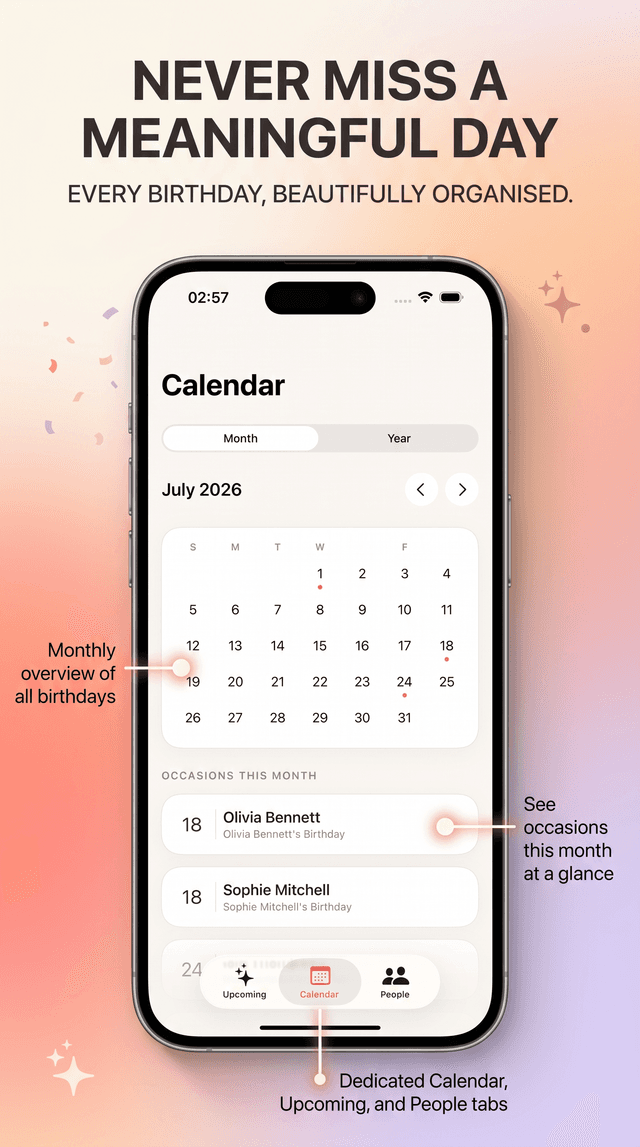
Birthday Reminder lets you choose lead days and an alert time for each occasion. Its App Store listing also confirms support for notes and gift ideas, so the date, preparation schedule, and city can stay together.
For a person abroad:
- Add the birthday using the date they celebrate locally.
- Choose lead days based on the action you intend to take.
- Set the alert for a useful time in your own day.
- Add their current city and preferred contact window to the note.
- Check World Clock close to the birthday.
- Add a separate Calendar event if you agree on an exact call time.
Do not assume the app automatically converts an alert into the recipient's time zone. Treat its alert as your prompt to prepare or act, then use World Clock for the recipient's current local time.
The Birthday Reminder app page explains how flexible alerts, countdowns, notes, and widgets fit together without requiring an account.
A yearly time-zone checklist
Use this short review before each birthday:
- Confirm the person still lives in the city saved in the note.
- Keep their birthday on their local month and day.
- Check whether the intended action needs an early reminder.
- Avoid copying last year's numerical time difference.
- Check World Clock close to the date.
- Verify your own device zone after travel.
- Use a separate zoned Calendar event for an agreed live call.
- Update the note after the birthday if the timing was inconvenient.
For a wider maintenance routine, use the simple birthday planning system.
Frequently asked questions
Does iPhone automatically adjust every birthday reminder for time zones?
No single rule covers every reminder app. iPhone can update its device time zone automatically, Apple Reminders has its own Time Zone setting, and third-party apps control how they schedule notifications. Verify the next alert after travel instead of assuming its behavior.
Should I save the birthday in my time zone or theirs?
Save the month and day the person recognizes as their birthday. Use your own schedule only when choosing when an alert should reach you.
Is World Clock enough for a future birthday call?
Use it to check the current time close to the birthday. Do not assume today's hour difference will still apply months later because daylight saving rules can change the offset.
Should I use one reminder or two?
Use one alert for a simple message. Use two when preparation or a live call is involved: an early action reminder and a closer prompt to check the recipient's local time.
Should I save a city, time-zone abbreviation, or UTC offset?
A city and country are usually clearest. Abbreviations can be ambiguous, and fixed UTC offsets do not reflect every seasonal clock change.
What if we have agreed on an exact call time?
Create a Calendar event in the relevant time zone and send the invitation if appropriate. Keep the birthday reminder for preparation and the Calendar event for the appointment.
The durable approach is simple: preserve the recipient's birthday date, schedule preparation around your own day, and check their current local clock before making contact. Browse the other Birthday Reminder guides for related iPhone setup and planning advice.