
The least awkward way to confirm someone's birthday is usually the most direct one:
“I'm updating my birthday reminders and want to get yours right. What month and day should I save? No need for the year.”
That sentence explains why you are asking, limits the request to what you need, and separates the birthday from the person's age. Once they answer, repeat the date using the month's name, record it immediately, and do not ask again next year.
Ask only for the information you need
For a reminder, card, or annual calendar, the month and day are normally enough. A birth year is useful only when age affects the plan, such as preparing for a milestone birthday.
Treat the year as a separate question rather than part of the default request:
- Say explicitly that the year is unnecessary.
- Do not estimate it from appearance, education, or work history.
- Leave it blank if the person does not volunteer it.
- If a milestone matters, explain why before asking.
“What month and day should I put in my calendar?” feels different from “What is your date of birth?” The first sounds like ordinary social planning. The second can sound like a request for an official record.
Give the question a visible purpose
A birthday question is easier to answer when the reason appears in the same sentence. You do not need a long explanation.
Useful reasons include:
- Updating a personal birthday calendar.
- Setting a reminder so you do not miss the day.
- Sending cards at the right time.
- Completing a family birthday list.
- Coordinating an optional workplace celebration.
Avoid inventing a reason or making the gesture sound more significant than it is. A simple, truthful explanation is enough.
If you already have a possible date, ask for confirmation rather than pretending you know it:
“I have your birthday as 14 May. Is that right?”
That is faster to answer and gives the person an easy opportunity to correct you.
Use a script that fits the relationship
The basic approach stays the same, but the wording can match the setting.
Friend or someone you are dating
“I want to make sure I don't miss your birthday. What date should I save? Month and day is plenty.”
This is warm without turning the question into an inquiry about age.
Relative or new in-law
“I'm checking the family birthday list so I stop relying on guesses. What month and day should I put down for you?”
For several relatives, ask in a family conversation rather than singling out the person you know least well.
Coworker
“We sometimes acknowledge birthdays, but only if people want to take part. Would you like yours included? Month and day is all we need.”
Do not retrieve a date from an HR record for a social list or announce it merely because the organization possesses it. SHRM warns that workplace birthday recognition can upset employees or lead to allegations of unequal treatment when it is handled poorly. A voluntary question with an easy way to decline is safer and kinder.
Older relative who may not want to discuss age
“I only need the month and day for my reminder. You don't need to tell me the year.”
Say this before they have to ask whether the year is required.
Parent of a child's friend
“Would you be comfortable sharing Maya's birthday month and day? We'd like to remember a card.”
Ask the parent or guardian, not the child, and avoid requesting the year unless there is a real age-related reason.
By text
“Quick calendar check: what month and day is your birthday? No year needed.”
Text can make the exchange easier because the person can answer without an immediate social reaction. It also gives you a written date to verify, although you should still clarify an ambiguous numeric answer.
Confirm a date without invading someone's privacy
If asking directly is not practical, begin with information the person already shared for the same purpose.
Reasonable places to check include:
- A previous invitation they sent you.
- A family calendar they agreed to join.
- An old conversation in which they stated the date.
- A contact card they maintain and shared with you.
- A birthday list they knowingly contributed to.
An old invitation or message is evidence, not a guarantee. Confirm it if there is any reason it may be incomplete or mistaken.
Be more careful with mutual contacts. Rather than asking someone to disclose another person's birthday, ask them to create the opening:
“I want to add Priya to my birthday reminders. Would you mind asking whether she's comfortable sharing the date with me?”
This preserves Priya's choice. A mutual friend can also include you in an existing planning conversation where the date is already being shared for that purpose.
Avoid searching public records, data-broker sites, or forgotten social profiles merely to avoid a short conversation. A date being discoverable does not mean the person intended you to collect and store it.
Repeat the date using the month's name
Numeric dates can be genuinely ambiguous. ISO uses 01/05/22 as an example: it could mean 5 January 2022 or 1 May 2022, depending on the convention being used. ISO 8601 removes that uncertainty in standardized data by using year-month-day order.
In an ordinary conversation, the simplest solution is to use words:
- “So that's 5 January, right?”
- “You mean 1 May, correct?”
- Write 5 January, not just 05/01, in a note.
This is especially important when the answer arrives as 5/1, when you and the other person grew up with different date conventions, or when a date has been copied between systems.
Repeating the answer is not awkward when it sounds like a routine accuracy check. It is much better than saving a wrong date with complete confidence.
Respond gracefully if someone declines
A person may dislike birthday attention, prefer not to share personal dates, or simply not want to answer. You do not need to determine the reason.
Use a short response:
“No problem at all.”
Then move on. Do not immediately ask for the month, question why they are private, or obtain the date from someone else. If they volunteer a lighter alternative, such as “It's sometime in October” or “I'll tell you when it gets close,” you can work with that, but it should be their choice.
Mark your record as unknown rather than entering a guess. A blank field is accurate about what you know; an unverified date is not.
Record the confirmation so you do not ask twice
Save the answer while the conversation is still open. Include three small details:
- The date written with the month's name.
- Whether the year was confirmed or intentionally left blank.
- A brief verification note, such as “Confirmed with Sam, September 2026.”
Apple's iPhone Contacts app supports a birthday field when editing a contact. Apple Reminders supports notes, due dates, recurring schedules, and early reminders, so it can hold both the date and a short confirmation note.
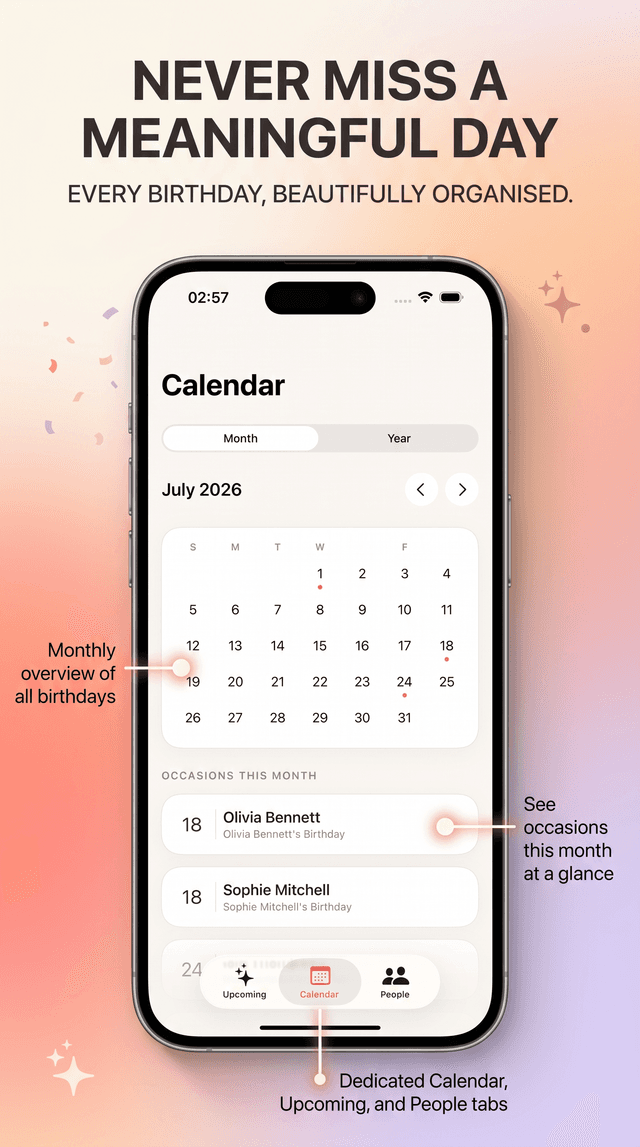
Birthday Reminder keeps birthday records, notes, countdowns, and flexible reminder schedules in one focused app. A note such as “Confirmed directly, September 2026” is enough; do not copy the whole conversation or store unnecessary personal information.
This guide focuses on how to confirm someone's birthday in conversation. For duplicate records, confidence labels, and recurring audits, use the separate guide to building a birthday list that stays accurate.
If you are rebuilding records from several places, read how to remember birthdays without social media. Once the dates are trustworthy, the three-stage birthday planning system and birthday reminder timing guide explain what to do with them.
Frequently asked questions
Is it rude to ask someone for their birthday?
Usually not when you explain the reason, ask only for the month and day, and make it easy to decline. It becomes intrusive when you press for the year, question a refusal, or collect the date without the person's knowledge.
Should I ask for the birth year too?
Not for an ordinary birthday reminder. Ask separately only when the year serves a real purpose, such as confirming an upcoming milestone, and explain that purpose.
How do I correct a birthday I previously got wrong?
Be direct: “I think I saved your birthday incorrectly. Is it 5 January or 1 May?” Correct the main record immediately, then check any calendar or reminder copies so the old date does not remain active.
Can I confirm a birthday without asking the person directly?
Check a previous invitation, message, shared calendar, or other record the person knowingly provided for that purpose. If you involve a mutual contact, ask them to prompt the person rather than disclose the date without permission.
What if a coworker does not want their birthday acknowledged?
Leave them out of the social birthday list and do not ask for an explanation. Workplace participation should feel optional, and a date held for administrative purposes should not automatically become celebration information.
How should I save an ambiguous date from a text?
Reply using the month's name: “Do you mean 5 January or 1 May?” Save the answer in words or in a system that displays an unambiguous full date.
Confirming a birthday should be a small exchange, not an investigation. Ask for the minimum, explain why, verify the format, and respect the answer.
The Birthday Reminder app page shows how confirmed dates, notes, countdowns, and reminders can stay together in one private place. You can also browse all Birthday Reminder guides or read our editorial policy.