The most useful birthday countdown widget ideas are not decorative. They answer a specific question quickly: whose birthday is next, how much time remains, or which celebration needs attention now.
Give the widget one job, show enough context to understand it, and place it somewhere you naturally look. Then pair it with a separate reminder for the action. That combination turns a passive number into a practical birthday-planning tool.
This guide assumes you already have, or are testing, a countdown app. If you are still choosing one, start with the comparison of the best birthday countdown widgets for iPhone.
Choose one job for the widget
A small widget cannot be a complete birthday database. Decide what you want to learn from one glance.
Choose one of these jobs:
- Show the nearest birthday. Display one person and the number of days remaining.
- Show the next few birthdays. Use a larger layout for two or three names and countdowns.
- Keep one milestone visible. Temporarily dedicate a widget to an important birthday that requires planning.
- Prompt a weekly review. Use the widget as an entry point to the full upcoming-birthdays list.
Avoid asking one widget to show every person, date, age, note, and reminder. More information is not automatically more useful, especially when it makes names difficult to scan.
Apply the ten-second glance test
Look at the widget briefly without opening the app. You should be able to answer:
- Whose birthday is shown?
- How many days remain?
- Is this the person who needs attention next?
A large “12” without a name fails the test. So does a dense list that requires careful reading.
The ideal information depends on size, but prioritize it in this order:
- Person’s name.
- Number of days remaining.
- Birthday date.
- Upcoming age, only when the birth year is known.
- A second or third upcoming birthday when space allows.
Keep planning notes inside the app unless the widget is specifically designed to show them. The widget should direct your attention, not expose every detail on the screen.
Pick the screen that matches your routine
Apple supports widgets on the Home Screen, Lock Screen, and Today View. StandBy can also display widgets while a charging iPhone is stationary on its side. The underlying app must provide a suitable format for each location, so support for one screen does not prove support for all of them.
| Your routine | Surface to test | Useful setup |
|---|---|---|
| You check app pages throughout the day | Home Screen | One compact countdown or a short upcoming list |
| You want the closest birthday visible before opening an app | Lock Screen | One name and day count in a compact format |
| You prefer an uncluttered Home Screen | Today View | A short list available with a swipe |
| Your phone charges beside a desk or bed | StandBy | One readable countdown tested from viewing distance |
For StandBy, Apple says to enable the feature in Settings, connect the iPhone to a charger, place it stationary on its side, and press the side button. Continuous visibility depends on the iPhone model and display settings, so test the real setup rather than assuming it will remain illuminated.
Add the widget and test every available size
On the Home Screen, Apple’s current instructions are to touch and hold a widget or empty area until the apps jiggle, tap Edit, choose Add Widget, select a size, and add it.
For the Lock Screen, touch and hold the Lock Screen, choose Customize, and tap Add Widgets. If the app does not appear there, its Home Screen widget cannot simply be dragged into that space.
After adding the widget, perform a short test:
- Confirm that the correct person appears.
- Check that the name and countdown are readable.
- Try another size instead of accepting the default.
- Add a second birthday and see how the order changes.
- Edit a test date in the app and confirm the widget eventually reflects it.
- Check the Lock Screen and StandBy separately if you intend to use them.
This test is more reliable than choosing a layout from a promotional screenshot.
Pair visibility with an action reminder
A countdown answers “how long?” It does not decide what to do.
Create a separate reminder for the next action:
- “Post Maya’s card on Friday.”
- “Ask Dad about birthday dinner.”
- “Order the photo book this weekend.”
- “Call at 7pm my time.”
- “Confirm the accessible restaurant.”
The widget keeps the birthday visible between alerts. The reminder interrupts you when action is useful. Treat them as complementary features rather than expecting the widget to replace notifications.
Use the birthday reminder timing guide to choose lead times for messages, gifts, bookings, deliveries, or travel.
Use a stack without hiding the birthday
Apple allows stacks of up to 10 widgets on the Home Screen or in Today View. A birthday countdown can share space with Calendar or Reminders, but a stack introduces one risk: the birthday may not be visible when you need it.
Try one of these approaches:
- Put the birthday widget first and swipe manually.
- Turn off Smart Rotate if automatic rotation hides it too often.
- Keep only two or three related widgets in the stack.
- Give an urgent milestone its own temporary Home Screen position.
Do not plan on putting this kind of stack on the Lock Screen. Lock Screen widgets use their own compact formats and placement area.
Try one of these four practical setups
The nearest-birthday setup
Use a compact Home Screen or Lock Screen widget that shows one person and a day count. This is the simplest option for people who mainly want to avoid overlooking the next birthday.
Pair it with an early preparation alert and a final birthday-day alert. Keep the full list inside the app.
The next-three planner
Use a medium or large Home Screen widget for the next two or three birthdays. This works well when several family birthdays fall close together.
Scan it once a week and open any birthday that has entered its preparation window. The simple birthday planning system explains how to move from remembering the date to preparing an action.
The temporary milestone widget
Give one important birthday a prominent widget for several weeks, then remove or repurpose it after the event.
This setup is useful for a milestone, trip, group celebration, or personalized gift. Add the real deadlines to reminders rather than trying to fit the entire plan into the widget.
The StandBy desk display
Use a readable countdown in StandBy if your phone regularly charges at a desk, kitchen counter, or bedside table. Check the layout from the distance where you will view it and make sure it identifies the person, not only the number of days.
Because StandBy is visible at a distance, avoid displaying birthday details you would not want other people nearby to see.
Keep the visible list intentional
A widget should not mirror an entire imported address book. Show the people whose approaching birthday would change what you do.
If your app supports favourites, use them to create a focused group. Otherwise, choose a layout that automatically shows only the nearest few birthdays.
A useful starting point is:
- One person in a compact widget.
- Two or three people in a larger widget.
- No more entries than you can understand in one glance.
The full list can remain inside the app. If that list is still cluttered or incomplete, first build a private birthday list.
Add context behind the widget
A countdown becomes more valuable when opening it leads to useful information.
For each important birthday, store one short detail such as:
- A gift idea.
- A preferred way to celebrate.
- A time zone.
- A posting or ordering deadline.
- The next action you intend to take.
Do not expect every widget format to display this note. Its purpose is to help after the countdown prompts you to open the birthday record.
Audit the setup after two weeks
Widgets can become background decoration surprisingly quickly. After using the setup for two weeks, ask:
- Did I notice the countdown without deliberately looking for it?
- Could I identify the person immediately?
- Did the widget lead to an action?
- Was the chosen screen visible often enough?
- Did another widget in the stack hide it?
- Is the visible list too broad?
Change one variable at a time. Move the widget, reduce the number of names, try another size, or rewrite the reminder. You do not need to rebuild the entire birthday system.
If information appears stale, first confirm that the date is correct inside the app. For Birthday Reminder specifically, current support guidance recommends opening the app once after changes and removing and adding the widget again if necessary.
Where Birthday Reminder fits
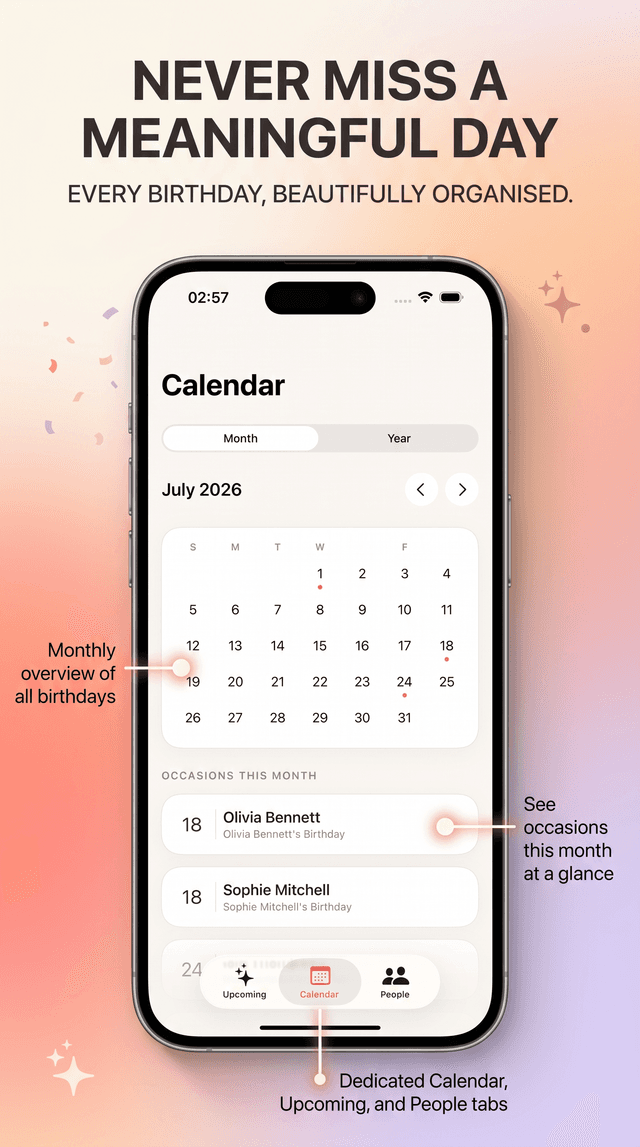
The current App Store listing for Birthday Reminder: Tracker confirms countdowns, customizable reminder lead days and times, notes, gift ideas, favourites, optional contact import, and a Home Screen widget. It also says no account is required and birthday information stays on the device.
That makes it suitable for the workflow in this guide: keep the next birthday visible, store planning context behind it, and schedule a separate alert for the action.
The App Store description explicitly names the Home Screen widget. If a Lock Screen or StandBy format is essential to your setup, confirm its current availability in the relevant iPhone widget gallery before relying on it.
Visit the Birthday Reminder app page for the current feature summary and App Store link.
Frequently asked questions
What should a birthday countdown widget show?
At minimum, it should show the person’s name and the number of days remaining. Add the date or upcoming age only when the widget has enough room to remain readable.
How many birthdays should I put on one widget?
Use one birthday in a compact widget or two to three in a larger layout. If finding a name requires careful scanning, show fewer people.
Does a countdown widget replace birthday reminders?
No. The widget provides passive visibility, while a notification prompts action at a chosen time. Use the widget between one early preparation reminder and the final birthday alert.
Can I put a widget stack on the Lock Screen?
Apple documents widget stacks for the Home Screen and Today View. The Lock Screen has a separate widget area with compact formats supplied by each app.
Why is my birthday widget showing an old date?
Check the birthday inside the app first, then open the app once so its data is current. Follow the developer’s support instructions and remove and add the widget again if the old information remains.
Does every Home Screen widget work in StandBy?
Do not assume so. The app must offer an appropriate widget, and the resulting layout still needs to be readable in StandBy. Test it while the phone is charging in the location where you intend to use it.
A useful birthday widget gives you the right amount of information in the right place, then points toward a real action. Keep the display focused, test it under normal use, and let reminders and notes handle the planning that cannot fit inside a widget.
Browse the remaining Birthday Reminder guides for related setup and planning advice. Our editorial policy explains how product and platform claims are checked.