
A birthday card reminder system should tell you what to do next, not merely announce that a birthday is approaching. Give the card three action dates:
- Buy or select it.
- Write and address it.
- Mail it.
For a standard U.S. card, start by mailing 5–7 days before the birthday. USPS currently lists First-Class Mail delivery at 1–5 days, but that is a service window, not an arrival guarantee for a particular card. The extra margin protects your plan from a late collection, a weekend, or a task that slips by a day.
Why remembering the birthday is not enough
A birthday alert can arrive on time while the card still arrives late. The alert tells you the date, but it may leave several unresolved jobs:
- Find an appropriate card.
- Confirm the mailing address.
- Write a message.
- Check the envelope's size and postage.
- Reach a mailbox before the final collection.
One reminder forces you to complete every step at once. Three smaller deadlines make the process easier to resume and reveal problems while there is still time to solve them.
This is a card-specific extension of the broader remember, prepare, and celebrate system. It focuses on inventory, addresses, postage, and mailing rather than trying to replace the general planning workflow.
Give buying, writing, and mailing their own dates
A useful default schedule for an ordinary domestic card is:
| Action | Starting point | What to complete |
|---|---|---|
| Buy or select | 14 days before | Choose from your stash or add a card to this week's shopping |
| Write and address | 10 days before | Write the message, confirm the address, and seal the envelope |
| 5–7 days before | Check postage and place the card in the mail | |
| Birthday gesture | Birthday morning | Call or message if that is part of your plan |
These are planning defaults, not universal deadlines. Move the first task earlier for a handmade card, a milestone birthday, an online card order, or an address you need to request.
Use action wording. “Rosa's birthday in two weeks” still requires a decision. “Choose Rosa's card from the desk drawer” is ready to do.
The broader birthday reminder timing guide covers gifts, reservations, travel, and other actions. Let that page own the general timing question while this checklist handles the physical card.
Set up the alerts without overstating what one app does
Different tools can handle different parts of the system:
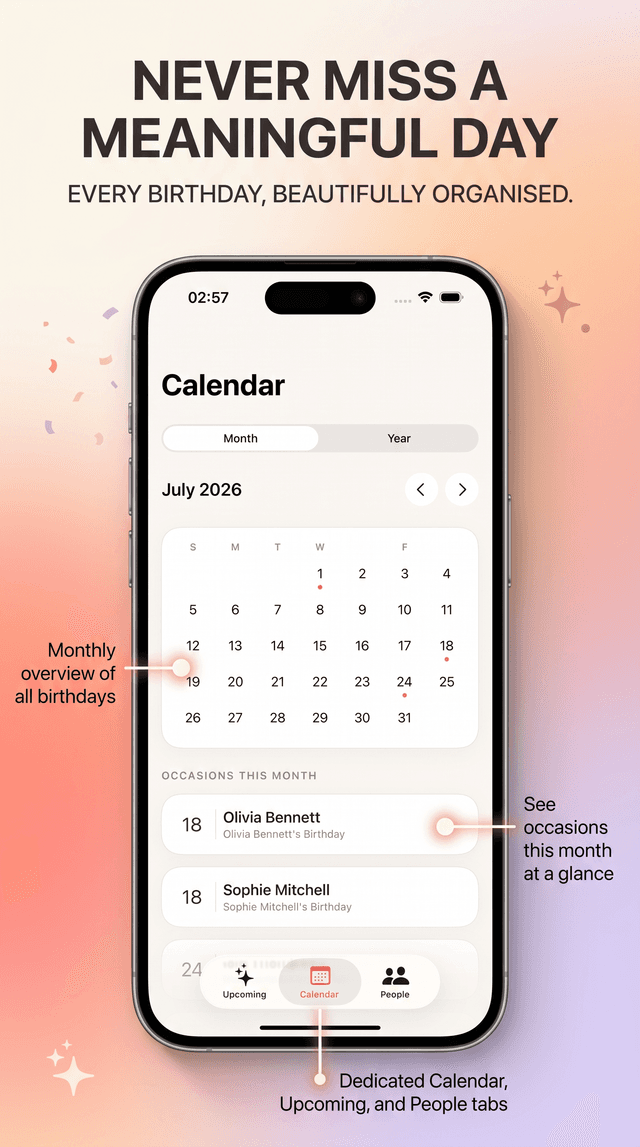
- Birthday Reminder: Keep the birthday, countdown, planning note, and per-occasion lead days and alert time together. Its current App Store listing supports personal notes and customizable reminder timing.
- Apple Reminders: Create separately named tasks such as “Buy Maya's card,” “Write Maya's card,” and “Mail Maya's card.” Apple documents dates, times, recurrence, notes, and an Early Reminder.
- Paper planner: Write the three actions into the relevant weeks and review the next month regularly.
Birthday Reminder is useful as the source of the birthday and the early heads-up. It does not need to be presented as three separately named task notifications. If you want each action to produce its own notification, pair the birthday record with action-specific reminders.
A birthday-focused widget can keep upcoming people and countdowns visible. Use a task list or calendar for exact mail-by deadlines rather than assuming the widget displays postal tasks.
For a fuller comparison, see Birthday Reminder app vs iPhone Reminders.
Keep a small card station
A card stash removes an errand, but it does not need to become a collection. Start with:
- Three to six blank or all-occasion cards.
- Standard rectangular envelopes that match them.
- A few current stamps.
- A pen that writes cleanly on the card stock.
- Return-address labels, if you use them.
Add specialist cards only when you can already see a need, such as an upcoming milestone. Review the stash every few months and replace what you actually used.
Standard rectangular envelopes are also easier to price than square, rigid, lumpy, or unusually shaped mail. Decorative packaging may look appealing, but it can change the postage category.
Work backward from the postal service
The following figures are current USPS information as of August 16, 2026. Prices can change, so check USPS when the exact amount matters.
| U.S. mailpiece | Current starting postage | USPS information | Editorial planning buffer |
|---|---|---|---|
| Standard rectangular letter up to 1 oz | $0.82 | First-Class Mail, 1–5 days | Mail 5–7 days before |
| Square, oversized, or unusually shaped envelope | $1.31 | Nonmachinable pricing applies | Mail about 7 days before |
| Qualifying large envelope or flat | $1.69 | Size and flexibility rules apply | Mail 7–10 days before |
| Standard international letter or postcard up to 1 oz | $1.75 | Delivery varies by destination | Begin 21–30 days before and verify locally |
The final column is a planning recommendation, not a USPS promise. International First-Class Mail has no single delivery window on the cited USPS page. Check the destination country, seasonal disruption, and local postal guidance before choosing a mail-by date.
Do not assume every bulky greeting card qualifies as a large envelope. A rigid, nonrectangular, or unevenly thick mailpiece may be charged as a package. When in doubt, use the USPS price calculator or take the sealed card to a retail counter.
USPS says you may ask a retail associate to hand-cancel First-Class Mail for free if you want a postmark from the day it is presented. That postmark is not the same as an official mailing receipt. USPS charges separately for a Certificate of Mailing.
Outside the United States, use the same method with your own carrier: find its service window, check the envelope rules, and add a reasonable margin.
Confirm the address before card-writing day
Do not make address research part of the final mailing task. Check it when the buy-or-select reminder appears.
Keep the full address in a trusted contact record or address book. In the birthday note, a small planning marker may be enough:
- “Address confirmed August 2026.”
- “International postage.”
- “Ask for new address.”
- “Handmade card may need package pricing.”
This avoids duplicating personal data while still showing what needs attention. If your dates and contact details are scattered, first build a trusted list with the guide to remembering birthdays without social media.
What to do when the card will be late
If the First-Class Mail buffer has passed:
- Check the actual route. USPS provides service estimates based on origin and destination.
- Compare Priority Mail. USPS lists expected delivery in 2–3 days in most cases, but it is more expensive and the estimate is not guaranteed.
- Acknowledge the birthday on time. Call or message, then send the physical card as a follow-up rather than abandoning it.
- Correct next year's system. Move the step that failed earlier, whether it was buying, confirming the address, writing, or mailing.
Do not pay for faster postage automatically. If the card cannot arrive on time even with the faster option, an honest birthday-day message and a later card may be the more sensible choice.
Frequently asked questions
How many days before a birthday should I mail a card?
For a standard U.S. First-Class Mail envelope, 5–7 days before the birthday is a practical starting point. USPS lists delivery at 1–5 days, and the additional margin makes the plan less fragile. This is not a guaranteed arrival date.
How early should I plan an international birthday card?
Start 21–30 days ahead, then check the destination rather than treating that range as universal. USPS states that First-Class Mail International delivery varies by country.
Do I need three birthday card reminders?
Use three when cards regularly stall between intention and mailing. If you already keep cards and stamps at home, the first alert can simply say “Select a card.” For a nearby person whose card you will deliver by hand, the mailing task can become “Put card in work bag.”
Can Birthday Reminder manage this system?
It can hold the birthday, countdown, personal note, and a customizable per-occasion reminder. Use the note for the card plan and the lead-time alert for the first action. If you want three separately named notifications, create action-specific tasks in Apple Reminders or another task manager.
How much postage does a birthday card need?
As of August 16, 2026, a qualifying standard U.S. letter up to 1 oz starts at $0.82. Square, oversized, or unusually shaped envelopes start at $1.31, and large envelopes start at $1.69. Standard international letters or postcards up to 1 oz start at $1.75. Weight, thickness, rigidity, shape, and destination can change the price.
Is a birthday card stash worth keeping?
A small stash is useful if buying the card is usually the step that causes delay. Keep only versatile cards you would genuinely send, plus matching envelopes and stamps. The goal is to remove an errand, not create more storage.
A reliable card system is simple: select early, write before the postal deadline, and mail with a buffer. Visit the Birthday Reminder app page to review its countdowns, personal notes, customizable reminder timing, and widget, or browse the other Birthday Reminder guides for related planning workflows.