If you want to remember birthdays with ADHD, do not make remembering the main task. Put each date in one trusted place, keep the next few birthdays visible, and create alerts that tell you exactly what to do.
A useful system does not depend on you thinking about a birthday at the right moment. It brings the birthday back into view while there is still time to act.
Why birthdays are easy to lose track of
Remembering to carry out a future intention is called prospective memory. It involves forming the intention, retaining it, noticing the right cue, acting, and checking that the action happened. A birthday plan can break down at any of those points.
ADHD often involves difficulties with attention and working memory. You may hear a date but never record it, open an app and become distracted, dismiss an alert while busy, or remember the birthday without retrieving the plan to buy a card.
Prospective-memory tasks can be:
- Time-based: Act on a date or at a particular time.
- Event-based: Act when an external cue appears.
A birthday is inherently time-based, but you can support it with event-based cues. For example, making coffee on Sunday can prompt you to check the next two weeks. The routine does not replace the stored date. It gives you a reliable reason to look at it.
Build a four-layer birthday system
Avoid giving five identical notifications the same job. Instead, build a small system in which each layer serves a different purpose.
| Layer | Its job | Example |
|---|---|---|
| Trusted record | Store the confirmed birthday | One entry in Birthday Reminder |
| Advance view | Keep approaching dates visible | A Home or Lock Screen widget |
| Action cue | Tell you what to do next | “Buy Priya’s card after work” |
| Selective fallback | Catch an important missed action | A labeled note beside your keys |
Not every birthday needs all four layers. A same-day message may need only a record and a final alert. A posted gift or planned visit may justify an action cue and a temporary physical fallback.
The important distinction is that redundancy should add a useful route back to the task, not more noise.
Keep every date in one trusted place
Choose one place where birthday records are created and corrected. A widget or calendar can display those records, but you should know where the authoritative version lives.
Start with the people you genuinely intend to contact or plan for. Confirm uncertain dates rather than creating reminders around guesses. If your dates are still scattered across profiles and message threads, use the process in how to remember birthdays without social media before adding ADHD-specific cues.
For each person, record only what helps you act:
- Name and confirmed month and day.
- Intended gesture, such as a message, card, call, or visit.
- One useful note, such as a time zone or delivery constraint.
- The amount of preparation that gesture requires.
Keeping this information together prevents the date, plan, and context from becoming three separate things to retrieve.
Make alerts name the next action
“Dad’s birthday in ten days” supplies information but still requires a decision. “Order Dad’s book tonight” tells you what success looks like.
Use an early alert for preparation and a final alert for the birthday itself. The exact lead time should come from the intended action. A message may need no preparation, while a delivery, reservation, or journey may need weeks. The birthday reminder timing guide provides practical starting points.
When an alert arrives, use one of four responses:
- Do it if the action is genuinely quick.
- Schedule it for a specific time you can act.
- Convert it into a task with a clear deadline.
- Dismiss it deliberately if the plan is no longer needed.
Avoid clearing the alert while telling yourself you will remember later. That hands the task straight back to prospective memory.
The broader three-stage birthday planning system can help when a birthday involves several actions. This article’s narrower job is making sure those actions re-enter your attention.
Attach a birthday check to an existing routine
A weekly look-ahead is easier to retrieve when it follows something that already happens.
Choose one stable pairing:
- After Sunday breakfast, check the next two weeks.
- When ordering groceries, see whether a card is needed.
- After a weekly planning meeting, scan upcoming birthdays.
- When charging your phone at night, glance at the countdown widget.
Make the check small. You are not planning every celebration. You are asking one question:
Does any birthday in the next two weeks need an action now?
If the answer is yes, create the action immediately. If it is no, stop. A two-minute review is more sustainable than a large monthly project that is easy to postpone.
Use visible and physical cues selectively
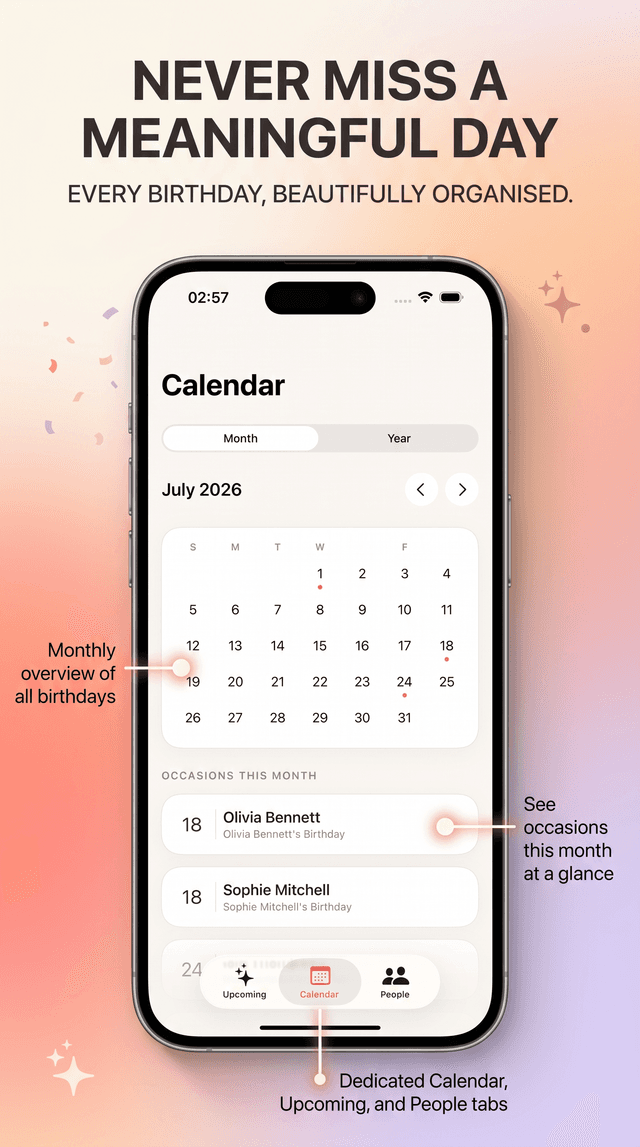
A widget is useful because it can show an approaching birthday without requiring you to open an app. The Birthday Reminder app supports countdowns, flexible reminder schedules, notes, and Home and Lock Screen widgets, so the record and advance view can remain together.
A physical cue can help with an immediate action, but it should be temporary and specific. “Post Leo’s card” beside your keys is clearer than an unexplained ribbon you may stop noticing. Remove the cue when the action is complete.
Do not cover every surface with reminders. When everything is visually urgent, nothing stands out. Reserve physical cues for actions that are both important and close enough to complete.
Configure iPhone alerts to reach you
First, confirm that notifications are enabled for the apps you depend on. Apple lets you choose alert styles, show previews, group notifications, and inspect Focus settings when alerts are not appearing as expected.
For a particularly important one-off task, Apple Reminders can provide a separate action cue. It supports time-based and location-based reminders, notes, Siri creation, and a Home Screen widget.
In iOS 26.2, an iCloud reminder can also be marked urgent. Apple says an urgent reminder schedules an alarm that activates even when the device is silenced or a Focus is on. Use that level selectively, such as for leaving with a card or making a planned international call. If every birthday becomes urgent, the distinction loses its practical value.
Set up the system in 15 minutes
Begin with five people rather than rebuilding your entire address book.
- Add or confirm their birthdays in your trusted record.
- Decide what you normally want to do for each person.
- Set one preparation alert where preparation is necessary.
- Set a final birthday-day alert.
- Rewrite each preparation alert as a concrete action.
- Add the upcoming-birthday widget somewhere you already look.
- Pair a two-week check with one weekly routine.
Run this small version for a month. Notice which alerts were useful, which arrived at inconvenient times, and which actions still disappeared. Adjust those points before adding more people.
When the system still fails
A missed birthday does not prove that the system is pointless or that you do not care. It identifies a failure point.
Ask:
- Was the date recorded correctly?
- Did the alert arrive early enough?
- Did it name a real action?
- Was the notification hidden, silenced, or dismissed?
- Did the task need a second format?
- Was the planned gesture too complicated to start?
Repair that specific point. You might move an alert to after work, shorten the intended gesture, add a widget, or create a temporary physical cue next year. CHADD’s prospective-memory guidance recommends replacing broad self-criticism with a more useful question: what cue was missing?
Frequently asked questions
Is forgetting birthdays a sign of ADHD?
Not by itself. ADHD diagnosis considers a persistent pattern of symptoms, their history, and their effect in more than one area of life. If forgetfulness is part of a wider pattern that concerns you, discuss it with a qualified healthcare professional rather than drawing a conclusion from birthdays alone.
How many birthday reminders should I set?
Use the fewest reminders that perform distinct jobs. For many birthdays, one preparation alert and one final alert are enough. Add a different-format fallback only when there is a real risk or deadline to catch.
What if I automatically dismiss notifications?
Change what the alert asks you to do. Use a concrete action, schedule it for a time when you can respond, and keep the next birthday visible in a widget. Adding more generic notifications usually adds noise without fixing the handoff to action.
Do I need a dedicated birthday app?
No. Contacts, a calendar, and a task app can form a workable system. A dedicated app is useful when you want birthday records, countdowns, notes, flexible schedules, and widgets in one focused place.
What if a routine-based cue stops working?
Move the check to a routine that is more stable or make the cue more visible. Life changes can weaken an old pairing. The goal is not to find one permanent trick, but to maintain a cue you still encounter reliably.
Remembering birthdays with ADHD becomes easier when the system stores the date, shows what is approaching, and presents one clear action. Start with five people and one weekly check. Expand only after that small version works.
You can browse more Birthday Reminder guides for related planning methods and read our editorial policy for how these articles are reviewed.