Work birthdays are different from family birthdays. The relationships are newer, the boundaries matter more, and the wrong kind of reminder, such as a notification flashing on your Lock Screen during a meeting, can feel exposing.
To remember coworkers' birthdays privately, keep a short personal list on your own phone rather than in any shared work tool. Ask for the month and day only, set one early reminder for group gestures and one final alert for your own message, hide notification previews at work, and write down almost nothing else. That is the whole system, and the rest of this guide explains each step.
Why work birthdays need a different approach
Workplace birthday preferences are genuinely split. In a survey by the gifting company Snappy, cited in SHRM's reporting, 67 percent of Americans said they would prefer birthdays at work to be celebrated quietly and privately, even though 81 percent also said a public acknowledgement in the workplace helps boost morale. HR leaders quoted in the same article recommend recording the month and day but not the year, and one CEO tracks each direct report's preference, public, private, or not at all, in a personal note on his own calendar.
That split is the point. Some work friends would love a desk visit and a card. Others would be mortified by either. A private system lets you match the gesture to the person instead of applying office-wide habits to everyone.
Privacy also cuts the other way. Many people do not want colleagues to know they keep a birthday list at all. A reminder that pops up while you are sharing your screen, or a visible countdown widget with a coworker's name on it, announces the system you meant to keep quiet.
Decide who belongs on your private list
Do not import the whole team directory. A work birthday list works best when it is short and honest.
Use one test: would I personally say something, sign something, or do something if I knew the date? If yes, add the person. If the only reason to know is that a platform would notify you anyway, leave them off.
A sensible first list usually includes:
- Work friends you talk to beyond tasks and meetings.
- Close teammates you would sign a card or chip in for.
- A manager or mentor you have a genuine rapport with.
- Former colleagues you still want to keep in touch with.
Two boundary notes. If you manage people, remembering direct reports' birthdays is thoughtful, but keep the records in your personal system and follow your company's norms for celebrating them. And if someone has told you they do not celebrate birthdays, for religious or personal reasons, respect that by not tracking theirs for workplace gestures at all.
Keep the list out of shared work tools
The most common privacy mistake is storing birthdays where other people or administrators can see them.
Avoid:
- The shared team or company calendar.
- A recurring event in your work calendar account, which colleagues with calendar access may be able to view.
- Notes in a shared document or project tool.
- Any list kept on a work-managed device.
Instead, keep the list on your personal phone in a personal app. The general principle from our guide to remembering birthdays without social media applies here too: one private place acts as the source of truth, and nothing about work relationships needs to live in a corporate system.
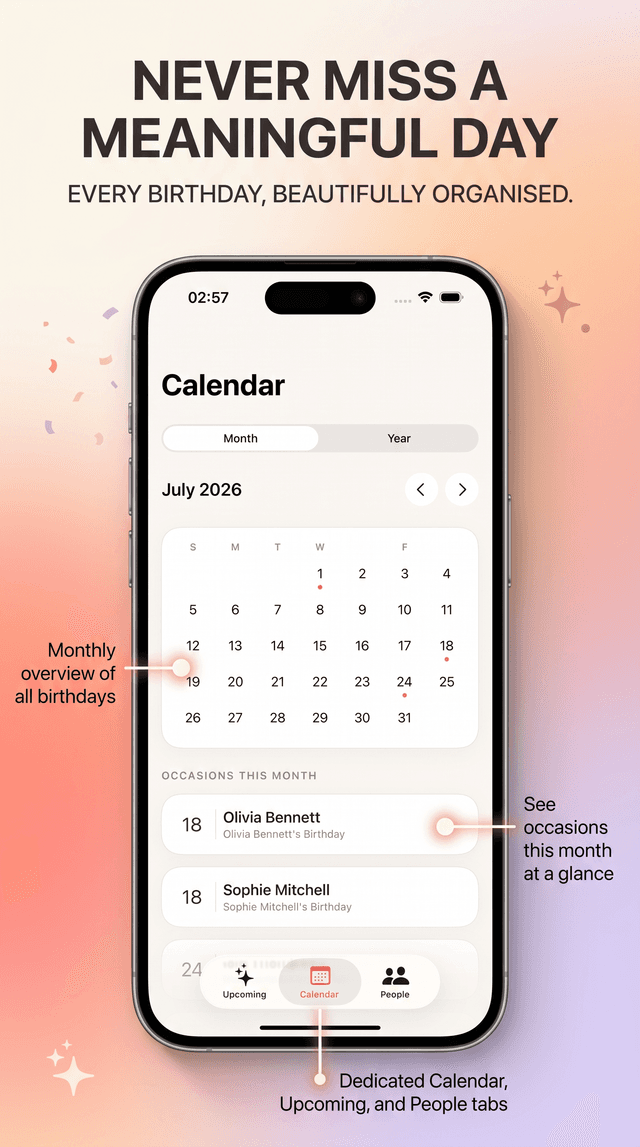
If you want a dedicated tool, Birthday Reminder stores names, dates, countdowns, and notes locally on your iPhone with no account, which suits exactly this situation. A private list you control is easier to keep discreet than a calendar entry colleagues can stumble across.
Ask for the date without making it awkward
You rarely need to interrogate anyone. Work birthdays surface naturally: someone mentions weekend plans, a manager circulates a card, a teammate jokes about getting older.
When you do ask directly, keep it light and ask for the month and day only. Do not ask for the year. The HR leaders quoted in SHRM's workplace birthday guidance make the same point: note the month and day, not the year. The year adds nothing to your reminder and touches on age, which many people prefer to keep out of the office.
Useful low-pressure openings:
- "When's your birthday? I want to make sure I actually remember it this time."
- "Are you doing anything for your birthday this year?"
- Adding the date immediately when someone mentions it, rather than trusting memory.
If a date is uncertain, mark it as unconfirmed in your notes rather than guessing. A wrong date quietly delivered is more awkward than asking once.
Make the reminders discreet on your iPhone
A private list still leaks if the alerts are loud. Apple provides several controls in the iPhone Settings app, under Notifications, that solve this:
- Hide previews. For the app holding your birthdays, set Show Previews to When Unlocked or Never. The Lock Screen then shows that a notification arrived without displaying the name or message to anyone glancing at your desk.
- Use Scheduled Summary. If you do not want personal alerts appearing during the workday at all, include the birthday app in a scheduled summary delivered at a time you choose, such as lunch or after work.
- Turn off screen-sharing alerts. Apple's notification settings include a Screen Sharing option that controls whether notifications appear while you share your screen. Turn it off so a birthday reminder never appears mid-presentation.
- Set up a Work Focus. A Focus can silence notifications from specific apps and people during work hours, then let everything through afterward. Apple's Focus documentation describes allowing or silencing notifications per app and per contact.
A Home Screen widget is fine on a personal phone. Think twice about a Lock Screen widget showing coworker names, since the Lock Screen is the most visible surface you own.
Time the reminders for workplace gestures
Office birthdays involve logistics that family birthdays do not. The card needs to circulate, the collection needs a deadline, and the person organizing it is often you.
A practical schedule:
| Gesture | First reminder | Final reminder |
|---|---|---|
| Personal message or quick chat | Day before or same morning | Birthday morning |
| Signing a circulating card | 3–5 days before | 1 day before |
| Organizing a group card or collection | 7 days before | 2 days before |
| Small team lunch or coffee | 7–14 days before | 2 days before |
The early alert should name the action, not the date. "Start the card for Priya" is useful. "Priya's birthday in 7 days" just starts the clock on your procrastination.
Our birthday reminder timing guide covers lead times in more depth, and the simple birthday planning system shows how the same remember, prepare, celebrate workflow scales across everyone you track.
What to write down, and what to leave out
For work relationships, minimalism is a feature. A good note is one short line that makes the gesture better:
- "Prefers low-key; just message her."
- "Bakes for everyone else; bring something for once."
- "Doesn't celebrate; skip."
- "Card goes round via Tom."
Leave out anything you would not want read over your shoulder: no speculation about age, family, health, or anything sensitive. If a note would embarrass either of you in a screen share, it does not belong in the record.
Manage your own birthday's visibility too
Privacy at work runs both directions. If you would rather not have your own birthday broadcast to your professional network, check your settings.
LinkedIn, for example, documents a birthday privacy setting that lets you adjust who can see the birthday on your profile. Review it rather than discovering your visibility from a flood of notifications on the day. The same applies to any workplace directory or chat tool that displays birthdays automatically.
It is also reasonable to tell close coworkers directly how you feel about being celebrated. The managers quoted in SHRM's reporting treat birthday recognition as opt-in for exactly this reason. You can extend the same courtesy to yourself.
Frequently asked questions
Is it weird to keep track of coworkers' birthdays?
No, provided the list is small, personal, and used for genuine gestures. Remembering a work friend's birthday and sending a kind message is ordinary thoughtfulness. It only becomes strange if you track people you barely know or store intrusive details.
Should I put coworker birthdays on the shared work calendar?
No. Shared calendars are visible to colleagues and, depending on permissions, administrators. Keep personal reminders on your personal device in a personal app.
How do I ask a coworker's birthday without asking their age?
Ask for the month and day only, and never ask for the year. "When's your birthday?" is a normal question. Following it with "what year?" is the part to skip.
Can my employer see birthday reminders on my phone?
On a personal iPhone, your employer has no access to your reminders or app data. On a work-managed device, your employer may administer parts of it, which is one more reason to keep the list on your own phone. Either way, hiding Lock Screen previews and screen-sharing notifications handles the everyday visibility problem.
What if I forget and miss a work friend's birthday?
A short message a day or two late is fine and better than silence. Then fix the system: add an early reminder for next year so the group card or collection is not the part that slips.
A private work birthday list is a small act of consistency. Keep it on your own phone, keep the notes kind and minimal, and let the reminders stay invisible until you need them. The Birthday Reminder app is built around that idea, with local, account-free storage, flexible alerts, and widgets you can keep off the Lock Screen, and you can browse more practical workflows in the Birthday Reminder guides. For how we research and source articles like this one, see our editorial policy.