To keep private birthday reminders on a shared iPhone, you need to control four things: who can open the app, what appears on the Lock Screen, what widgets are visible, and what happens when you hand the phone to someone. iOS gives you a tool for each of these, and together they prevent a family member, child, or colleague from seeing names, dates, notes, and gift ideas you would rather keep to yourself.
The core problem is that birthday reminders are personal. A notification that says "Mum's birthday tomorrow" or a widget showing a countdown to a surprise party can reveal information you do not want others to see. On a shared device, the default settings show almost everything to anyone who picks up the phone.
Why Shared iPhones Expose Birthday Reminders
When an iPhone is unlocked or has no passcode, every app, notification, and widget is visible to anyone holding it. Even with a passcode, notification previews often appear on the Lock Screen before the device is unlocked, and widgets on the Home Screen display countdowns and upcoming dates without requiring authentication.
Apple's built-in birthday system makes this worse. Birthdays stored in Contacts appear automatically in the Birthdays calendar, which anyone can open through the Calendar app. Contacts is a pre-installed app, and Apple does not allow it to be locked or hidden. You can lock the Calendar app itself with Face ID, but the underlying birthday data still lives in Contacts, which remains accessible to anyone who can unlock the phone.
A dedicated birthday app downloaded from the App Store, by contrast, can be locked, hidden, and have its notification previews controlled independently. That difference matters on a shared device.
Lock Your Birthday App With Face ID
Since iOS 18, iPhone lets you require Face ID, Touch ID, or a passcode to open any app downloaded from the App Store. Apple's documentation confirms that when an app is locked, information inside it will not appear in notification previews, search, Siri suggestions, or call history.
To lock a birthday app:
- Go to the Home Screen and find the app icon.
- Touch and hold the icon until the menu appears.
- Tap Require Face ID (or Touch ID or Passcode).
- Authenticate to confirm.
The app now requires Face ID every time it is opened. After you quit the app, it relocks automatically. Anyone who taps the icon without your face or passcode cannot see your birthday list, notes, or gift ideas.
This is the single most effective step. It protects the app itself, and it also suppresses the app's notification previews and search results, so birthday names do not leak through other parts of the system.
Note that some built-in apps cannot be locked, including Contacts and Settings. If you rely on the built-in birthday system through Contacts, you cannot apply this protection to that data. A dedicated app like Birthday Reminder can be locked because it is an App Store download.
Hide the App From the Home Screen
Locking an app keeps its contents private, but the icon is still visible. If you want to go further, iOS lets you hide the app entirely from the Home Screen.
To hide an app:
- Touch and hold the app icon on the Home Screen.
- Tap Require Face ID (or Touch ID or Passcode).
- Tap Hide and Require Face ID, authenticate, then tap Hide App.
The app disappears from the Home Screen and moves to the Hidden folder at the bottom of App Library. To open it, swipe left past all Home Screen pages to reach App Library, tap the Hidden folder, authenticate with Face ID, then tap the app and authenticate again.
Apple notes that hidden apps are still visible in Screen Time, Battery Usage, and App Store purchase history, so hiding is not absolute. But it removes the icon from casual view, which is often enough on a shared device.
There is an important trade-off: hidden apps do not deliver notifications. If you hide your birthday app, you will stop receiving birthday alerts entirely. For most people, locking the app is the better choice because it protects the contents while still allowing notifications to arrive with previews suppressed. Reserve hiding for situations where even the app icon's presence is a concern.
Only apps downloaded from the App Store can be hidden. Built-in apps like Contacts and Calendar cannot.
Stop Birthday Names From Showing in Notification Previews
Even with the app locked, birthday reminders may still trigger notifications. By default, iOS shows notification previews on the Lock Screen, which means a birthday alert could display a name and message before the phone is unlocked.
Apple provides three preview options per app: Always, When Unlocked, and Never.
To change preview settings for a birthday app:
- Open Settings and tap Notifications.
- Find the birthday app under Notification Style and tap it.
- Scroll down and tap Show Previews.
- Select When Unlocked or Never.
With When Unlocked, previews appear only after you authenticate, so anyone glancing at the Lock Screen sees only the app name and a generic "Notification" label. With Never, previews are hidden even after unlocking.
If you have locked the app with Face ID, Apple's documentation states that locked apps already suppress notification previews. Setting Show Previews to When Unlocked provides a second layer of protection for apps that are not locked, or for situations where the app has been temporarily unlocked.
For a broader approach to keeping birthday records outside social feeds and shared services, see our guide to remembering birthdays without social media.
Remove Birthday Widgets From Shared Screens
Home Screen and Lock Screen widgets can display countdowns, upcoming dates, and names without requiring authentication. If a birthday widget sits on a Home Screen page that others can see, it undermines every other privacy setting.
To remove a birthday widget:
- Touch and hold the widget on the Home Screen or Lock Screen.
- Tap Remove Widget (or the minus icon).
- Confirm removal.
If you want to keep the widget for your own use, move it to a Home Screen page that others are unlikely to scroll to. Press and hold the widget, drag it to the right edge of the screen, and release it on a later page.
On the Lock Screen, widgets are visible to anyone who wakes the phone. Remove birthday widgets from the Lock Screen entirely if the device is shared, and rely on notifications instead.
Use Guided Access When Handing Over the Phone
Sometimes you need to hand your iPhone to someone for a specific purpose: making a call, checking a map, or playing a game. Guided Access locks the device to a single app so the person cannot navigate elsewhere.
To set up Guided Access:
- Open Settings, tap Accessibility, then tap Guided Access.
- Turn on Guided Access.
- Tap Passcode Settings and set a passcode (different from your device passcode).
- Optionally turn on Face ID or Touch ID to end sessions.
To start a session:
- Open the app you want the other person to use.
- Triple-click the side button (or Home button on older models).
- Tap Start if the session screen appears.
The phone is now locked to that app. To end the session, triple-click the side button again (or double-click on iOS 18 or earlier) and enter the Guided Access passcode or authenticate with Face ID.
Guided Access is the strongest protection for temporary handoffs. The other person cannot swipe to the Home Screen, open your birthday app, or see your widgets. Apple notes that Crash Detection and Emergency Services are not available during a Guided Access session, so end the session if those features are needed.
Keep Birthday Data Off Shared Calendars
Apple's Birthdays calendar is a read-only view that automatically displays every birthday stored in Contacts. You can lock the Calendar app itself with Face ID, but the underlying birthday data still lives in Contacts, which Apple does not allow to be locked or hidden. Anyone who can unlock the phone can open the Contacts app and see every birthday in your address book. Locking Calendar also means you lose convenient access to your own birthday view, while the data remains exposed through Contacts.
If privacy on a shared device is a priority, consider moving birthday tracking out of Contacts and Calendar entirely. A dedicated app stores dates, notes, and gift ideas in its own private space, which can then be locked and hidden using the settings above.
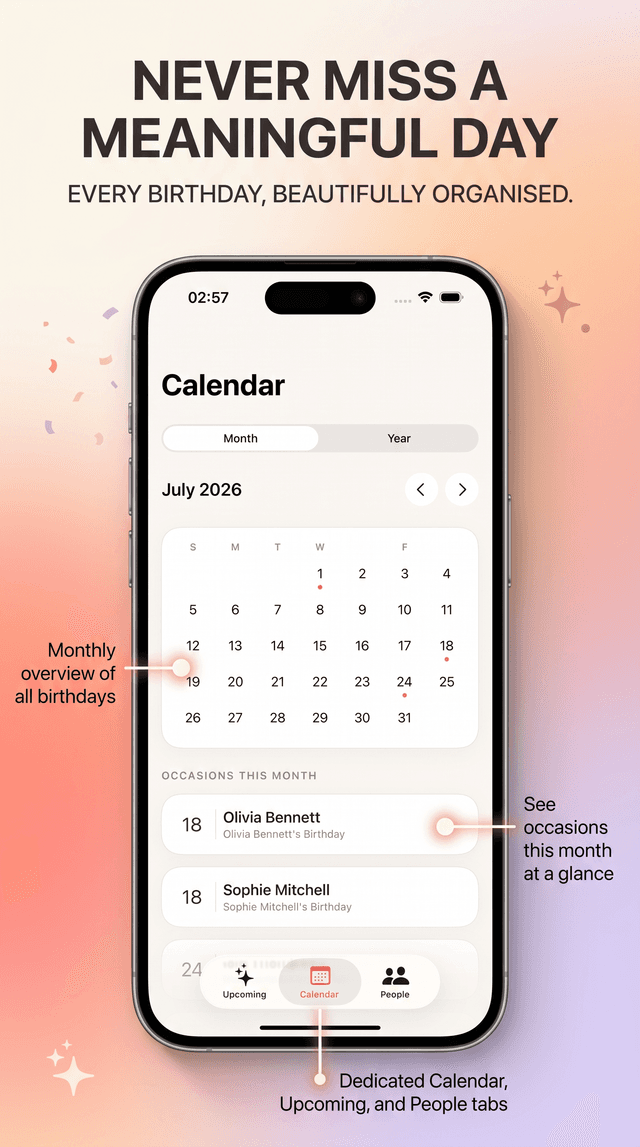
The Birthday Reminder app stores all data on-device with no account, optional iCloud backup, and no third-party analytics. Because it is an App Store app, it can be locked with Face ID and hidden from the Home Screen, protections that the built-in Contacts app does not support. Its notifications can also be controlled independently through iOS notification settings.
For help deciding when those reminders should fire, the birthday reminder timing guide covers lead times for messages, cards, gifts, and travel. For a complete workflow that organises birthdays into remember, prepare, and celebrate stages, see the simple birthday planning system. You can also browse all Birthday Reminder guides for more setup advice.
Frequently Asked Questions
Can I lock the built-in Contacts or Calendar app on iPhone?
Contacts cannot be locked or hidden. Apple lists it among the built-in apps that do not support locking. Calendar can be locked, but the Birthdays calendar inside it pulls data from Contacts, which remains accessible to anyone who can unlock the phone. If your birthday data lives in Contacts, it is visible to anyone who can unlock the phone and open the Contacts app.
Does locking an app also hide its notifications?
Yes. According to Apple's documentation, information inside a locked app will not appear in notification previews, search, Siri suggestions, or call history. Locking the app is sufficient to suppress its notification content on the Lock Screen.
What is the difference between locking and hiding an app?
Locking an app requires Face ID or a passcode to open it, but the icon remains visible on the Home Screen and notifications still arrive with previews suppressed. Hiding an app removes the icon from the Home Screen entirely and moves it to a Hidden folder in App Library, but hidden apps do not deliver notifications at all. Both can be applied to the same app, but hiding is rarely the right choice for a birthday reminder app because you lose all alerts.
Is Guided Access safe for children?
Guided Access is designed for situations like letting a child use your phone. It restricts the device to one app and can disable touch, buttons, and set time limits. Apple notes that Crash Detection and Emergency Services are not available during a session, so end the session if those features are needed.
Can someone see my birthday widgets on the Lock Screen?
Yes. Lock Screen widgets are visible to anyone who wakes the phone, regardless of whether the app is locked. Remove birthday widgets from the Lock Screen if the device is shared, and keep them only on Home Screen pages you control.
Our editorial policy describes how we research and verify these guides.