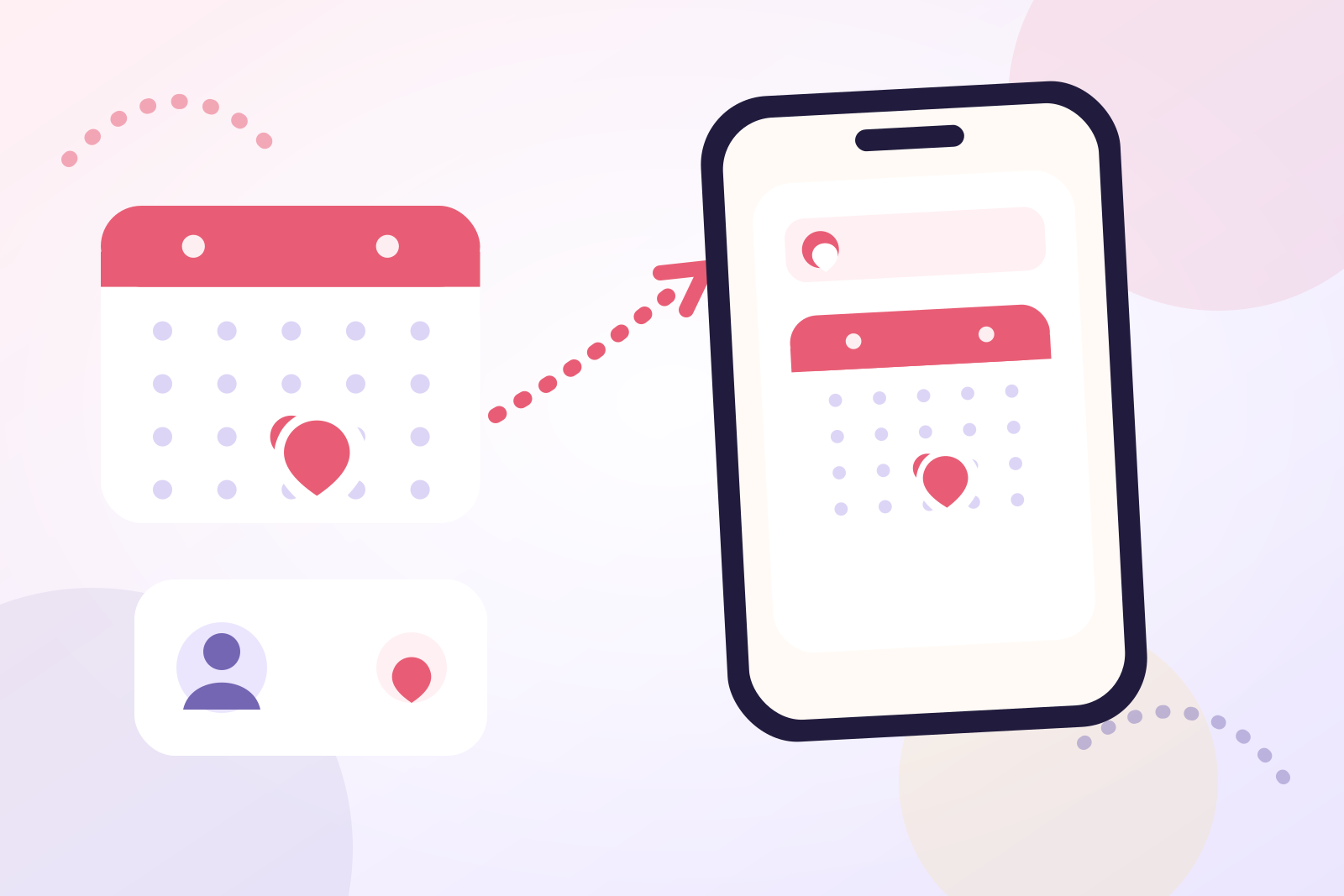
If you want to sync birthday reminders between iPhone and iPad, the built-in answer is iCloud. Birthdays live on your contact cards, iCloud keeps those contacts identical on both devices, and the Calendar app displays them through a special Birthdays calendar. Set it up once and a birthday added on your iPhone appears on your iPad on its own.
There is one honest caveat: a private birthday app that stores data on your device is a separate layer from iCloud sync, not a replacement for it. This guide covers both, so you can choose the setup that matches how you use each device.
How birthdays actually sync between iPhone and iPad
The sync chain has three links, and each one can break independently:
- The contact card holds the birthday. A birthday typed into a calendar event does not join this chain.
- iCloud Contacts copies contact cards between every device signed in to your Apple Account.
- The Birthdays calendar is generated automatically from those contacts and can be shown in the Calendar app on iPhone, iPad, Mac, and iCloud.com.
This explains the most common frustration: a birthday visible on one device but missing on the other. The date itself always travels through the contact card, so that is where setup begins.
Step 1: Save each birthday on the contact card
On either device:
- Open the Contacts app.
- Tap the person, then tap Edit.
- Add or update the birthday field.
- Tap Done.
Apple's iPhone user guide lists adding a birthday as a standard contact edit, and the same contact record is what the Birthdays calendar reads. If you do not know the birth year, record the month and day rather than guessing an age.
A practical tip: edit contacts on whichever device you use most. Once iCloud Contacts is on, the change reaches the other device without extra work.
Step 2: Turn on iCloud Contacts on both devices
According to Apple's iCloud setup guide, the requirement is simple: the same Apple Account on each device, with Contacts switched on.
On your iPhone, and then again on your iPad:
- Open Settings and tap your name at the top.
- Tap iCloud.
- Tap See All (or Show All).
- Turn on Contacts.
After this, the contacts shown in the Contacts app are stored in iCloud and stay up to date everywhere. If you skip this on the iPad, birthdays edited on the iPhone have no way to travel.
Be aware of one behavior: if you later turn Contacts off on a device, iCloud contacts are removed from that device. They remain in iCloud and on your other devices.
Step 3: Turn on iCloud Calendar and show the Birthdays calendar
Contacts carry the dates; Calendar displays them. Apple documents the following steps for iOS 17 and iPadOS 17 or later:
- Go to Settings, tap your name, then tap iCloud.
- Tap See All (or Show All), tap iCloud Calendar, then turn on "Use on this iPhone" or "Use on this iPad."
- Open the Calendar app and make sure Birthdays is selected:
- iPhone: tap Calendars at the bottom of the screen, then tick Birthdays.
- iPad: select Birthdays in the sidebar.
Do this on both devices. The Birthdays calendar is per-device visibility: hiding it on the iPad does not affect the iPhone, and vice versa.
One expectation to set correctly: Apple notes that the iCloud Birthdays calendar updates daily, so a birthday you add today may not appear in Calendar until tomorrow. This delay is normal, not a sync failure.
Step 4: Make iCloud the default account for new contacts
This step prevents the subtlest sync problem. If new contacts are saved to a third-party account, such as a work email account, or to "On My iPhone" storage, iCloud never sees them, so their birthdays never reach your iPad.
Apple's troubleshooting guidance for this:
- Go to Settings, tap Apps, then tap Contacts. (On iOS 17 or earlier, go straight to Settings, then Contacts.)
- Tap Default Account.
- Select iCloud.
Repeat on the iPad. From then on, every new person you add lands in the account that syncs.
If your birthday dates currently live in Facebook or another social feed rather than in contacts, migrate them first with the workflow in how to remember birthdays without social media, then return here for the sync setup.
Choose alerts that give you time to act
A synced date is only half the job. The other half is being alerted early enough to do something about it.
The built-in Birthdays calendar gives you basic annual visibility on both devices. That works for a same-day message, but it was not designed around preparation lead times such as ordering a gift two weeks ahead.
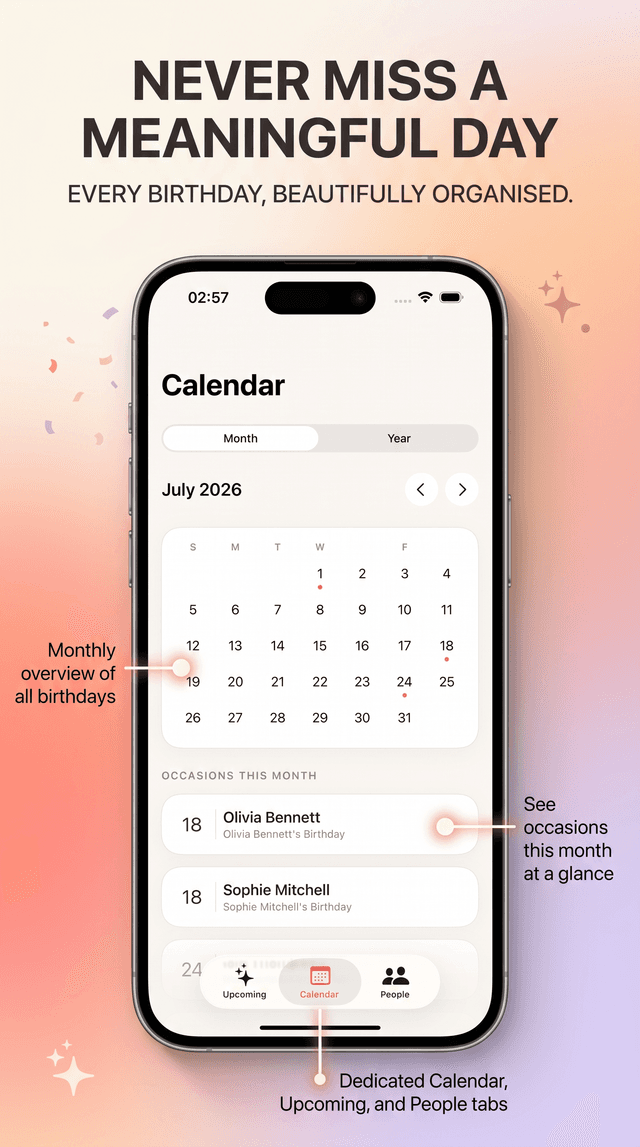
This is where a dedicated birthday app earns its place. Birthday Reminder: Tracker, for example, runs on both iPhone (iOS 17 or later) and iPad (iPadOS 17 or later), and its App Store listing describes per-occasion reminders with your choice of lead days and alert time, countdowns, a Home Screen widget, and notes for gift ideas. Our birthday reminder timing guide helps you choose sensible lead times, whether you use Apple's tools or a dedicated app.
Where a dedicated app fits across two devices
Here is the part most guides skip, and it matters for this exact search.
Birthday Reminder: Tracker is deliberately account-free. Its App Store privacy information states that what you add stays on your device and that the developer does not collect any data. Treat it as a private, on-device layer rather than a shared database: if you install it on two devices, do not assume the two copies stay in step on their own, and check the app's current version notes for its backup and export options before relying on it as your only copy.
So decide deliberately:
- Pick a primary device. Most people glance at their iPhone, so that is the natural home for the full birthday list, widgets, and per-person alerts.
- Use iCloud as the shared baseline. Let the built-in Contacts and Birthdays calendar carry the same dates to the iPad, so both devices still show what is coming.
- Avoid maintaining two app lists. Entering every birthday twice invites the two copies to drift apart. One app list plus one iCloud-synced contact set is far easier to keep accurate.
If you want the deeper organization layer, planning levels, and a monthly review routine on top of this setup, the three-stage birthday planning system covers it. The Birthday Reminder app page shows how countdowns, widgets, notes, and flexible alerts work alongside this setup.
Fix birthdays that are not syncing
If a birthday appears on one device but not the other, work through Apple's troubleshooting order before assuming something is broken:
- Confirm the same Apple Account. Check Settings on both devices. A family iPad signed in to a different account will never receive your contacts.
- Confirm both toggles. Contacts and iCloud Calendar must be on for each device under Settings > [your name] > iCloud.
- Refresh Contacts. Open Contacts and swipe down on the list.
- Refresh Calendar. Open Calendar, tap the Calendars tab, and swipe down.
- Check what is visible. In Contacts, tap Lists and make sure All iCloud is selected. In Calendar, make sure Birthdays is ticked.
- Check the default account. New contacts must default to iCloud, as described in step 4 above.
- Check date and time settings for your current location.
- Wait a day. The Birthdays calendar updates daily, so recent changes can legitimately lag.
- Restart the device if everything above looks correct.
This sequence resolves the large majority of "birthdays on iPhone but not iPad" reports, because the cause is almost always one toggle, one default account, or the daily refresh window.
Frequently asked questions
Why do birthdays show on my iPhone but not my iPad?
Usually one of three reasons: the iPad is signed in to a different Apple Account, Contacts or iCloud Calendar is turned off in the iPad's iCloud settings, or the Birthdays calendar is not ticked in the iPad's Calendar sidebar. Check those in that order.
Do I need an app to sync birthdays between iPhone and iPad?
No. iCloud Contacts and the built-in Birthdays calendar sync the dates for free. A dedicated app adds things the built-in route does not, such as per-person lead days, countdowns, widgets, and gift notes, as a private layer on top of that shared baseline.
How long does iCloud take to update birthdays?
Apple states the iCloud Birthdays calendar updates daily, so give a new or edited birthday until the next day before troubleshooting. Contact edits themselves move between devices much sooner; the daily delay applies to the calendar display.
Can I sync birthdays without iCloud?
You can keep contacts in another account, such as a Google account, and both devices will sync through that provider instead. The principle is identical: one account, both devices, birthdays on contact cards. Mixing accounts is what causes missing dates.
Does Birthday Reminder: Tracker sync between my devices?
The app is account-free by design and stores what you add on your device. For guaranteed cross-device visibility, keep birthdays on contact cards and let iCloud carry them, then use the app on the device you check most for richer alerts, countdowns, and widgets.
Sync is a one-time setup with a daily refresh rhythm. Get the contact cards right, point both devices at the same Apple Account, and your birthdays will follow you from iPhone to iPad without further effort. Browse the other Birthday Reminder guides for the timing, organization, and privacy routines that sit on top of this foundation.