To set a reliable birthday reminder for elderly parents, first decide what the reminder should help you do. A phone call needs little preparation. A posted card, visit, accessible outing, or family gathering needs more notice.
Confirm the date, keep it in one trusted record, and set two alerts with different jobs: one to prepare and one to follow through. Most importantly, ask your parent when and how they would like to be contacted. Age alone does not tell you what support or schedule someone needs.
Treat the reminder as a prompt to connect
The National Institute on Aging explains that older adults can face a greater risk of loneliness or social isolation because of changes in health, mobility, hearing, vision, memory, or social connections. Its guidance recommends scheduling regular contact through calls, messages, visits, letters, or cards.
A birthday provides one natural occasion for that contact. It is not a substitute for regular connection, and one call does not solve loneliness. The reminder simply helps you follow through on a date that matters.
That means the useful question is not only “When is the birthday?” It is also “What does my parent want to happen that day?”
Decide whose phone should hold the reminder
There are three common arrangements:
- You want to remember your parent's birthday. Put the alerts on your phone. Your parent does not need the same app or even a smartphone.
- Your parent wants a reminder for a family call or event. Help set it up on their phone only with their agreement, then let them control the notification.
- Several relatives are involved. Each person can keep an alert for their own action, while one message thread or shared note records who is doing what.
Do not take over a parent's device or schedule merely because they are older. If they manage their own calendar, ask what help they want. If a support person already manages appointments or visits, involve that person only when appropriate and with your parent's knowledge.
Set up the birthday on iPhone
Choose either Apple's built-in system or a dedicated birthday app. Avoid maintaining several independent copies unless you have a clear reason.
Option 1: Use Contacts and Calendar
Apple's automatic Birthdays calendar reads dates saved in contact cards:
- Open Contacts and select your parent.
- Tap Edit, add or correct the birthday, and tap Done.
- Open Calendar and tap Calendars.
- Select Birthdays so contact birthdays appear.
- Open Settings > Apps > Calendar > Default Alert Times > Birthdays and choose a timing.
- Check Settings > Notifications > Calendar and allow notifications.
Apple provides one shared default alert choice for birthdays from Contacts. That may be enough if you want the same notice for everyone. It does not create a separate early and same-day schedule for each parent.
Our full guide to adding birthdays to iPhone Calendar and enabling alerts covers visibility and notification troubleshooting.
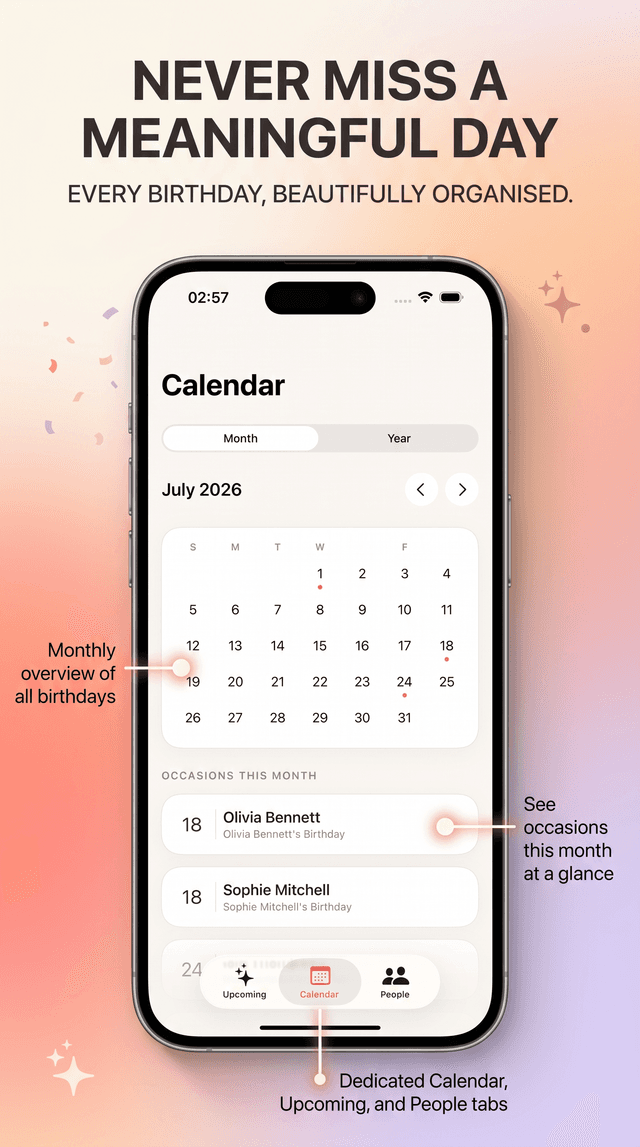
Option 2: Use Birthday Reminder
A dedicated app is useful when your mother, father, or another parent figure needs a different schedule from the rest of your birthday list.
In Birthday Reminder:
- Add the person manually or import their existing contact birthday.
- Open the birthday and turn on reminders.
- Choose the lead days you need, such as one week before, one day before, and the birthday morning.
- Add a short note only if it helps you act.
- Save the record and check the app's next-alert information.
Contact import saves you from retyping available details, but review the imported date before relying on it. Treat later corrections as something to verify rather than assuming every copy updates automatically.
For other built-in and app-based methods, see how to create two birthday alerts on iPhone.
Give the two alerts different jobs
Use the first alert for preparation and the second for contact. These ranges are starting points, not guarantees:
| Plan | Preparation alert | Birthday-day action |
|---|---|---|
| Phone or video call | 1 day before | Call during the time your parent prefers |
| Posted card | 7–10 days before | Call or message on the birthday |
| Gift or flower delivery | 7–14 days before | Confirm receipt without spoiling a surprise |
| Meal or local visit | 14–30 days before | Reconfirm the time and transport |
| Milestone gathering | 60 or more days before | Add intermediate booking and attendance checks |
Postal deadlines, travel, venue availability, and family circumstances may require more time. The broader birthday reminder timing guide explains how to adjust these ranges.
Ask about the final contact time instead of guessing. Some people enjoy an early call, while others prefer the afternoon or evening. If hearing, energy, appointments, or a support schedule affects the timing, let your parent or their agreed support person tell you what works.
Coordinate siblings without implying app sharing
Birthday Reminder is designed for a private organizer. Do not assume that everyone can collaboratively edit the same birthday record.
Instead, use a simple family handoff:
| Person | Action | Checkpoint |
|---|---|---|
| One sibling | Confirm the preferred plan with the parent | Two to four weeks before |
| Another relative | Post the card or arrange the gift | Before the delivery deadline |
| Call organizer | Confirm who is joining | A few days before |
| Visitor | Recheck time and transport | The day before |
AARP's guidance for sibling caregivers recommends assigned roles and periodic review as needs and availability change. That guidance addresses caregiving rather than birthday planning, but the narrow coordination principle applies: name the task and its owner instead of relying on a vague group intention.
Keep your parent involved. A coordinated surprise is not thoughtful if they dislike surprises, large groups, or being discussed without their input.
Add one respectful note
A useful note should remove one small decision. Examples include:
- “Prefers a call after lunch.”
- “Ask whether she wants lunch at home or the café.”
- “Confirm the current postal address before sending.”
- “Keep it quiet this year; no surprise gathering.”
- “Milestone next year; discuss plans before booking.”
Do not store diagnoses, medication details, care instructions, family conflict, or other sensitive information in a birthday record. Those details belong in an appropriate care plan, not beside a celebration reminder.
The guide to adding useful context to birthday reminders has more examples and privacy limits.
Adjust the iPhone only when your parent uses it
If your parent will read or act on a reminder on their own iPhone, ask whether the display is comfortable.
Apple's current paths are:
- Settings > Display & Brightness > Text Size to enlarge text.
- Settings > Display & Brightness > Bold Text to make text heavier.
- Settings > Display & Brightness > Display Zoom to magnify more of the interface.
- Settings > Accessibility > Display & Text Size for additional reading adjustments.
These settings are optional and affect the phone more broadly than one reminder. Change them with the phone's owner, not on their behalf. If the alerts are only on your phone, changing your parent's display settings serves no purpose.
Plan milestone birthdays without using age as a diagnosis
A milestone birthday may require earlier planning because more people, bookings, or travel are involved. Starting 60 days ahead is a practical prompt, not a universal rule.
Ask about the celebration before solving problems your parent may not have:
- Would they prefer a call, meal, visit, or gathering?
- Who do they want included?
- Is daytime or evening better?
- Are venue access or transport relevant?
- Who should make the final booking decision?
For larger plans, use the remember, prepare, and celebrate system, but keep the parent's preference at the center of each stage.
A setup checklist you can finish today
- Confirm the month and day without guessing the birth year.
- Decide whose phone should receive each alert.
- Save the birthday in one trusted record.
- Set a preparation alert and a birthday-day alert.
- Check notification permission.
- Ask your parent for their preferred contact time.
- Assign any family tasks by name.
- Review the setup after this year's birthday.
Frequently asked questions
Can Apple's Birthdays calendar send two alerts?
Apple provides one shared default alert setting for contact birthdays. For two notifications tied to one person, use a yearly Reminder with an early reminder, a suitable recurring Calendar event, or a birthday app that supports multiple lead days.
What if my parent does not use a smartphone?
Keep the reminders on your phone. The system is there to prompt your call, card, visit, or planning task. Your parent does not need to install anything.
Should every sibling use the same birthday app?
No. Assign actions in a shared note or message thread, then let each relative use the reminder tool they already trust. This avoids implying collaboration features that an app may not provide.
What if my parent receives daily support?
Ask your parent how they want the birthday handled. If timing must fit a residence, visitor, or support schedule, coordinate only the necessary logistics with the appropriate person. Keep medical and care information out of the birthday record.
What if I am unsure of the date?
Ask your parent or a close relative, or check a trusted family record. Mark the date as uncertain until it is confirmed. A visible gap is safer than a confident reminder on the wrong day.
A good birthday reminder respects both the date and the person. It gives you enough time to prepare, arrives when you can act, and supports the kind of contact your parent actually wants.
Visit the Birthday Reminder app page to see its flexible alerts, countdowns, notes, contact import, and private organization. You can also browse the other Birthday Reminder guides or read our editorial policy.