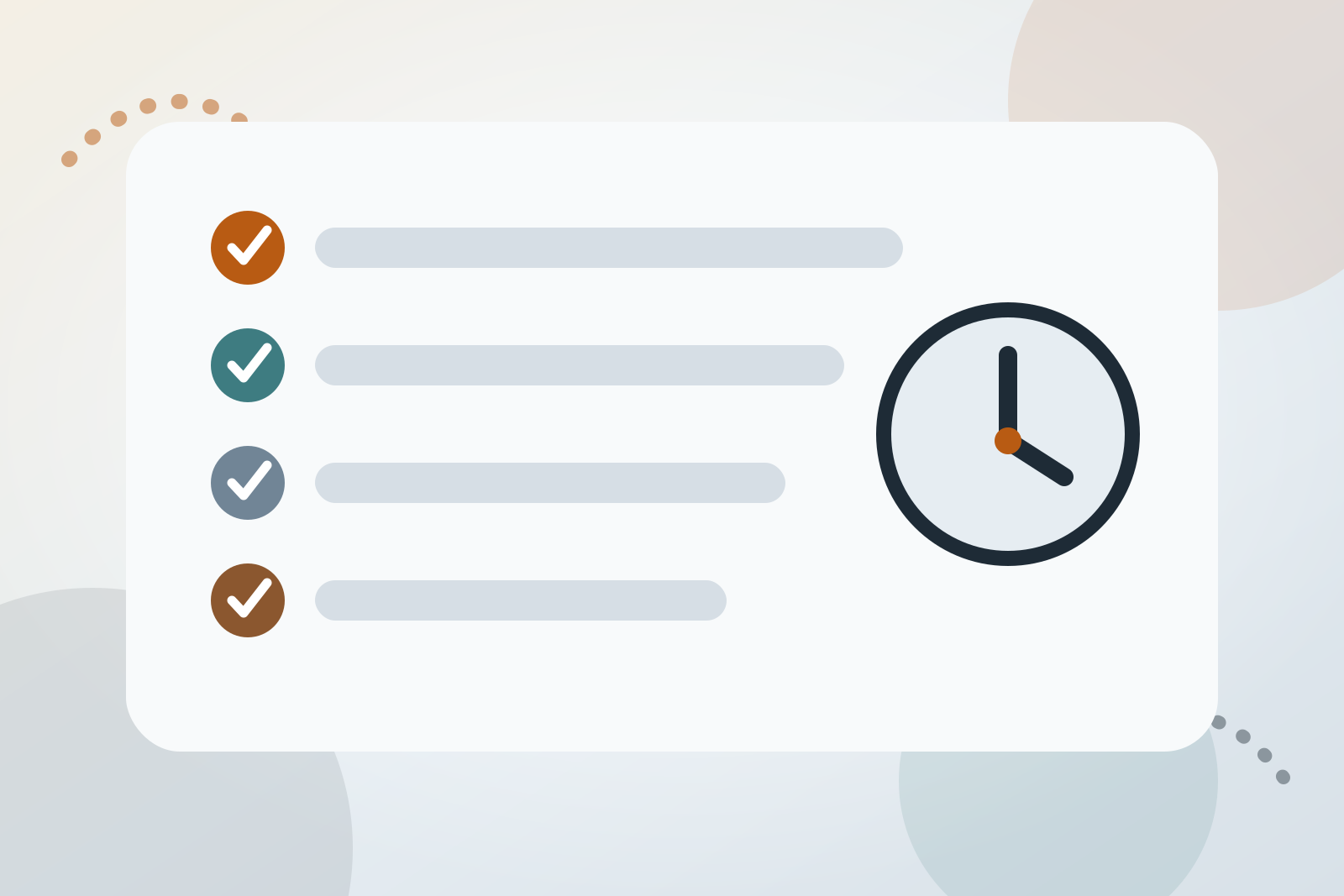
To stop scrolling in the morning, prepare the first ten minutes before you go to bed. Put the phone somewhere that interrupts an automatic reach, decide which necessary checks are allowed, and choose one small action to do after the alarm. Then name the checkpoint where you may open a feed, such as after getting dressed.
You do not need to promise yourself a perfect phone-free morning. You need a clear route from waking to the next ordinary part of your day.
Make the decisions before you wake
Sleep researchers use sleep inertia to describe the temporary grogginess, disorientation, and reduced cognitive performance that can follow waking. A review in Nature and Science of Sleep found that the largest effects commonly occur within the first 30 minutes, although the timing varies. It also found that subjective alertness does not always match objective performance.
That research mainly concerns alertness and safety-critical tasks. It does not show that sleep inertia causes scrolling, that checking a phone after waking is harmful, or that ten minutes is a clinical threshold.
The narrower practical point is that a groggy moment may not be the easiest time to make a careful decision about an open-ended feed. Preparing a simple route the night before removes that decision from the moment.
Choose where the phone sleeps
Start with the distance between your hand and the phone. You are not trying to make the device impossible to use. You are adding enough movement to notice what you are about to open.
Options include:
- charging it across the room, in the hallway, or outside the bedroom,
- using a separate alarm clock,
- putting it on a shelf that requires you to stand,
- keeping it face down so notifications are not the first thing you see,
- silencing non-essential alerts while allowing calls from chosen contacts,
- moving feed apps away from the first Home Screen.
NHS Every Mind Matters suggests putting a phone on silent, placing it face down, keeping clocks out of view, and maintaining similar sleep and waking times when possible. Its guidance is about sleep rather than morning scrolling, but several of those changes also reduce the number of overnight prompts waiting beside the pillow.
If the phone regularly follows you into bed, begin with the separate guide to stopping scrolling in bed at night.
Separate necessary checks from open feeds
A total morning phone ban may fail because phones also contain alarms, transport details, weather, messages, accessibility tools, and caregiving alerts.
Define what counts as necessary before you go to sleep. For example:
- turn off the alarm,
- check one message from a named person,
- confirm a train time,
- check the weather,
- respond to an on-call alert.
Give each allowed task an endpoint. “Read the message from Alex” ends. “Check messages” can expand. “Look up the 7:42 train” ends. “See what is happening” does not.
Then choose the first point where an open feed is allowed:
- after getting dressed,
- after breakfast,
- after leaving home,
- after the school run,
- after ten minutes on a visible clock.
This is a delay, not a moral rule. You can still make a deliberate choice to read news or social media once you reach the checkpoint.
Give the waking cue one replacement action
A British Journal of General Practice article describes habits as actions that become linked to repeated contextual cues. It recommends choosing a positive action rather than trying to form a habit of not doing something. It also notes that simpler actions tend to become automatic faster than elaborate routines.
Choose one action that fits the first minute after your alarm:
- stand and open the curtains,
- fill a glass of water,
- put the kettle on,
- step into the shower,
- feed a pet,
- put on clothes laid out the night before,
- write one sentence on paper.
The action does not need to improve your entire life. Its job is to occupy the point where the feed usually opens.
If boredom or empty time is the main cue, match the replacement to the gap the feed was filling.
Write one handover line
Put one sentence where you can see it before opening the phone:
When my alarm goes off, I will stand up, put the phone on the kitchen shelf, and fill the kettle. I can open a feed after I am dressed.
The sentence contains four useful parts:
- the cue,
- the physical move,
- the replacement action,
- the first-check point.
Keep the wording stable for several mornings. Adding a workout, meditation, journaling, breakfast preparation, and a full digital detox creates more places for the plan to break.
Adapt the plan to your real morning
Some phones cannot leave the room. You may be on call, use the device as an accessibility tool, care for someone, work shifts, or need to remain reachable overnight.
Keep the necessary function and change only the route into the feed. You might:
- allow calls from selected contacts,
- leave the phone on an accessible stand rather than in your hand,
- use a Focus mode that hides feed notifications,
- place necessary apps on the first screen and feeds elsewhere,
- use a spoken or vibrating alarm,
- make the checkpoint “after medication” or “after the first care task” rather than “after breakfast.”
A workable boundary is better than an idealized routine that ignores your responsibilities.
Review fourteen mornings without scoring yourself
Two weeks gives you two examples of each weekday. It is a practical review period, not a claim about how quickly behavior should change.
Record five brief facts each morning:
- when you woke,
- where the phone was,
- the first phone task,
- whether a feed opened before the checkpoint,
- what happened immediately before it.
A short entry is enough:
Thursday, 6:48am; phone on hallway shelf; checked weather; opened feed after dressing; about four minutes.
A difficult morning is equally useful:
Saturday, 7:20am; phone beside bed after changing the alarm; opened a message and then a feed; about 35 minutes.
After fourteen mornings, ask:
- Did phone location change the route?
- Which necessary check most often became a feed?
- Was the replacement action easy enough while tired?
- Did weekends, poor sleep, shifts, or caregiving change the pattern?
- What was different on mornings when you reached the checkpoint?
Change one condition for the next week. If the phone returned to the bed after a late alarm change, prepare the alarm earlier. If one message repeatedly led to a feed, move messaging and feed apps farther apart.
For automatic app-opening times, track the hours you scroll most with iPhone Shortcuts. An app opening is only a proxy for scrolling, so combine it with a short context note.
Hard Bit is an optional iPhone tracker for those notes. Entries remain on the device without an account or feed. Logging, the journal, counter, and hard-moment flow are free. A subscription adds the on-device forecast, warning, patterns, calendar, widgets, and short reads. The forecast makes no prediction below five entries and relies more fully on your history at around twenty. The Hard Bit overview explains the current boundaries.
Use paper if opening a tracking app would become another route into checking. Whichever method you choose, keep the record neutral rather than turning it into shame.
Notice when scrolling is doing a bigger job
Sometimes the feed postpones something painful: getting out of bed, facing work, managing anxiety, or starting a day that feels overwhelming. Moving the charger may interrupt the sequence, but it will not resolve the underlying problem.
Speak to a qualified health professional if poor sleep, low mood, anxiety, or dread is persistent or affecting daily life. If you are thinking about harming yourself, contact a local crisis service or someone who can stay with you. Call emergency services if you or anyone else is in immediate danger.
Our editorial policy explains how health and product information is reviewed. More practical articles are available in the Hard Bit guide library.
Frequently asked questions
Is ten minutes the right target?
Ten minutes is a practical frame, not a clinical threshold. Choose the first natural checkpoint in your morning. It might be three minutes on a workday and twenty minutes on a day off.
Do I have to stop using my phone as an alarm?
No. Put it where turning off the alarm requires one deliberate movement, then leave it there while you begin the replacement action. A separate alarm is optional.
What if I need to check an important message?
Define the person or message in advance and stop after that task. Necessary communication and an open feed do not have to share the same boundary.
How long will the new routine take to feel automatic?
There is no reliable fixed timeline for morning scrolling. The habit-formation research cited above found wide variation between people and behaviors. It also found that an occasional missed opportunity did not seriously disrupt the process. Look for gradual changes rather than a deadline.
Should I delete the feed apps?
You can. Deleting or signing out adds friction, but it does not decide what happens after the alarm. Pair removal with a small replacement action and a clear first-check point.