In a birthday calendar vs reminder app decision, choose the calendar when you mainly need an accurate annual date beside the rest of your schedule. Choose the reminder app when the date should trigger preparation, such as ordering a gift, arranging a call, or making a reservation.
The distinction is not simply passive calendar versus active notification. Digital calendars can send alerts too. What changes is where the birthday is stored, how much control you have for each person, and whether the system is organized around dates, tasks, or people.
This article compares system types rather than ranking individual products. For a direct product matchup, read Birthday Reminder app vs Apple Calendar. For ranked alternatives, see the birthday reminder apps for iPhone comparison.
Quick verdict
Use a birthday calendar if:
- Birthdays already live accurately in Contacts.
- You want them visible beside appointments and other events.
- Most people can use the same alert timing.
- You want the least additional setup.
Use a reminder app if:
- Different people need different amounts of notice.
- You want the alert to name the next action.
- Countdowns or a focused upcoming-birthdays view help you plan.
- You want notes or gift ideas attached to the occasion.
Do not maintain both by default. Two systems are worthwhile only when each has a clear job and you know which record must be corrected when a date changes.
What counts as a birthday calendar?
“Birthday calendar” can describe three different systems.
A contact-powered birthday calendar displays birthday fields stored in an address book. Apple’s special Birthdays calendar can display dates saved in iCloud Contacts. Google Calendar similarly syncs birthday information added to Google Contacts. In both cases, the contact record is central to the workflow.
A manually maintained digital calendar uses ordinary annual events. This requires more entry work, but it may provide event-level options that a special birthday layer does not. Apple documents one alert and a second alert for ordinary iCloud Calendar events, for example.
A paper calendar provides visibility but no notification. It works only when it remains somewhere you regularly look.
These systems should not be treated as identical. A contact-powered layer minimizes duplicate entry, while a manual event gives more control at the cost of maintaining another record.
What counts as a reminder app?
A reminder system can also take two forms.
A general task app treats the birthday action as a recurring task. Apple Reminders supports notes, dates, times, repetition, and an early reminder. Instead of recording only “Maya’s birthday,” you could create “Post Maya’s card,” repeat it annually, and schedule an early warning.
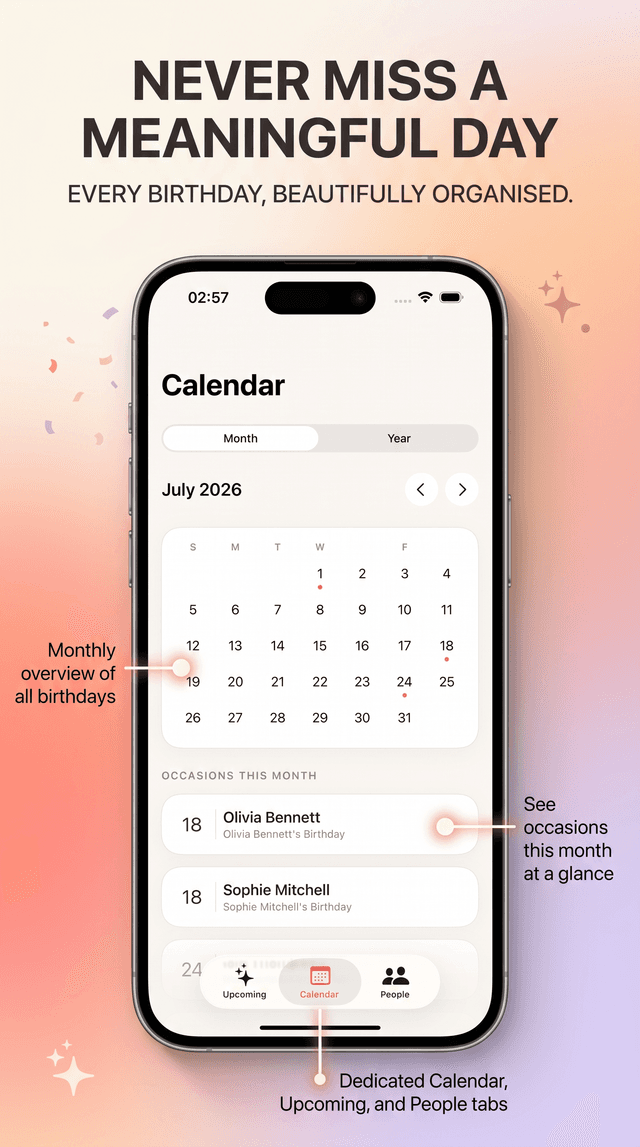
A dedicated birthday app keeps the person, occasion, countdown, reminders, and planning context together. The current Birthday Reminder: Tracker listing confirms per-occasion lead days and alert times, countdowns, notes, gift ideas, optional contact import, and a Home Screen widget without requiring an account.
The trade-off is maintenance. A general task or imported birthday record may remain separate from the original contact. Import should not be assumed to mean continuous synchronization unless the app explicitly promises it.
Where a calendar system works better
A contact-based calendar is usually the strongest minimalist choice.
It works well when you already maintain accurate contact cards and most birthdays require the same response, such as a message or short call. Apple provides a Default Alert Times > Birthdays setting for its Birthdays category, so the system can notify you without requiring you to open the calendar first.
A calendar is also useful for context. Seeing a birthday beside travel, work, school, or family commitments can reveal that the birthday falls on a busy day.
Choose this route when:
- One standard alert is genuinely sufficient.
- A month or agenda view is more useful than a countdown.
- You want edits to begin in Contacts.
- You do not need birthday-specific notes or preparation stages.
If you need setup instructions, use the separate guide to add birthdays to iPhone Calendar and get reminders.
Where a reminder app works better
A reminder-based system becomes valuable when a birthday creates work before the day itself.
One person may need a same-day message. Another may require two weeks for a personalized gift, while a milestone celebration may involve travel or a venue. A category-level birthday alert cannot express all three plans. Per-occasion timing can.
Action wording is another advantage. “Birthday in seven days” provides information. “Order the photo book today” tells you what to do.
Choose a reminder app when:
- Lead time varies by person or occasion.
- You want a countdown or focused upcoming list.
- Notes, gift ideas, or favourites reduce planning friction.
- Birthdays disappear inside a crowded general calendar.
- You want to import only selected contacts into a smaller active list.
The birthday reminder timing guide explains how to choose lead time from the intended action rather than the relationship label.
Side-by-side comparison
| Factor | Contact birthday calendar | Manual calendar event | Reminder app |
|---|---|---|---|
| Primary record | Contact card | Recurring calendar event | Recurring task or birthday record |
| Main view | Dates beside other events | Dates beside other events | Tasks, people, or upcoming countdowns |
| Alert control | May be shared across a birthday category | Can offer event-level alerts | Can offer task-level or occasion-level timing |
| Preparation context | Usually limited | Event notes may be available | Action notes are central to the workflow |
| Initial setup | Low when Contacts is accurate | One event per birthday | Manual entry or selected import |
| Ongoing risk | Incorrect contact data | Event and contact can disagree | Imported or manual records can drift from Contacts |
| Best use | Standard annual awareness | Calendar-based custom alerts | Different preparation plans |
The important comparison is not which column has the most features. It is which maintenance model you will continue using.
Choose according to what happens next
Ask what you normally do after learning that a birthday is approaching.
Send a message or make a short call: A contact-based calendar and standard alert may be enough.
Post a card or order a gift: Use a reminder with enough lead time and an action such as “confirm address” or “order by Friday.”
Plan a meal or group event: A reminder workflow is usually clearer because booking, invitations, and confirmation are separate tasks.
Review the month with your family: A calendar view may remain the most useful display, even if a reminder handles preparation for selected people.
Track a small inner circle: A dedicated birthday app can keep those people separate from a large address book or busy work calendar.
The simple birthday planning system provides a broader remember, prepare, and celebrate workflow without requiring a particular app.
Combine systems only with clear rules
A combined setup can work, but more records do not automatically create more reliability.
Use a hybrid only if you can define the roles clearly:
- Keep confirmed dates in Contacts as the reference record.
- Use the calendar for broad visibility.
- Add reminder records only for birthdays that require preparation.
- Let one system send the important alert to avoid notification noise.
- Check every separate copy when a birthday changes.
Birthday Reminder supports optional contact import, but its public listing does not promise that imported dates remain synchronized with Contacts. Treat the imported entry as a separate record unless current product documentation says otherwise.
For a controlled import workflow, read how to import birthdays from Contacts without creating clutter.
Test the system before moving every birthday
A ten-minute trial is more useful than comparing feature lists indefinitely:
- Add two birthdays with different preparation needs.
- Set the alerts you would actually use.
- Check notification permission in your phone settings.
- Add one practical note.
- Wait for or temporarily schedule a test notification.
- Confirm where corrections must be made.
- Decide whether the view is useful without opening several apps.
If the simpler system passes, keep it. If you can name a missing capability, test a reminder app specifically for that gap.
Disclosure: Daily Life Apps publishes Birthday Reminder. Product claims in this article were checked against its current App Store listing. Apple and Google claims were checked against their official support documentation. Our editorial policy explains how comparisons involving our apps are reviewed.
Frequently asked questions
Can a birthday calendar send notifications?
Yes, a digital calendar can send notifications when alerts and system permissions are configured. On iPhone, Apple provides one Default Alert Times choice for the special Birthdays category. Ordinary calendar events can have different alert controls.
Is a reminder app more accurate than a calendar?
No. Accuracy depends on the stored date. A synced contact birthday can be convenient, while a manually entered reminder can be equally accurate if it is maintained. Neither system can correct an unverified date automatically.
Can each Apple contact birthday have a different alert?
Apple’s documented automatic Birthdays workflow provides a category-level default alert setting. It does not document a separate schedule for each contact birthday. An ordinary recurring calendar event or reminder task is a different workflow and may provide more control.
Does importing birthdays keep them synchronized with Contacts?
Do not assume so. Import confirms that an app can copy selected information during setup. Continuous synchronization is a separate feature that should be stated explicitly by the app.
Should I use a calendar and reminder app together?
Only when they have separate roles. A sensible combination uses the calendar for visibility and reminders for selected preparation tasks. Otherwise, one maintained system is simpler and less likely to contain conflicting dates.
A birthday calendar works best for simple annual awareness. A reminder app works best when remembering the date is only the beginning of the plan.
Visit the Birthday Reminder app page to review its countdowns, per-occasion alerts, notes, and widget, or browse all Birthday Reminder guides for app-independent setup and planning advice.