Birthday countdown apps and widgets serve two related but different purposes. The app stores dates, calculates countdowns, and schedules reminders. The widget exposes a small part of that information outside the app.
The right choice depends on whether you want a decorative countdown to one event or a dependable way to remember several people. Compare the underlying app first, then verify each widget surface separately. A polished screenshot is not proof that the app supports the screen, reminder schedule, or privacy model you need.
Daily Life Apps publishes Birthday Reminder, one of the apps discussed below. We apply the same source checks to our own product claims, as explained in our editorial policy.
Choose the right type of countdown app
Start by identifying the job you need completed.
| Type | Best for | Main limitation |
|---|---|---|
| Single-event countdown | Counting down to your own birthday, a party, holiday, or trip | Often lacks a useful multi-person list |
| Birthday tracker | Remembering birthdays for family, friends, and colleagues | Requires an initial list and occasional maintenance |
| Calendar or contacts system | Basic annual date visibility | May offer less control over countdowns, notes, and preparation alerts |
| Dedicated planning app | Combining dates, countdowns, reminders, notes, and widgets | More features to assess before committing |
If you only want to see “18 days until my birthday,” a simple event countdown may be enough. If you want to remember other people throughout the year, prioritize an upcoming-birthdays list and individual reminder settings.
Our Birthday Reminder app versus Apple Calendar comparison covers the separate choice between a dedicated tracker and Apple’s built-in system.
Score each app out of 100
Use the same criteria for every option instead of comparing screenshots from memory:
- Multi-birthday usefulness, 20 points: Does it show several upcoming birthdays, names, dates, and ages clearly?
- Reminder control, 20 points: Can reminder lead days and alert times vary by person?
- Widget usefulness, 20 points: Which surfaces and sizes are actually supported, and what information appears on each?
- Notes and follow-through, 10 points: Can you save a gift idea, time zone, or intended action?
- Privacy and account model, 15 points: Is an account required? Is contact access optional? Where is information stored?
- Setup and reliability, 15 points: Can you add, edit, import, back up, or export records without unnecessary work?
A strong visual design still matters because you are more likely to keep a readable widget visible. It should not compensate for missing reminders or unclear data handling.
Check every widget surface separately
On iPhone, “supports widgets” is not a precise claim. Apple uses different widget families in different places:
| Surface | Relevant iPhone widget formats | Practical use |
|---|---|---|
| Home Screen | Small, medium, and large system widgets | A prominent countdown or short list of upcoming birthdays |
| Today View | Small, medium, and large system widgets | Similar information available with a swipe |
| Lock Screen | Circular, inline, and rectangular accessory widgets | One compact countdown, date, or short line |
| StandBy | Small system widgets | Enlarged glanceable information while the phone charges horizontally |
Lock Screen widgets have been available since iOS 16, but an app must provide an appropriate accessory widget. A Home Screen widget does not automatically prove that a Lock Screen version exists.
A small system widget can appear in StandBy, but you should still test the specific app. To start StandBy, Apple says to ensure it is enabled in Settings, connect the iPhone to a charger, place it stationary on its side, and press the side button.
When comparing apps, open the widget gallery and answer three questions:
- Does the app appear on the surface you want?
- Which sizes or formats does it offer there?
- Does the widget show useful information or merely open the app?
Prefer context over a large countdown number
A number such as “12 days” is ambiguous without a name or date. For a multi-person birthday system, a useful widget should ideally show:
- The person’s name.
- The number of days remaining.
- The birthday date.
- The next two or three people when space allows.
- An upcoming age only when a birth year is known.
Small and Lock Screen widgets have limited room, so showing one birthday can be a sensible design choice. Medium or large Home Screen widgets should use their additional space meaningfully rather than stretching the same number across a larger panel.
If you are rebuilding a list previously supplied by a social network, follow the guide to remembering birthdays without social media before evaluating widget design.
Expect periodic rather than continuous updates
Apple states that widgets refresh periodically and do not support continuous real-time updates. The system can also adjust update limits.
That is not a serious drawback for a birthday measured in days. It does mean a widget may not change the instant you edit a record. Check the developer’s support instructions before assuming the underlying birthday was lost. Birthday Reminder’s current support guidance recommends opening the app after making changes and, if necessary, removing and adding its widget again.
A countdown widget should remain accurate across day changes without requiring routine maintenance. Test that behavior during a trial rather than expecting a live-ticking clock.
Compare reminders separately from countdowns
A countdown tells you how long remains. A reminder tells you when to act.
Look for controls that answer these questions:
- Can each birthday use a different lead time?
- Can you choose the alert time?
- Is there a birthday-day alert as well as an early alert?
- Can you tell which notification permission is required?
- Does editing the birthday update its scheduled reminders?
Individual controls matter because a message may need no preparation, while a gift, booking, delivery, or trip may require days or weeks. The birthday reminder timing guide provides practical starting points for each type of action.
Avoid awarding extra points merely because an app sends many alerts. Two purposeful notifications are usually better than five identical countdown warnings.
Look for notes that lead to action
A countdown answers “when,” but useful planning also requires “what next.”
Helpful fields include:
- A gift or celebration idea.
- The person’s time zone.
- Their preferred contact method.
- A posting, booking, or ordering deadline.
- A short reminder of the gesture you intend to make.
These notes should remain optional. A birthday app does not need to become a detailed personal database. The simple birthday planning system explains how to turn one short note into a useful next action.
Also check whether favourites or groups can keep close relationships visible without deleting everyone else.
Read privacy details before importing contacts
Birthday records concern other people, so check the data model before importing an address book.
Ask:
- Does the app work without an account?
- Can birthdays be entered manually?
- Is contact access optional?
- Which contact fields does the app read?
- Is information stored on the device, synced, or sent to a server?
- Can records be deleted, backed up, or exported?
Apple explains that App Store privacy information is self-reported by the developer. App listings also state when those declarations have not been verified by Apple. Treat the label as useful disclosure, not an independent audit.
Read the linked privacy policy as well. It may explain behavior that cannot fit in the label, including local notifications, optional contact permissions, and device storage.
What Birthday Reminder currently confirms
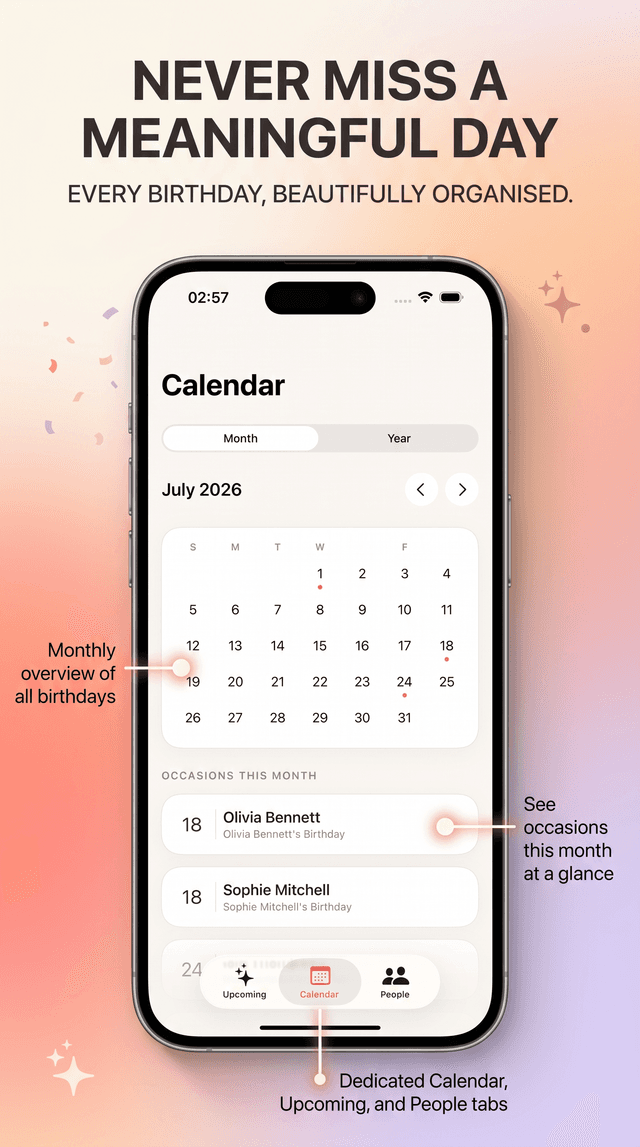
As of August 8, 2026, Birthday Reminder’s App Store listing confirms:
- Birthday and special-occasion countdowns.
- An organized upcoming view.
- Per-occasion reminder lead days and alert times.
- Notes, gift ideas, and favourites.
- Optional contact import.
- Automatic upcoming-age calculation.
- A Home Screen widget.
- No required account.
- A developer-declared “Data Not Collected” label.
The linked privacy policy states that added information stays on the device, contact access is optional, and reminders use local notifications.
Daily Life Apps’ product page advertises both Home and Lock Screen widgets, while the App Store description explicitly names only the Home Screen widget. Neither page promises StandBy support. If Lock Screen or StandBy placement is essential, confirm that the desired format appears in your iPhone’s widget gallery before choosing the app on that basis.
Visit the Birthday Reminder app page for its current features and App Store link.
Run a two-birthday test before importing
A short trial exposes more than a feature list:
- Add two birthdays manually, one with a birth year and one without.
- Set different reminder lead times for them.
- Add a useful note to one record.
- Find the app in the Home Screen widget gallery.
- Check the Lock Screen and StandBy surfaces separately if you need them.
- Edit one birthday and verify that the app and widget reflect the change.
- Confirm notification permissions and wait for a test alert if possible.
- Read the privacy policy before granting contact access.
- Import additional records only after the workflow passes.
This test reveals whether the app is a good birthday system, not merely whether its promotional countdown looks attractive.
Frequently asked questions
What is the best widget size for upcoming birthdays?
A medium or large Home Screen widget usually has enough room for several names and countdowns. A small or Lock Screen widget is better for showing only the nearest birthday.
Can a Home Screen birthday widget also appear on the Lock Screen?
Not necessarily. The Lock Screen uses accessory widget formats that an app must support separately. Check the Lock Screen widget gallery rather than relying on a general “widgets included” claim.
Will a small birthday widget work in StandBy?
Apple supports small system widgets in StandBy, but you should verify the specific app and layout. StandBy presentation can differ from the Home Screen appearance.
Why does a birthday widget not update instantly?
Widgets refresh according to schedules managed by iOS rather than continuously. Follow the app developer’s troubleshooting guidance if an edited record remains stale.
Do birthday countdown apps need contact access?
No. A well-designed app can allow manual entry and request contact access only for optional importing. Check which fields it reads before granting permission.
Is a “Data Not Collected” label independently verified?
No. Apple says App Store privacy information is self-reported by developers. Read the developer’s privacy policy and account requirements as well.
The best birthday countdown app is not necessarily the one with the biggest number or brightest design. Choose the app that tracks the right people, gives you enough time to act, explains its data handling, and provides a widget that remains useful on your preferred screen.
For ranked alternatives, read the birthday reminder apps for iPhone comparison, or browse all Birthday Reminder guides.