In a birthday list spreadsheet vs reminder app decision, choose the spreadsheet when the list itself is the priority. Choose the app when being alerted at the right time is the priority.
A spreadsheet is better for custom fields, bulk editing, printing, and keeping a portable copy. A dedicated reminder app is better for notifications, individual lead times, countdowns, and a focused view of what is coming next.
The key question is not which tool can hold a date. Both can. It is whether you will remember to check the list or need the list to reach you first.
Quick verdict
Use a birthday list spreadsheet if:
- You want complete control over columns and categories.
- You regularly work in the spreadsheet already.
- You need to sort, print, share, or edit many records at once.
- The file is primarily a reference list or backup.
- You are willing to maintain a separate calendar or automation for alerts.
Use a dedicated reminder app if:
- Missing an alert is the problem you are trying to solve.
- Different people need different amounts of notice.
- You want countdowns or an upcoming-birthdays widget.
- Notes and gift ideas should stay beside each occasion.
- You do not want to build and maintain formulas or scripts.
A digital calendar sits between the two. It can send event notifications without offering the custom table of a spreadsheet or the focused planning features of a birthday app. The broader birthday calendar vs reminder app comparison covers that choice separately.
What a birthday spreadsheet does well
A spreadsheet gives you an adaptable record. Useful columns might include:
- Name and birthday.
- Relationship or group.
- Preferred way to celebrate.
- Gift idea.
- Time zone.
- Date last confirmed.
- Reminder lead time.
- A simple planning status.
You can filter for one month, sort by the next birthday, print a household copy, or make a separate view for family members. Bulk corrections are also easier than opening dozens of individual records.
A spreadsheet can calculate days between dates. Microsoft documents that Excel’s DATEDIF function returns days, months, or years between a supplied start date and end date. However, an annual birthday countdown requires additional logic to construct the birthday’s next occurrence. DATEDIF alone does not automatically turn an old birth date into next year’s birthday.
That calculation still produces only a cell value. It does not create a phone alert.
Why spreadsheet notifications need care
A spreadsheet can be turned into a reminder system, but the notification layer is separate from the birthday list.
Google Sheets offers conditional notifications for certain work or school accounts. Those rules send email when a cell value changes in a selected range or column. They are not a calendar scheduler that simply fires because a date has arrived.
Google also warns that volatile functions such as TODAY() may miss changes that occur while the spreadsheet is closed. That matters when a countdown or status column depends on the current date. Email delivery may not be immediate, either.
Three spreadsheet workflows are realistic:
- Check it manually. Open the file on a fixed weekly or monthly schedule.
- Copy birthdays into a calendar. Let the calendar send alerts, while accepting that you now maintain two records.
- Build scheduled automation. Use a script or integration that checks dates and sends messages, then maintain it when permissions or formulas change.
A spreadsheet is therefore capable of supporting alerts, but reliable alerts are not a default consequence of adding a date formula.
What a dedicated reminder app adds
A dedicated app makes the occasion and its notification part of the same record.
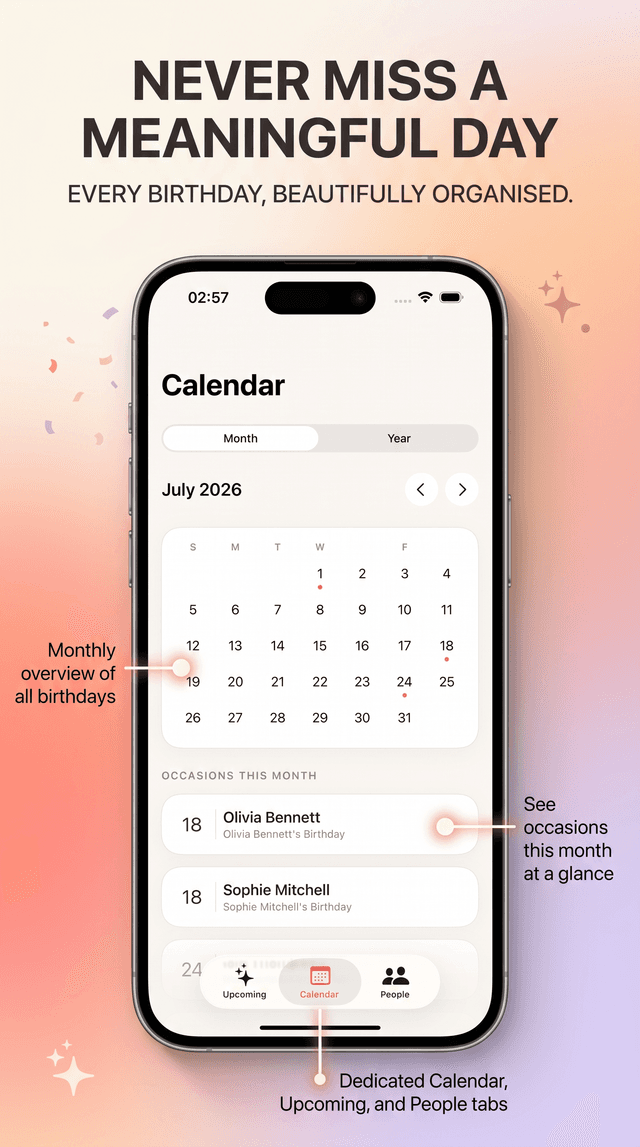
The current App Store listing for Birthday Reminder: Tracker confirms:
- Lead days and alert time customizable for each occasion.
- Countdowns for upcoming birthdays and other occasions.
- Optional birthday import from Contacts.
- Personal notes and gift ideas.
- Favourites.
- A Home Screen widget.
- No required account.
This arrangement reduces setup when one birthday needs a same-day message and another needs two weeks for a gift or reservation. The birthday reminder timing guide explains how to choose those lead times from the intended action.
The trade-off is less structural freedom. You cannot invent arbitrary columns as you can in a spreadsheet, and bulk editing or printing depends on what the chosen app supports.
Spreadsheet vs reminder app, side by side
| Capability | Birthday list spreadsheet | Dedicated reminder app |
|---|---|---|
| Custom fields | Add as many columns as needed | Limited to supported fields |
| Bulk editing | Strong | Usually record by record |
| Birthday countdown | Requires date logic and recalculation | Built into the birthday workflow |
| Phone notification | Requires another tool or automation | Built in when enabled |
| Different lead time per person | Possible through separate setup | Designed for per-occasion settings |
| Notes and gift ideas | Fully customizable columns | Kept beside the occasion when supported |
| Contact import | Usually requires an export or manual transfer | May support direct import |
| Printing and offline copies | Straightforward | Depends on export options |
| Focused widget | Not a normal spreadsheet feature | Available in Birthday Reminder |
| Maintenance risk | Formulas, duplicate records, forgotten checks | Notification permissions and separate imported records |
The best tool is the one whose maintenance burden matches your habits.
Which system fits your actual routine?
Choose the spreadsheet if you can name when you will open it. “I review it on the first Sunday of each month” is a system. “I will remember to check it” is not.
Choose the app if you need an interruption at a useful time. The alert should arrive early enough for the action, not merely announce the date after preparation is no longer possible.
Consider three examples:
- A club administrator managing 150 birthdays: A spreadsheet is useful for filtering, shared updates, and custom membership fields.
- Someone tracking 15 close relationships: A dedicated app is easier when each birthday needs a reliable alert and a short personal note.
- A household that wants both: Keep the spreadsheet as the reference copy, but designate one app or calendar as the only source of active notifications.
If the birthday dates currently live in social profiles and message threads, first use the guide to remembering birthdays without social media.
How to use both without creating duplicates
A hybrid system works only when each tool has a defined role.
- Clean the spreadsheet and mark uncertain dates before importing anything.
- Treat the spreadsheet as the reference or backup.
- Add only the people who need active alerts to the reminder app.
- Decide which system sends notifications so you do not receive duplicates.
- When a date changes, update every separate copy.
- Review the two lists after the first month, then on a regular schedule.
Import should not be assumed to create continuous synchronization. Birthday Reminder’s listing confirms contact import, but it does not promise that later changes in Contacts automatically update imported records.
The simple birthday planning system provides a useful remember, prepare, and celebrate workflow regardless of where the backup list lives.
Privacy and portability
A spreadsheet is not automatically private. Privacy depends on where it is stored, who can access the file, and whether a shared link exposes names, dates, or notes. Use the narrowest sharing permissions possible and avoid storing sensitive details that do not help with birthday planning.
Birthday Reminder says no account is required and that birthday information stays on the device. Its App Store privacy section displays “Data Not Collected,” based on the developer’s disclosure. Apple states that this disclosure has not been verified by Apple.
Daily Life Apps publishes Birthday Reminder. Product claims in this comparison were checked against its current public listing, while spreadsheet and calendar claims were checked against official Google, Microsoft, and Apple documentation. Our editorial policy explains how comparisons involving our apps are reviewed.
Frequently asked questions
Can Google Sheets notify me before a birthday?
Not through a simple date formula alone. Conditional notifications send email when qualifying cell values change, are available only to certain work or school accounts, and may miss TODAY()-based changes while the document is closed. A calendar or scheduled script is more suitable for date-driven alerts.
Is Excel DATEDIF enough for a birthday countdown?
No. DATEDIF calculates the difference between two supplied dates. A recurring birthday tracker must first determine the next occurrence of the birthday, account for whether this year’s date has passed, and then calculate the remaining time. The resulting cell still does not send an alert.
Is a calendar better than both options?
It can be. Apple’s iCloud Calendar can display birthdays saved in iCloud Contacts, while Google Calendar supports event notifications by phone, browser, or email. A calendar is a strong middle option when you need alerts but not custom spreadsheet fields or birthday-specific planning tools.
Should I delete my spreadsheet after moving to an app?
Not immediately. Keep the cleaned file as a backup while testing notifications and checking imported dates. Afterward, decide whether the backup has a clear purpose and how often it will be updated.
Does Birthday Reminder require an account?
No. Its current App Store listing says no account is required. Contact access is optional and used when you choose to import birthdays.
A spreadsheet is strongest as a flexible record. A dedicated app is strongest as an active reminder. Choose according to the task you are most likely to neglect.
Visit the Birthday Reminder app page to review its current countdown, reminder, note, and widget features, or browse all Birthday Reminder guides for app-independent planning advice.