A paper birthday calendar is a wall chart, usually undated, with a line under each day where you write names once and reuse the chart every year. A birthday reminder app stores the same dates on your phone and adds what paper cannot do: countdowns, per-person alert schedules, and notifications that arrive whether or not you thought to check. Paper wins on visibility and simplicity; an app wins on timing, because it reminds you before the birthday instead of waiting for you to notice it. Many households end up using both, with the app as the accurate source and the wall chart as the shared glanceable copy.
This comparison covers how each system works day to day, where each one fails, and how to decide between them. If you are starting from a social feed rather than a paper chart, the guide to remembering birthdays without social media covers that migration instead.
How each system actually works
A perpetual birthday calendar is deliberately simple. Manufacturers such as Good Tuesday sell them as undated wall planners with writable lines under each day, meant to be filled in once and reused year after year (product page checked 2026-08-28). You hang it where the household passes by, write "Mum – 14 May" on the line, and the record stays put until a name changes. Nothing updates, nothing notifies, and nothing needs charging.
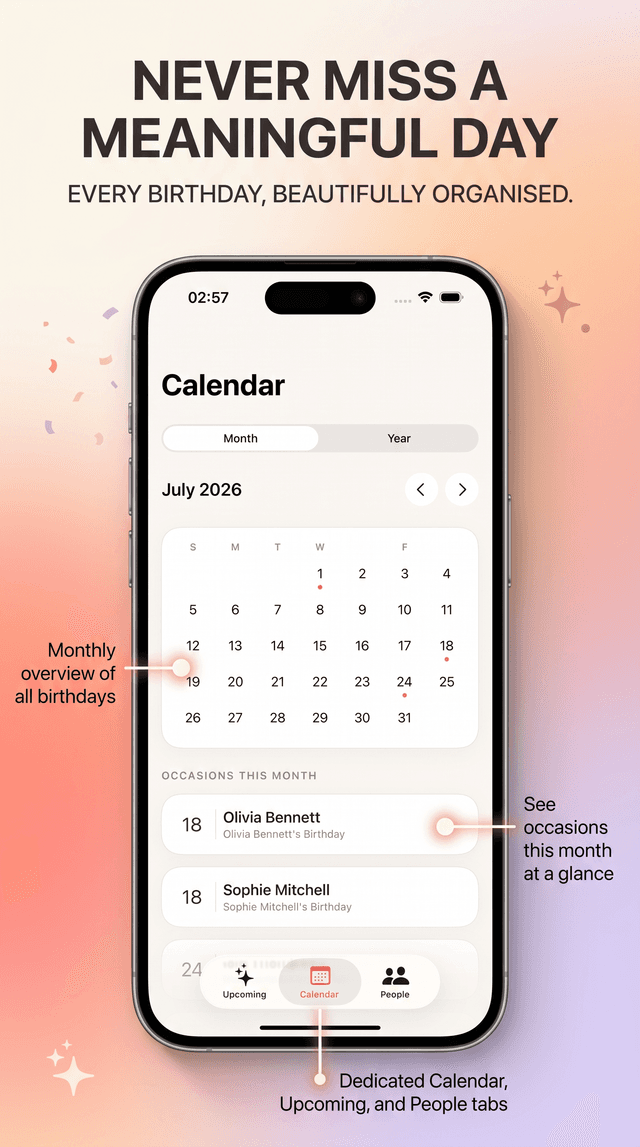
A birthday reminder app replaces the chart with a private list on your phone. Each person becomes a record with a date, a countdown, and a reminder schedule. The Birthday Reminder: Tracker app, for example, tracks birthdays with countdowns, lets you customize reminders for each occasion with your chosen lead days and alert time, supports notes and gift ideas, and offers a Home Screen widget (App Store listing checked 2026-08-28). No account is required, and the data stays on the device.
The storage problem is solved equally well by both. What separates them is delivery: how the date reaches you at the moment it matters.
Where a paper birthday calendar wins
Paper has real advantages that apps have never replicated:
- Household visibility. Everyone in the house sees the same chart. There is no syncing, sharing, or family subscription to arrange.
- Zero learning curve. A pen is the entire interface. No import, no permissions, no notification settings.
- No screen required. The chart works during device-free dinners, power cuts, and for family members who avoid smartphones.
- One-time effort. Write the names once a decade, not once per device upgrade.
If your current system is a wall chart that everyone in the house actually reads, you have already solved the visibility problem that most apps struggle with.
Where a birthday reminder app wins
The app's advantage is not organisation; it is timing. A chart shows you the whole year only when you stand in front of it. An app can change what happens in the weeks before a birthday:
- Alerts that find you. A notification arrives on the day and, more importantly, days or weeks earlier, wherever you are. Paper cannot do this under any circumstances.
- Per-person lead times. A message to a friend and a posted gift to another country need very different warning periods. A dedicated app lets you set a different lead time for each person; the birthday reminder timing guide explains how to choose them.
- Countdowns. Seeing "12 days" on a Home Screen widget creates useful pressure that a static annual grid does not.
- Context beside the date. Gift ideas, time zones, and celebration preferences live with the person, not on a crowded line shared with three other names.
- Privacy. A phone-based list is not visible to visitors, which matters to some households, though it also means family members cannot see it without being shown.
One honest limitation of the built-in option: on iPhone, birthday alerts are governed by a single Default Alert Times setting in Calendar, so every birthday gets the same default warning rather than a flexible per-person schedule (Apple Support, checked 2026-08-28). Birthdays come from contact records you edit in Contacts. That is workable for same-day messages, but flexible preparation schedules for cards, orders, and travel are where a dedicated app earns its setup time. For the full digital-calendar-versus-app breakdown, including Google Calendar and manual events, read Birthday Calendar vs Reminder App.
The failure modes are opposite
This is the most useful way to compare the two, because each system fails in the opposite direction.
Paper fails silently. The chart is only as good as the habit of looking at it. Miss the glance during a busy month and a correctly recorded birthday still passes unmarked. The failure is invisible: nothing is broken, you simply did not look. This is why wall charts so often have one cluster of filled-in months and several untouched ones.
An app fails loudly or not at all. If the list is set up, alerts fire even when you are distracted. The failure modes are different in kind: notifications turned off, a phone left behind, or a list that was never finished in the first place. Setup effort is front-loaded, but after that the system pushes toward you instead of waiting to be consulted.
Match the failure mode to your own history. If you have missed dates that were correctly written on the wall, the problem is delivery, and no amount of tidier handwriting will fix it. If you have never once stood in your hallway and failed to check the chart, paper may be serving you fine.
Side-by-side comparison
| Factor | Paper birthday calendar | Birthday reminder app |
|---|---|---|
| Alert before the date | None; you must look | Yes, with per-person lead days and alert times |
| Household visibility | Excellent, shared by default | Private to one device unless shown |
| Setup effort | Minutes with a pen | Moderate initial setup, then passive |
| Yearly maintenance | None beyond edits | None; recurring by design |
| Countdowns | No | Yes, including widgets |
| Notes and gift ideas | A short line shared per day | Attached to each person |
| Works without a phone | Yes | No |
| Survives a lost item | Rebuy the chart; rewrite names | Restored with the phone's backup |
| Portability | Fixed to one wall | In your pocket everywhere |
Neither column is dominant. The right question is which failure mode you can live with.
When paper is genuinely the better choice
Choose or keep a paper calendar when:
- The whole household relies on seeing the same chart, including children or relatives who do not use smartphones.
- Your birthdays mostly need same-day messages and calls, which you reliably remember once reminded by a glance.
- You want a ritual, not a system. Some people value the annual re-reading of the chart.
- Your list is small and stable, changing only every few years.
Paper is not a lesser option; it is a different contract. It assumes someone will look.
When an app is the better choice
Choose an app when:
- You have missed birthdays that were correctly written down. That is a delivery failure, and only an alert fixes it.
- Your gestures require preparation: posted cards, online orders, bookings, international delivery, or milestone events.
- Birthdays are scattered across family members and you want one private list instead of memory and guesswork.
- You travel or work variable hours, so a wall chart in one building cannot reach you.
- You want gift ideas and time zones recorded beside each person instead of in your head.
If you take the app route, the three-stage birthday planning system shows how to move each birthday from a remembered date to a completed gesture.
Using both without duplicating work
A hybrid setup gives you the strengths of each, with one rule that keeps it maintainable: choose a single source of truth for edits.
- Keep the wall chart for shared visibility. The household can read it any time.
- Make the app the master copy. Every new date, correction, and note goes into the app first.
- Once or twice a year, redraw the chart from the app. Ten minutes with a pen catches corrections in both directions.
- Let the app handle all timing. The chart shows the month ahead; the alerts drive the action.
What you must avoid is editing both. Two writable copies always drift apart, and you will eventually trust the wrong one. If you also keep dates in phone contacts or a digital calendar, decide which system owns the record and treat the rest as read-only mirrors.
Moving from paper to an app in one sitting
The migration is short, because a wall chart is already a curated list:
- Photograph the chart so nothing is lost mid-transfer.
- Enter each name and date into the app, correcting anything you know has changed.
- Set an early reminder for anyone who needs more than a same-day message, and a birthday-day alert for everyone.
- Add one note where context helps: a time zone, a gift idea, or a milestone year.
- Keep the chart on the wall as the household's read-only copy, and redraw it once a year from the app.
Ten to twenty names is a thirty-minute job. The discipline of entering each date yourself is also a feature: it forces the date-checking step that automatic imports tend to skip.
A note on this comparison
Daily Life Apps publishes Birthday Reminder: Tracker, the iPhone app referenced in this article, so treat our view of apps with that in mind. We have tried to give paper its due and to state Apple's built-in Calendar accurately rather than strawmanning the free option. Our editorial policy explains how we research and review, and every product claim in this article was checked against a primary source on 2026-08-28.
Frequently asked questions
Can a paper birthday calendar send alerts?
No. A paper calendar is a static record; it cannot notify you at any time, let alone days in advance. Everything about its usefulness depends on someone choosing to look at it. If you want warnings that find you, that requires a digital reminder, whether in a calendar app or a dedicated birthday app.
Is the iPhone's built-in Calendar enough instead of a dedicated app?
For same-day awareness, often yes. Apple's Calendar can show birthdays from your contacts and alert you using a default alert time for all birthdays. Its limits appear when you want different lead times per person, countdowns, birthday-specific notes, or a Home Screen widget showing upcoming dates. If your needs stay at "tell me on the morning," the built-in tools are a reasonable free starting point.
Which is better for a shared family birthday list?
A wall chart is the better shared display, because every household member sees it without any setup. But it cannot coordinate preparation. A common combination is an app as the accurate, editable source that sends the alerts, with the paper chart redrawn from it once a year so the family still has a glanceable copy.
How long does it take to move my paper list into an app?
For a typical chart of 10 to 30 names, around half an hour, including setting reminder schedules. Photograph the chart first so you can verify nothing was skipped, and correct any dates you already suspect are wrong rather than copying them faithfully.
Do I have to throw the paper calendar away if I get an app?
No, and you probably should not. The chart retains its value as the household's shared display. Just make it read-only: all edits happen in the app, and the wall copy gets refreshed from the app rather than written over independently.
A paper calendar and a reminder app are answering the same question with different tools: one trusts your eyes, the other trusts an alert. If your eyes have been letting you down in busy months, the app is the upgrade that matters. If they have not, the wall chart you already maintain may be all you need.
You can compare features directly on the Birthday Reminder app page, or browse the other Birthday Reminder guides for building the habit around whichever system you choose.