
The safest birthday wishes after an argument are short, sincere, and free of blame. Say happy birthday in words you would normally use, add one honest sentence if it helps, and stop before the greeting becomes another round of the dispute.
You do not have to pretend everything is fine. You also do not have to resolve the argument on their birthday. The message only needs to acknowledge the person without demanding forgiveness, agreement, or a reply.
Decide whether sending a message is appropriate
A brief greeting usually makes sense when contact is still welcome and you want to acknowledge the birthday despite unresolved tension.
Do not send one if the person has clearly asked you not to contact them, has blocked you, or would experience the message as unwanted. Do not use another number, account, friend, gift delivery, or public post to bypass that boundary. If the conflict involved threats, abuse, or a safety concern, prioritize safety rather than treating the birthday as an opening.
When contact is appropriate, ask three questions:
- How raw is the argument? A disagreement this morning calls for less warmth than one you have both had time to consider.
- Do I owe a clear apology? If so, one direct sentence may fit, but the birthday greeting should not become the only apology.
- What tone would sound true aloud? If the message works only because text hides your discomfort, simplify it.
The aim is not maximum warmth. It is honest warmth.
Use a three-part message
A reliable structure has three parts:
- Direct greeting: Say happy birthday plainly.
- Optional honest sentence: Acknowledge the tension, take responsibility, or add one genuine detail.
- Low-pressure close: Wish them something modest without requesting a response.
For example:
Happy birthday, [Name]. I know things are strained, but I wanted to acknowledge your day. I hope it is a peaceful one.
Choose the appropriate level of warmth:
| Where things stand | Suitable approach |
|---|---|
| Contact is civil but distant | A direct greeting and simple wish |
| You both care but remain upset | Briefly acknowledge that both things are true |
| You owe an apology | Take responsibility without adding an excuse |
| They need space | Keep it short and explicitly remove pressure to reply |
Avoid placing “but” immediately after an apology. “I am sorry, but you also…” cancels the accountability and restarts the argument.
Birthday messages by tone
Use these as starting points. Change the wording to match how you actually speak.
Neutral and respectful
- “Happy birthday, [Name]. I hope you have a good day.”
- “Wishing you a peaceful birthday and a good year ahead.”
- “Happy birthday. I wanted to make sure I acknowledged the day.”
- “Happy birthday, [Name]. I hope today gives you some time to enjoy yourself.”
A neutral message is not necessarily cold. It may be the most respectful option when warmth would feel false.
Warm but honest
- “Happy birthday. Things are still unsettled between us, but I care about you and hope today is kind to you.”
- “We may not be okay yet, but I did not want your birthday to pass without telling you that you matter to me.”
- “Happy birthday. I know this is not our easiest week, and I still genuinely hope you have a lovely day.”
- “Happy birthday. I am not trying to solve everything in this message. I just want to wish you a good day.”
Brief and vulnerable
- “Happy birthday. I am still upset, and I still care. Both are true.”
- “I do not have the right words for everything yet, but I do mean this: happy birthday.”
- “Happy birthday. I wish things felt easier between us today, and I hope the day itself is gentle.”
- “I know we still need to talk. For now, I simply hope you have a good birthday.”
Birthday wishes for specific situations
If the argument was mostly your fault
Take responsibility for your action, not for their reaction:
Happy birthday. I am sorry for what I said yesterday. It was hurtful, and you did not deserve it. I will give you space today, but I wanted to wish you a peaceful birthday.
A complete apology may need a later conversation. Do not add a defense, ask whether you are forgiven, or expect the birthday person to comfort you.
If you are still hurt
You can be civil without denying your feelings:
Happy birthday. I am not ready to talk through what happened yet, but I wanted to acknowledge your day. I hope it is a good one. No reply needed.
If you are not speaking
If there is no explicit no-contact boundary, use one uncomplicated line:
Happy birthday, [Name]. I know we have not been speaking, but I wanted to wish you well today.
Do not follow it with several messages when they do not respond.
For a partner or spouse
Happy birthday. I know we are in a difficult moment, but that does not erase how much I care about you. I hope lunch with your sister is lovely, and we can talk properly another day.
A specific plan already mentioned by the recipient makes this warmer without pretending the argument has disappeared.
For a friend or family member
Happy birthday. Things feel strained after last week, and I do not want to act as though they do not. I still hope the new place is starting to feel like home and that you have a good day.
For a coworker or roommate
Keep a shared workplace or home comfortable. You usually do not need to mention the disagreement:
Happy birthday, Sam. I hope you have a good day and a restful weekend.
If you missed the birthday because communication stopped during the argument, use the separate guide to belated birthday wishes that acknowledge the delay.
Personalize the message without reopening the fight
One true detail can keep a restrained message from sounding automatic. Choose something unrelated to the dispute:
- A current event in their life.
- A birthday plan they have already mentioned.
- An ordinary interest or ritual you know they enjoy.
- A quality you can support with a real example.
- A shared memory that does not carry emotional pressure.
Compare:
Happy birthday. Hope you have a good day.
With:
Happy birthday. I hope the first week in the new job has given you something to celebrate, even with everything else feeling unsettled.
The second message recognizes the whole person rather than defining them by the argument.
Before sending, use three checks:
- Truth: Do I mean every sentence?
- Pressure: Am I asking for reassurance, forgiveness, or a reply?
- Swap: Could this go to anyone after changing the name?
If the swap test fails in a good way because the detail belongs to this person, the message is personal. The guide to planning birthday messages without making them generic explains that method in more depth.
What to avoid after an argument
- A recap of the dispute: Even a carefully written summary invites a rebuttal.
- A false apology: “I am sorry you were offended” avoids responsibility.
- A hidden demand: “I hope you finally understand me” is not a birthday wish.
- Forced cheerfulness: Excessive affection can feel like an attempt to erase what happened.
- A dramatic promise: Do not say “I am never leaving” or “everything will be fine” unless that commitment is both true and appropriate.
- Guilt: Do not describe how difficult it was for you to send the message.
- Public pressure: Avoid posting an intimate reconciliation message where other people can see it.
- Repeated follow-ups: A greeting does not require an immediate response.
A two-sentence message that respects the situation is stronger than a long message trying to control its outcome.
A birthday greeting can be a small repair, not a resolution
The Gottman Institute defines a repair attempt as “any statement or action — silly or otherwise — that prevents negativity from escalating out of control.” Its related guidance, written for couples, groups de-escalating phrases under headings such as “I Feel,” “I Need to Calm Down,” “Sorry,” and “I Appreciate.”
That research does not prove that a birthday message repairs every relationship. It offers a useful, limited principle: a small gesture can reduce tension when it is sincere, welcome, and not used to avoid the real conversation.
Treat the greeting as acknowledgment, not evidence that the conflict is over.
Plan the message without storing the argument
If you know a difficult conversation may happen near a birthday, set a private prompt early enough to choose your words calmly. Keep the note practical, such as “write a short, low-pressure message,” rather than recording sensitive details about the dispute.
Apple confirms that Reminders on iPhone supports notes, due dates, repeating schedules, and early reminders, although some features require updated Reminders in iCloud.
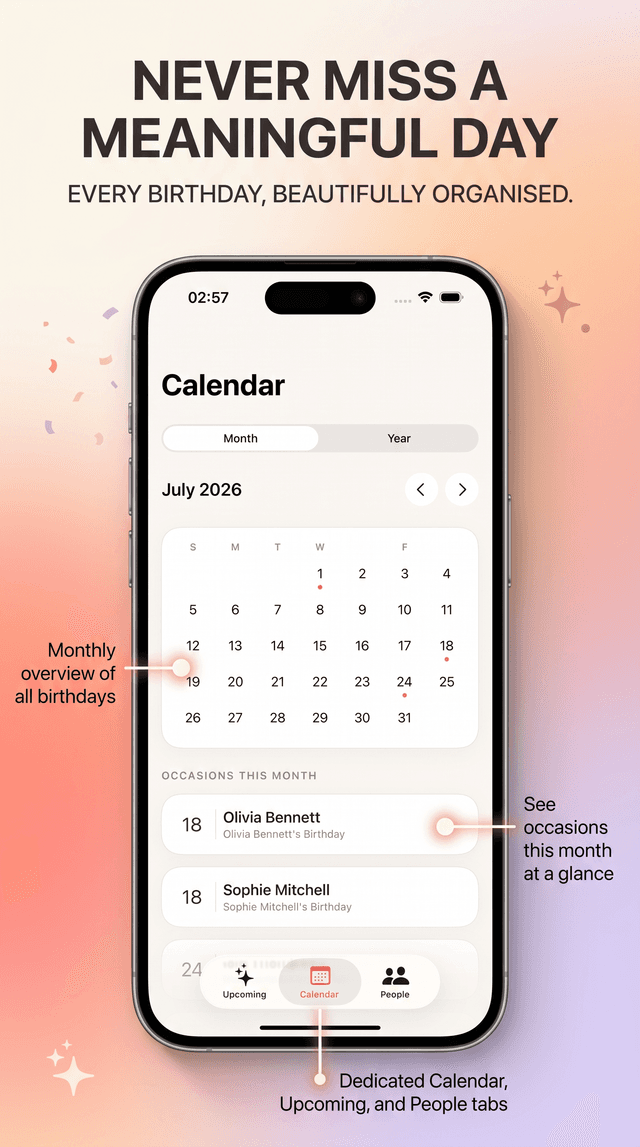
Birthday Reminder: Tracker’s current App Store listing describes personal notes, customizable lead days and alert times, countdowns, and a Home Screen widget without requiring an account. Those features can keep a short writing prompt beside the date. The birthday reminder timing guide can help you choose an alert that leaves time to write rather than react.
Frequently asked questions
Should I say happy birthday during a fight?
If contact remains welcome, a short and civil greeting is usually reasonable. Do not send one if they have requested no contact, blocked you, or if communication would create a safety concern.
Should I mention the argument?
Mention it in one non-defensive sentence only when ignoring it would feel false. Do not summarize your position or ask to settle the disagreement inside the greeting.
What if the argument was my fault?
Use a direct acknowledgment such as “I am sorry for what I said.” Name your action without an excuse. Arrange a proper conversation later if more accountability is needed.
Is a very short message rude?
No. “Happy birthday. I hope you have a peaceful day” can be more respectful than exaggerated warmth you do not currently feel.
Should I send the message at midnight?
Usually not when the relationship is tense. Send it at a normal time when it will feel like a calm acknowledgment rather than an emotionally loaded event.
What if they do not reply?
Do not chase a response on their birthday. Let the message stand. A later conversation should happen because both people are ready, not because the greeting created an obligation.
The right birthday message after an argument does one small job. It acknowledges the person honestly while leaving space for the conversation that still needs to happen.
Visit the Birthday Reminder app page to see how dates, notes, countdowns, and flexible alerts can stay together, or browse the other Birthday Reminder guides.