
The best birthday wishes for your sister-in-law talk to her as herself, not just as your brother's wife or your partner's sister. Choose a tone that fits how close you really are. Add one detail that could only be about her, like a project, a tradition she started, or the way she is with your kids. Then write it the way you would say it across the table at a family dinner. This guide covers how the type of sister-in-law changes what you write, a quick test for compliments that only describe her role, messages for different situations, and the lines that cause trouble.
Which kind of sister-in-law is she?
"Sister-in-law" can mean three different relationships, and each changes what sounds natural.
- Your spouse's sister. She has known your partner all her life, and you came along later. She has inside jokes and history you will never fully share. A good message respects that history and doesn't compete with it.
- Your sibling's wife. She joined your family. Your message quietly tells her she belongs and that she is valued for herself, not only because she makes your sibling happy.
- Your spouse's brother's wife. You both married in. That shared outsider view is often the easiest common ground you have, and a little "we're in this together" warmth goes a long way.
Hallmark's guide to birthday wishes for sisters gives sisters-in-law their own section, separate from sisters by birth. That's a useful reminder that even a close sister-in-law usually expects a slightly different tone than a sister would.
Write to her, not to her job title
Many generic wishes praise a sister-in-law only for what she does for other people: what a great wife she is, what a wonderful mother, how smoothly she runs the holidays. Those things may be true. But a message made only of role-based compliments tells her you see her as a function in the family.
Try this before you send. Cross out every reference to her husband, children, or hosting. Is anything left? If not, add one line about her own life:
- Her work, studies, or a career change.
- A hobby she takes seriously, like running, pottery, gardening, or a book club.
- A trip she took, a goal she reached, or a hard year she got through.
- Something about her personality that you genuinely like.
Role-based praise can be one ingredient. It shouldn't be the whole message.
Ask the person who knows her best
The Knot's guide to sister-in-law birthday messages says sincerity matters most and suggests asking your partner or sibling for input. That advice is especially useful for this relationship, because someone close to you usually knows her far better than you do.
A quick, quiet question a week ahead is enough:
- "What's she most proud of this year?"
- "Is there a nickname she loves, or one she can't stand?"
- "Is anything off-limits right now?" This one matters. Your partner may know about a job worry, a health issue, or fertility news that would make a light joke land badly.
You'll get a better detail in two minutes than you would from any list of quotes.
Warm and sincere messages
Use these when you get along well and want her to feel appreciated. Replace the bracketed parts with something real.
- "Happy birthday, [name]. You've become one of the people I most look forward to seeing at family things, and that has nothing to do with who you married."
- "Watching you take on [the new job / the marathon / the move] this year was impressive. Happy birthday, and I hope the next year is a little easier on you."
- "Happy birthday to the person who remembers everyone's allergies, birthdays, and coffee orders. Today someone gets to remember yours."
- "You make it easy to feel at home, even in a house full of [family name]s. Happy birthday. I'm really glad you're my sister-in-law."
- "Happy birthday, [name]. Thank you for [the long phone call in March / the casserole when we moved / always saving me a seat]. I haven't forgotten it."
Each one names something real. That detail does most of the work.
Funny and lighthearted messages
Only use humor if you already joke together in real life. Aim it at shared family chaos, not at her age, her looks, or her marriage.
- "Happy birthday to my partner in quietly ranking everyone's potato salad at reunions. Same scoring system this year?"
- "Thanks for being the only other person at family dinners who notices what I notice. Happy birthday, co-conspirator."
- "Happy birthday! I'd make a joke about getting older, but you'd see it coming, outsmart it, and bring a better dessert."
- "Another year of you putting up with our family's group chat. That should come with a medal. Cake will have to do."
If she's your spouse's sister, be careful with jokes about your partner. She has known them longer than you have, and teasing that crosses an invisible line can sting. If she's your sibling's wife, a joke about your sibling is usually safer, but only when it's clearly affectionate.
Messages for a new sister-in-law
In the first year or two, your message quietly tells her she's welcome. Be generous, but don't claim a closeness you haven't built yet.
- "Happy first birthday as an official [family name], at least on paper. We're very glad you said yes to all of us."
- "I hope this is the first of a lot of birthdays we get to celebrate with you. Happy birthday, [name]."
- "Happy birthday! I'd love to hear more about [her work / her hometown / her running club] next time we're together. Hope it's a great day."
If she was your friend before she was family, say so: "Friend first, sister-in-law second, favorite either way. Happy birthday."
Leave out phrases like "now you're stuck with us" if she seems unsure about the family. Never hint at timelines for children, even as a joke.
For the aunt of your children
If she's good with your kids, tell her specifically. Many people value that kind of praise most, because it's about who she is when no one is performing.
- "Happy birthday to the aunt who taught [child's name] to [whistle / play cards / make pancakes]. They talk about it constantly. Thank you."
- "Our kids think you're the coolest grown-up they know. They're not wrong. Happy birthday, Aunt [name]."
Let the kids add something of their own: a drawing, or a line in their own spelling like "Happy birthday Auntie, you are the best at hide and seek." It will probably mean more than anything you write.
Signing one card with your partner
When you and your partner share a card, write at least one line in your own voice. Otherwise it reads as your partner's message with your name added.
A simple way to split it: the person who has known her longest writes the memory, and the other adds the personal note.
- "From both of us: happy birthday, [name]. And from me specifically: thank you for making me feel like part of the family from the very first dinner."
When you're not close, or things are strained
Not every sister-in-law is a friend, and that's fine. You don't need to invent warmth. A short, sincere message reads as respectful.
- "Happy birthday, [name]. I hope today is easy and the year ahead is kind to you."
- "Happy birthday. I hope [the new house / the garden / the new role] is everything you wanted it to be."
- "Thinking of you on your birthday, [name]. Have a lovely day."
If things are tense, keep it to one or two kind lines. Don't hint at old disagreements, and don't add a "hope we can move past things" postscript. If you need help with that situation, see the guide to birthday wishes after an argument.
If she lives far away or you're late, keep it simple: "Happy birthday from [your city]. I'm saving my hug for [the next visit], with interest." Or: "Late, but sincere. Happy birthday, [name]. I hope someone made a fuss of you."
Find the detail that makes it hers
Most people can't think of a personal detail because they're looking for it on the day. Look in three places instead:
- Your own notes. Anything you jotted down during the year: "started the pottery class," "taught Maya to swim."
- What she has told the family she's proud of. A promotion she mentioned at dinner, a race she posted about, a garden she showed everyone.
- Your partner or sibling. One quiet question, as described above.
Then do two final checks. Use the name the family actually calls her, and read the message aloud. If you wouldn't say it to her face, rewrite it until you would. If you're writing to the couple, our guide to birthday wishes for your brother-in-law has messages for him.
What to avoid in a sister-in-law message
- Praise based only on her role. "Best wife and mother" on its own can make her feel unseen as a person.
- Comparisons. "You're the sister I never had" stings if you have a sister. "So much better than [his ex]" can become a family story that outlasts the birthday.
- Putting her in the middle. Skip jokes about her and your mother, or her and your mother-in-law, even if everyone knows there's tension.
- Pressure topics. Children, weight, the wedding budget, job security, or anything she hasn't joked about herself.
- Unedited copies. A pasted poem from a wishes website is worse than two plain sentences of your own.
- Going public before private. If you post on social media, send her a personal message too.
Make sure the date never catches you off guard
Rushed, generic messages usually happen because the birthday arrived before you'd thought about it. A little lead time gives you room to ask your partner a question or remember the detail that makes the message hers.
Start with a private list of the birthdays you care about, as in the guide to remembering birthdays without social media. The birthday reminder timing guide suggests five to seven days ahead for a posted card and a same-day alert for a text. During the year, add short notes to her entry, as shown in adding birthday notes and gift ideas on iPhone, so the detail is waiting when the reminder arrives. The simple birthday planning system shows how to keep that routine light.
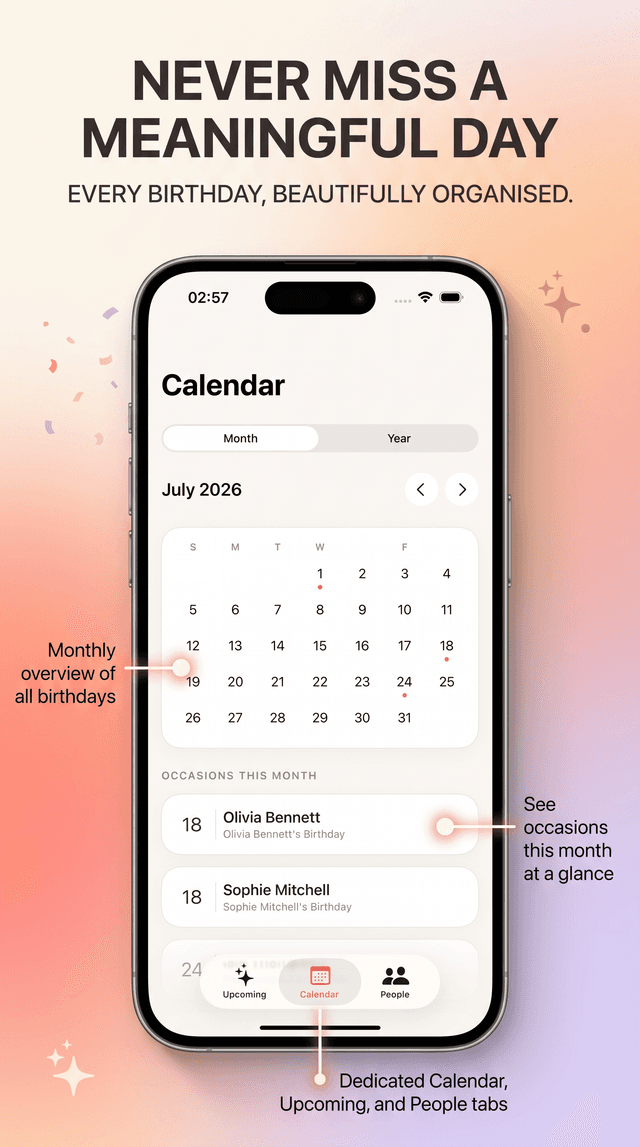
If you use an iPhone, Birthday Reminder keeps birthdays, countdowns, notes, and flexible reminder schedules in one private place, with no account needed. Its widgets can keep upcoming birthdays on your Home Screen or, on iOS 16 and later, your Lock Screen. You can browse more guides on the Birthday Reminder blog, and read how we research and review articles in our editorial policy.
Frequently asked questions
What is a good short birthday message for a sister-in-law?
"Happy birthday, [name]. I'm really glad you're part of our family. I hope this year is a great one for you." A short message works best when it uses her name and has at least one sincere line. Add a detail if you have room.
Is it okay to call my sister-in-law my "sister" in a birthday message?
Yes, if it reflects how you both actually feel, especially if she has used similar language with you. If you've only met a few times, it can feel like too much. "I'm glad you're family" carries the same warmth without overstating things.
Should my message be different if she's my spouse's sister or my sibling's wife?
A little. With your spouse's sister, respect the history she shares with your partner and be careful with jokes about them. With your sibling's wife, focus on making her feel welcome and valued in her own right. Either way, the core is the same: one real detail, written in your own voice.
What should I write if our relationship is complicated?
Keep it brief and kind, for example: "Happy birthday, [name]. Wishing you a good day and a peaceful year ahead." Leave out references to past tension, apologies, or requests. A short, warm message keeps things civil without forcing a conversation.
What if she was my friend before she married into the family?
Lean into it. Mention a memory from before the wedding, or the fact that you get to see her at every holiday now. Just keep the joke about having "introduced them" affectionate, and don't make the message about your sibling.