
If you are wondering what to do after forgetting a birthday, contact the person as soon as you realize. Do not postpone the message until you have found a gift, written a card, or invented a polished explanation.
Say that you missed the birthday, apologize plainly, and add one genuine detail. If the mistake caused real hurt, offer a practical next step and give the person room to respond.
This guide is about repairing the miss and preventing a repeat. For ready-to-use wording, see the separate guide to belated birthday wishes.
What to do in the first 15 minutes
Your first task is not to erase the mistake. It is to end the silence.
Use this order:
- Check the date. Make sure you have not misunderstood the birthday or time zone.
- Send a direct message. A text or voice note is usually enough to open the conversation.
- Name what happened. Say “I missed your birthday” rather than using a vague apology.
- Add one personal detail. Mention their celebration, a shared memory, or something currently important to them.
- Offer only what you can complete. Suggest a call, meal, or visit only if you intend to arrange it.
For example:
I missed your birthday yesterday, and I'm sorry. I hope your concert was brilliant. Could I call you this evening and hear about it?
The detail makes the message personal. The proposed call creates a realistic next step. Neither requires the recipient to reassure you.
If you are several weeks late, do not disguise the delay with “birthday month” or a joke. State it accurately and keep moving toward the person rather than toward an excuse.
Build an apology that does not create more work
Research on apology structure offers a useful framework, although it was not conducted specifically on forgotten birthdays.
In two experiments reported by Ohio State News, participants rated apologies containing different combinations of six elements. Acknowledgment of responsibility was the most important element, followed by an offer of repair. A request for forgiveness ranked lowest.
That does not mean every missed birthday requires a grand repair. It means a useful apology should establish responsibility before seeking relief.
Use four parts when the relationship or impact warrants them:
- Identify the mistake: “I missed your birthday.”
- Accept responsibility: “That was my mistake.”
- Express regret: “I'm sorry I did not contact you.”
- Offer a fitting repair: “I'd like to take you for lunch this weekend, if you want to.”
UC Berkeley's Greater Good Science Center also advises against vague acknowledgments, long excuse-like explanations, and amends chosen mainly to ease the apologizer's guilt.
A brief explanation can be appropriate when it provides necessary context. “I was dealing with a family emergency” may help the person understand what happened. A detailed account of your workload usually shifts attention back to you.
Avoid adding:
- “You know how busy I am.”
- “I'm the worst person ever.”
- “You're not angry, are you?”
- “I can't believe my phone didn't remind me.”
- “I'll make it up to you somehow.”
The first four invite either debate or reassurance. The last is too vague to count as a plan.
Choose a follow-up based on impact, not guilt
A gift is not an admission fee for a valid apology. The right follow-up depends on how the mistake affected the person, how close you are, how late you are, and whether this has happened before.
| Situation | A message may be enough | Consider a concrete follow-up |
|---|---|---|
| Delay | You noticed within a day or two | Several days or weeks have passed |
| Expected gesture | You normally exchange brief wishes | You had agreed to call, visit, or attend |
| Impact | The person appears untroubled | The person says they felt forgotten |
| Pattern | This is an isolated mistake | You have missed their important dates repeatedly |
| Occasion | No plan depended on you | You missed a milestone or shared celebration |
A follow-up could be:
- A call at a time that suits them.
- A handwritten card with a personal note.
- A meal or activity you arrange and attend.
- A delayed gift that genuinely fits their interests.
- Completing a birthday plan you had already promised.
Price is not a measure of repair. Reliability matters more. If you offer dinner, choose a date. If you say you will call, call when agreed. An impressive gesture followed by more poor follow-through can deepen the original frustration.
Respond well if they are hurt, quiet, or dismissive
You cannot control how quickly someone accepts an apology. You can control whether your response makes space for their experience.
If they say it is fine
Accept the response without repeatedly asking whether they are sure. Thank them, wish them well, and complete any follow-up you offered.
If they say they are hurt
Listen before explaining. A simple response is:
I understand why that hurt. I'm sorry, and I won't argue with how it felt.
You can then ask whether the proposed repair would be welcome. Do not treat forgiveness as something they owe because you apologized correctly.
If they do not reply
Do not send a stream of increasingly anxious messages. For a close relationship, one calm follow-up after a reasonable interval may be appropriate. Keep it low-pressure and avoid demanding a response.
If this is part of a larger pattern
The birthday may not be the whole problem. The person may be reacting to repeated missed plans, uneven effort, or feeling overlooked. Address that pattern directly rather than trying to solve it with a larger present.
Diagnose why the birthday was missed
Before changing your reminder system, identify the actual failure.
Ask yourself:
- Date failure: Was the birthday missing or recorded incorrectly?
- Alert failure: Was there no notification, or was it scheduled too late?
- Visibility failure: Did the alert appear somewhere you rarely check?
- Action failure: Did you see it but postpone the message?
- Preparation failure: Did you remember the date but lack time for the gesture you intended?
A 2026 diary study of self-assigned, non-routine next-day intentions found that only about 10 to 14 percent of non-fulfilled intentions in its samples were attributed to forgetting. Participants more often reported reprioritization, lack of time, low motivation, health problems, or external causes.
That study involved a volunteer student pool and general daily intentions, not birthdays, so it cannot tell you why your birthday plan failed. Its useful lesson is narrower: non-completion and forgetting are not always the same problem.
If you saw the alert and dismissed it, adding five more alerts may create notification noise rather than solve the issue. A reminder that says “Buy card today” or “Call at 7pm” may work better than one that merely announces a date. The guide to calendar alerts versus preparation reminders explains that distinction.
Prevent the same mistake next year
Fix the record while the details are fresh:
- Confirm the correct month and day.
- Store it in one trusted place.
- Choose the gesture you normally want to make.
- Set an early reminder for preparation.
- Keep a final alert for the birthday.
- Add a short action note, such as “book lunch” or “call after 6pm.”
- Check that notifications are allowed on your device.
Apple's current iPhone guide documents due dates, recurring reminders, notes, and early reminders in Reminders. Apple also notes that some features require updated Reminders in iCloud and may be unavailable with other accounts.
For lead-time suggestions based on cards, gifts, calls, bookings, and travel, use the birthday reminder timing guide. If your dates are scattered, start with the private birthday system guide or the three-stage planning system.
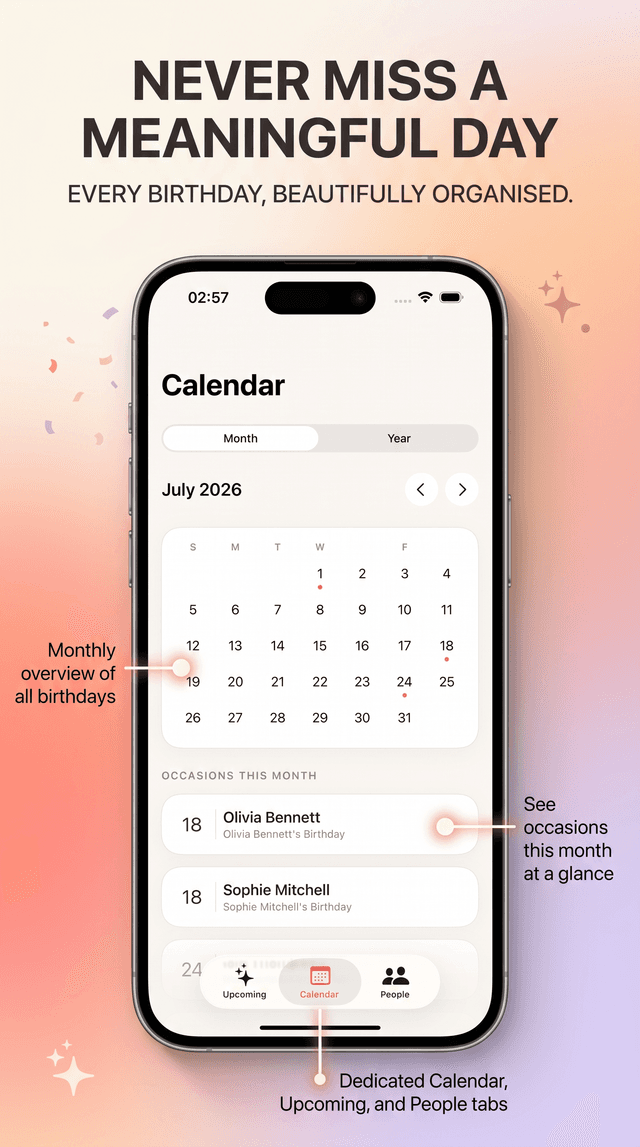
The Birthday Reminder app keeps birthday countdowns, customizable reminder lead times, notes, and a Home Screen widget together without requiring an account. Use it if a focused birthday list suits you better than birthdays mixed into general tasks and calendar events.
Frequently asked questions
What should I say after forgetting someone's birthday?
Say that you missed the birthday, apologize directly, and include one detail specific to the person. Offer a realistic next step if the relationship or impact calls for one.
Is it too late to apologize a week later?
No. A week-late acknowledgment is usually more constructive than continued silence. State the delay honestly and avoid pretending the birthday was yesterday.
Should I explain why I forgot?
Explain only when the context is true and useful. Keep it to one sentence. A long account of your schedule can sound like a request to excuse the mistake.
Do I need to send a belated birthday gift?
Not automatically. A gift can support an apology, but it cannot replace acknowledgment or follow-through. Choose one only when it fits the relationship and the person would value it.
What if they do not accept my apology?
Respect their response. Do not pressure them to forgive you or send repeated messages. Complete any commitment you made and let your future behavior show whether the mistake was an exception.
How can I make sure I do not forget next year?
Confirm the date, keep it in one reliable system, and set an alert early enough for the action you intend to take. Use a second alert on the birthday if the first reminder is for preparation.
Forgetting a birthday does not come with a perfect undo button. The useful response is simpler: acknowledge the miss promptly, listen if it caused hurt, complete the repair you offer, and change the part of your system that actually failed.
Our editorial policy explains how Daily Life Apps reviews factual and product claims. You can also browse all Birthday Reminder guides for related planning advice.