
A monthly birthday review is a short, scheduled check of the birthdays coming in the next several weeks. Once a month, on a day you have chosen in advance, you open your birthday list, look six weeks ahead, decide which dates need more than a quick message, and give each one a clear next step. The whole thing takes about ten minutes.
That small habit solves the two problems reminders alone cannot: it catches birthdays that need preparation before their alerts fire, and it keeps your list accurate so the alerts you do get are worth trusting.
Why reminders alone are not enough
Reminders are good at one job: making a date appear at the right moment. They are bad at judgement. A reminder cannot tell you that three birthdays land in the same week as a work trip, that a posted card needs to leave before the first alert fires, or that this year is a milestone birthday you mentioned celebrating properly back in March.
A review is where that judgement happens. Productivity methods have relied on this idea for decades. David Allen, creator of Getting Things Done, calls the regular review the "critical success factor" of his system: the lists only stay trustworthy because someone looks at them on a schedule. Birthdays are a much smaller domain than a full GTD setup, but the principle is the same. Ten minutes of looking ahead prevents hours of last-minute scrambling.
Choose a review date you can keep
The most common failure is not a bad review; it is a review that never happens. Consistency matters more than the specific day. Todoist's guidance on review rituals makes the same point: hold the review at the same day and time, ideally in the same place, until skipping it feels stranger than doing it.
Good candidates for a monthly birthday review:
- The first Sunday morning of the month, with coffee.
- The last weekday of the month, before leaving work.
- The evening of the 1st, after dinner.
- Payday, if you budget for gifts and cards.
Protect the slot with a repeating reminder. Apple Reminders supports recurring items natively: set a date and time, tap Repeat, and choose a monthly frequency. Call the reminder something active, such as "Review the next six weeks of birthdays," rather than a vague "Birthdays."
Look six weeks ahead, not one month
The most useful design decision in a monthly birthday review is the window. Looking only at the current month creates a blind spot: on 28 October, a review of "October's birthdays" ignores the friend whose birthday is 3 November.
Six weeks fixes this. From any review date, six weeks reaches comfortably into the following month, so every birthday gets reviewed at least once with time to spare, and early-month birthdays get nearly a full month of runway. It also matches real preparation needs: a card, a gift order, or a restaurant booking almost always fits inside a six-week window, and anything bigger, such as travel or a milestone party, should already have its own earlier alerts. Our birthday reminder timing guide maps lead times to specific gestures if you want the detail.
The review window and the preparation timeline are different tools. When a review surfaces one birthday that needs the full window to prepare, the six-week birthday planning routine breaks those weeks into short, ordered steps.
The 10-minute monthly birthday review agenda
Keep a written agenda so the review stays a review and does not drift into gift shopping. This one is deliberately short:
- Scan (2 minutes). Read every birthday in the next six weeks. No decisions yet, just load the list into your head.
- Sort (3 minutes). Put each birthday into one of three buckets: act now, scheduled, or no action. More on these below.
- Prepare (3 minutes). For every act now birthday, write or record the next concrete step: "order the print," "ask about dinner plans," "check shipping cutoff."
- Maintain (2 minutes). Confirm one uncertain date, improve one note, and remove any duplicate or outdated entries.
Stop when the ten minutes are up, even if the maintenance step is unfinished. A routine that reliably fits inside a busy month beats a thorough one you start avoiding. If ten minutes is consistently not enough, the problem is usually the list, not the routine: too many low-priority entries or too much detail per person. The guide to organizing a simple birthday planning system covers how to slim that down.
Sort every birthday into one of three actions
The sort is the heart of the review. Each upcoming birthday gets exactly one bucket:
| Bucket | Meaning | Example |
|---|---|---|
| Act now | Something must happen this week to stay on schedule | Order a personalized gift with a long lead time |
| Scheduled | The existing reminders are enough; nothing to do yet | A card reminder is already set for 7 days before |
| No action | A message or call on the day is the whole plan | A friend who prefers a simple text |
Two rules keep the sort honest. First, "act now" must produce a named next step, not a feeling of obligation. "Do something about Mum's birthday" is not a step; "ask Mum whether she wants lunch out or at home" is. Second, be generous with "no action." Most birthdays on most lists genuinely need nothing until the day arrives, and pretending otherwise is how reviews balloon to an hour and die.
Update the records, not just your memory
A review that only looks ahead slowly decays, because the list itself drifts. Dates get mistyped and never corrected. A friend mentions a new city and the old time zone note stays. Someone casually says "I would love to try pottery" in June, and by their November birthday the idea is gone.
Use the maintenance step to move small facts from memory into the record:
- A gift idea someone mentioned in passing.
- A new address, city, or time zone.
- A milestone coming up next year worth flagging early.
- A date you are not sure about, marked clearly as unconfirmed.
- A preference learned from this year's celebration: "loved the call, skip the card."
Keep these notes practical and minimal. If your birthday list still lives partly in Facebook notifications or scattered message threads, it is worth consolidating first; the guide to remembering birthdays without social media walks through that setup.
Plan around seasonal pressure points
Some months are structurally harder than others, and a monthly review is exactly where you see them coming.
- November and December. Birthdays collide with holiday shipping deadlines, travel, and end-of-year busyness. In October's review, flag any December birthday that involves a posted gift, and treat the shipping calendar as part of the birthday plan.
- Family clusters. Many families have a month where three or four birthdays bunch together. When your review shows a cluster, split the preparation across the weeks before it rather than absorbing it all at once.
- Your own busy season. If you know a work deadline or a trip lands mid-month, use the review to move every affected birthday's preparation earlier, before the crunch arrives.
This is also where a visible countdown helps. Seeing "12 days," "24 days," and "37 days" side by side makes the pressure obvious in a way a list of dates does not.
Keep upcoming birthdays visible between reviews
A monthly review sets the plan, but a full month of life happens between reviews. Two lightweight habits keep the system alive in the gaps.
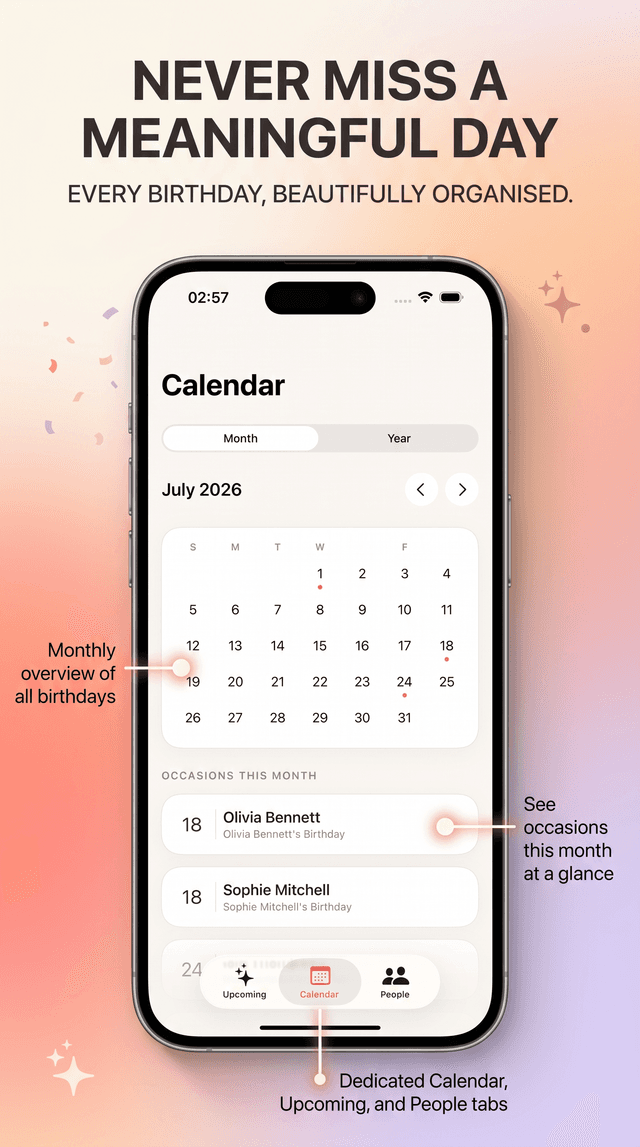
First, make the next few birthdays glanceable. A Home Screen or Lock Screen widget showing upcoming birthdays and countdowns means you absorb the approaching dates passively, without opening anything. The Birthday Reminder app is built around exactly this: countdowns, flexible reminder schedules, widgets, and notes, in a private, account-free app on your iPhone.
Second, capture new dates the moment you learn them. A birthday mentioned in a conversation, a new colleague, a new baby in the family: add it to the list immediately and let the next monthly review handle the rest. The review is where you organize; it should not be where you first record things.
Mistakes that make a monthly review fail
- Reviewing only the current month. Use the six-week window so early-month birthdays are never missed.
- Letting the review expand. Cap it at ten minutes. Move anything bigger, like gift shopping, into its own task.
- Treating every birthday as a project. Most birthdays need no preparation. The review exists to find the few that do.
- Skipping the maintenance step. Two minutes of updating notes and confirming dates is what keeps next year's alerts accurate.
- Choosing a floating time. "Sometime at the start of the month" quietly becomes never. Tie it to a recurring reminder.
Frequently asked questions
How long should a monthly birthday review take?
About ten minutes for a list of 15 to 30 birthdays. If it regularly takes much longer, trim the list to people you would genuinely contact or plan for, and reduce the detail stored per person.
Why look six weeks ahead instead of one month?
A one-month window hides birthdays in the first days of the following month until it is too late to prepare. Six weeks guarantees every birthday is reviewed at least once with enough runway for cards, orders, or bookings.
What is the best day of the month for the review?
Any day you will actually keep. The first weekend and the last weekday are popular because they feel like natural boundaries. Anchor it with a recurring monthly reminder so the habit survives busy stretches.
Should I review birthdays more often than monthly?
For most people, no. Monthly reviews plus a visible widget or countdown for the next few birthdays is enough. Weekly attention adds effort without adding much foresight, unless you are inside a heavy birthday season like December.
What if I keep forgetting the review itself?
Attach it to something that already happens: the first Sunday coffee of the month, payday, or the evening of the 1st. Then back it with a repeating reminder. Habits anchored to existing routines survive far better than free-floating intentions.
A monthly birthday review is not another chore. It is ten minutes a month that let you trust your system the rest of the time. Browse the other Birthday Reminder guides for the setup and timing pieces that make the review itself almost effortless.