To set up birthday reminders for children's friends, keep a small working list for each child, add only birthdays that a family has shared or confirmed, and separate the birthday from the party administration.
The most reliable setup uses three different records:
- A recurring birthday record.
- A one-off task for the RSVP deadline.
- A calendar event for the party date, time, and location.
This distinction prevents a Saturday party from being saved as the child's birthday or an RSVP task from returning every year.
Decide which friends belong on the list
Do not begin by copying an entire class roster. A school list may include children your child barely knows, and access to a name does not mean you have an accurate birthday or permission to retain it.
Add a friend when at least one of these applies:
- Your child has an ongoing friendship with them.
- The children regularly exchange cards, messages, or small gifts.
- Your family is likely to attend their birthday celebrations.
- Their parent or guardian has shared the birthday for that purpose.
- The friendship continues through a club, team, neighborhood, or previous class.
A single invitation does not automatically create a permanent reminder. You can add the party to Calendar and wait to see whether the friendship continues.
This is a narrower decision than choosing every birthday you might ever acknowledge. The guide to deciding which birthdays to track provides a broader relationship-based test.
Keep one working list per child
Separate lists make it clear which child knows each friend. They also prevent siblings' changing school circles from becoming one large household directory.
Use a simple label such as:
- Ava's school friends
- Leo's football friends
- Maya's neighborhood friends
One friend can appear in more than one context without needing duplicate birthday records. If siblings know the same child, keep one date and note both relationships.
The list does not need a target size. Five current friends may be enough for one child, while another may have a larger circle across school and activities. Include people because the reminder supports a likely action, not to make the list look complete.
Choose one home for the birthday record
Pick one place where birthday corrections are made. Other tools may display dates or hold party tasks, but they should not become competing sources of truth.
| System | Best use | Important limitation |
|---|---|---|
| iPhone Contacts | Basic birthday records linked to people you already contact | Contact groups do not by themselves create separate birthday alert schedules |
| Manual iCloud calendar | Shared visibility between parents or caregivers | Each birthday is a yearly event maintained separately |
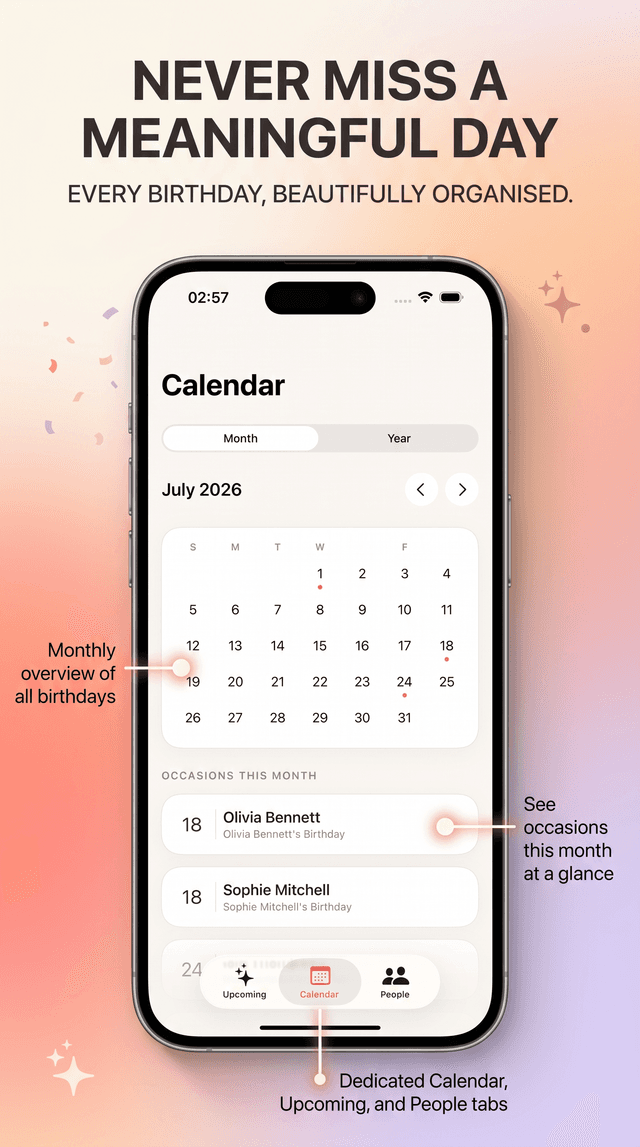
| Birthday Reminder | A private upcoming view with countdowns, notes, widgets, and flexible alerts | Use another tool for one-off RSVP and party tasks |
| Reminders or another task app | RSVP, gift, card, and preparation deadlines | It is less suitable as the permanent birthday directory |
If you use Birthday Reminder, add friends manually or import only selected contacts. A short note such as “Ava's school friend, Year 3” provides enough context without claiming that the app creates a separate list automatically.
The app can then hold the birthday countdown and advance alert. Keep the RSVP deadline in a task app and the party itself in Calendar.
Create a minimal, respectful record
A school friend's birthday entry rarely needs more than:
- The name your child uses.
- A confirmed month and day.
- Which child knows them.
- A current context such as school, football, or neighborhood.
- One intended action, such as “help Ava make a card.”
Add a birth year only when it was shared and you genuinely need it. Do not infer the year from a class or grade, since classmates are not always the same age.
Keep temporary party information with the invitation or calendar event. There is usually no reason to copy dietary details, medical information, addresses, family circumstances, or pickup arrangements into a permanent birthday note.
If a parent's contact details arrived with an invitation, retain them only where you would normally manage that conversation, such as Contacts or the message thread. A birthday record should not become a profile of another child.
Add birthdays through iPhone Contacts
Apple confirms that a birthday can be added while editing a contact:
- Open Contacts.
- Select the person and tap Edit.
- Scroll to add birthday.
- Enter the confirmed date.
- Tap Done, then reopen the card to verify it.
For a full explanation of how that date appears in Calendar, use the guide to adding a birthday to iPhone Contacts.
If you want an organizational list, Apple also documents creating additional contact lists through Contacts on iCloud.com. Its web interface requires a tablet or computer:
- Open icloud.com/contacts.
- Create a list named for the relevant child.
- Add the selected contacts to that list.
- Remove outdated entries from the list without deleting their underlying contact cards.
A contact can remain in All Contacts and appear in additional lists. Treat these lists as an organizational aid. Apple's list documentation does not say that a custom list receives its own birthday notification schedule or filters the Contacts-powered Birthdays calendar.
If you prefer a selective app import, review the process for importing birthdays without creating clutter.
Separate birthdays, invitations, and party dates
A birthday and its celebration often fall on different dates. Treating them as one event causes the most common errors in this system.
Use this pattern:
| Information received | Where it belongs | Example wording |
|---|---|---|
| Confirmed birthday | Recurring birthday record | “Mia's birthday” |
| RSVP deadline | One-off dated task | “Reply to Mia's party invitation” |
| Party date and location | Calendar event | “Mia's party, Saturday at 2pm” |
| Card or gift preparation | Advance reminder or task | “Help Ava make Mia's card” |
When an invitation arrives, create the RSVP task immediately. Use the printed deadline. If the invitation gives no deadline, choose a prompt that leaves the host reasonable time to plan rather than creating an unsupported universal rule.
For the birthday itself, choose the alert from the action:
- Simple message or school greeting: the birthday morning.
- Homemade card: two or three days before.
- Small gift or planned visit: enough time to buy or arrange it.
- Party attendance: use the separate party event and any preparation task.
The birthday reminder timing guide covers cards, gifts, bookings, and travel in more detail.
Coordinate carefully with another caregiver
If another parent or caregiver needs visibility, share only the information required for coordination.
Apple allows an iCloud calendar owner to share a calendar with selected iCloud users and decide whether each person may edit events. A manually created calendar such as Ava's Parties can therefore hold party dates and RSVP deadlines.
This is different from sharing a contact list or Apple's generated Birthdays calendar. For a shared workflow:
- Create a dedicated iCloud calendar.
- Add only the relevant birthday-party events.
- Invite the caregiver privately.
- Enable editing only if they will maintain events.
- Keep Public Calendar turned off.
- Remove access when the coordination arrangement ends.
Avoid sharing your entire personal calendar merely to expose a few children's events. Also consider whether names need to appear on a grandparent's or occasional caregiver's device at all.
Check school rules before using class information
Schools differ on whether they share birthday lists, allow invitations in class, or require the whole class to be invited when invitations are distributed at school. Check the current school or teacher policy instead of treating one etiquette rule as universal.
In PureWow, etiquette adviser Myka Meier says that a class of 20 or more can justify a smaller guest list, but specifically advises against inviting 15 of 20 children and excluding only a few. She also recommends contacting invited parents privately rather than handing selective invitations out at school.
That is one etiquette expert's guidance, not a substitute for the school's policy. For reminder purposes, the safest rule is simpler: use only dates and contact details that were shared appropriately, and do not turn a class directory into a personal birthday database.
Review the list each school term
School friendships change faster than family relationships, but that does not mean every former classmate should be deleted automatically.
At the beginning and end of each term:
- Ask your child which friendships are still active.
- Add newly confirmed birthdays one at a time.
- Correct dates that were entered from an uncertain source.
- Remove obsolete class labels.
- Disable alerts that no longer lead to an intended action.
- Keep friends who remain close despite changing classes or schools.
- Check the next six weeks for invitations, cards, or clustered parties.
Removing someone from an active list does not require deleting their contact card. You can remove the reminder, take them out of the child-specific list, or leave the record without an alert.
This lighter term review complements the monthly scan in the simple birthday planning system.
Frequently asked questions
Should I record every classmate's birthday?
No. Record birthdays connected to an ongoing friendship or likely family action. Do not copy a class roster merely because it is available.
What if I know the party date but not the birthday?
Save the party as a one-off calendar event. Do not assume the party date is the birthday or create a yearly reminder from it.
Should I keep the RSVP deadline in the birthday app?
Use a dated task or calendar event for the RSVP. Birthday Reminder is better suited to the recurring date, countdown, advance birthday alerts, and a concise note.
Do I need the friend's birth year?
Usually not. The month and day are enough for a recurring reminder. Add the year only when it was shared and serves a real purpose.
Can both parents edit the same birthday calendar?
Apple allows the owner of an iCloud calendar to invite specific iCloud users and grant or remove editing access. Use a manually created calendar for this purpose rather than assuming a Contacts birthday list is collaborative.
What should I do when the children stop being friends?
Disable the active reminder or remove the friend from the child-specific list. Delete the underlying contact only if you no longer need it for any other reason.
A useful school-friend birthday system stays small, accurate, and easy to retire. Keep the birthday stable, put party administration in separate one-off records, and review each child's list as friendships change.
The Birthday Reminder app page explains how private birthday records, selected contact imports, countdowns, flexible alerts, notes, and widgets support the recurring part of this workflow. Browse the other Birthday Reminder guides for related setup advice, or read our editorial policy to see how product and factual claims are checked.