If you are asking which birthdays should I remember, track the dates that would prompt a deliberate action if you knew in time. That includes close relationships and genuine commitments, such as a family tradition or an ongoing role in a child's life.
Use a lighter tier when you would sincerely send a short message but make no advance plan. Leave off dates that would only produce a reflexive response because an app displayed them. This is not a ranking of people's worth. It is a decision about where reminders will help you act as intended.
Decide by intended action, not relationship label
Labels such as “family,” “friend,” and “coworker” are poor shortcuts. You may speak to a distant cousin every week and rarely contact a sibling. One colleague may be a close friend, while another is simply someone whose date appeared in an imported address book.
Ask a more useful question:
If I received enough notice, what would I genuinely choose to do for this person?
A specific answer, such as calling, posting a card, arranging dinner, helping with a family plan, or taking a private moment to remember them, supports tracking the date. “I suppose I should say something” is weaker evidence.
This guide decides who belongs on the list. Once that is settled, the birthday reminder timing guide can help you choose how early each alert should arrive.
Use three tracking levels
A flat list gives every birthday equal weight. Three simple levels preserve the distinction between planning, acknowledging, and not needing an alert.
| Level | Use it when | Typical setup |
|---|---|---|
| Active tracking | You expect to call, visit, send something, coordinate, or prepare | A preparation alert and a birthday-day alert |
| Light tracking | You want to acknowledge the day, but no advance preparation is normally needed | One birthday-day or day-before alert |
| No active reminder | You have no intended action, the person prefers no acknowledgment, or contact would cross a boundary | No birthday alert |
Choose the lightest level that supports what you actually intend to do. A close friend who prefers a simple call may need only light tracking. An in-law's birthday may need active tracking because several people coordinate a meal.
The levels describe your actions, not the strength or value of the relationship.
Run a five-question decision test
Use these questions when a name feels difficult to place:
- What would I do? Name the likely call, message, card, visit, plan, or private act.
- Is there an ongoing commitment? Consider family traditions, caregiving roles, godparent relationships, or plans shared with a partner.
- Would the person welcome it? Their stated preference matters more than your habit.
- Would silence feel inconsistent with the relationship? Focus on your real relationship, not a social rule.
- Is the date trustworthy? If not, mark it for confirmation instead of treating a guess as fact.
A clear action plus a continuing relationship or commitment usually means active tracking. A small but sincere action fits light tracking. No intended action usually means no active reminder.
An uncertain date is a separate problem. It does not mean the person is unimportant. Use the guide to confirming a birthday without making it awkward before activating the reminder.
Handle difficult relationships individually
Some categories deserve a specific decision rather than an automatic rule.
Immediate and extended family
A family default can be practical when your household consistently calls, sends cards, or coordinates celebrations. It need not include every relative. Track the people connected to a real tradition or responsibility, then use light tracking for relatives you sincerely acknowledge without planning.
For a shared household process, see how to organize family birthdays in one place.
A partner's family
Decide together who handles each birthday. Tracking an in-law can be a coordination responsibility even when you are not personally close. Avoid duplicate planning by recording who will call, buy, book, or remind the children.
Coworkers
Add a coworker to your personal list when the relationship is genuinely personal or you independently want to remember. A voluntary workplace birthday routine may belong in a team system instead.
Do not copy every colleague into a personal list simply because their dates are available. If someone opts out of workplace recognition, leave them out without asking for an explanation.
Friends' children
Track a child's birthday when you have an ongoing role, regular contact, or a continuing card or gift tradition. A single party invitation is not necessarily a lasting commitment. Ask a parent or guardian before storing a child's date if it has not already been shared for that purpose.
New friends and relationships
There is no minimum number of months before someone can belong on the list. Add them when you genuinely want to remember and they are comfortable sharing the date. Do not turn a new connection into an investigation through old profiles or mutual contacts.
Former partners and faded friendships
There is no universal rule for ex-partners or people you no longer see. Keep a light reminder if contact remains mutual and welcome. Disable it when the alert creates pressure to reopen a relationship or cross a boundary.
Respect preferences, grief, and boundaries
If someone says they dislike birthday attention, believe them. No active reminder is the respectful choice unless they have requested a quieter form of acknowledgment.
A birthday belonging to someone who has died is different from an outdated contact. You may keep it as a private remembrance date, remove the alert because it is painful, or retain the record without treating it as a celebration task. Choose what helps rather than forcing it into a social category.
Estrangement also deserves care. Turning off a birthday reminder does not require deleting the entire contact or erasing the relationship's history. The guide to cleaning up an old birthday list explains how to park or remove records without deleting more than intended.
Build the first list without importing everyone
A deliberate first pass can take about 15 minutes:
- Write names from memory before opening Contacts or social media.
- Put one intended action beside each name.
- Assign active, light, or no active reminder.
- Confirm the dates for people in the first two levels.
- Add those people to your chosen system.
- Stop before browsing the rest of your address book.
Starting from memory is not a test of affection. It prevents an imported directory from deciding the scope of the list. You can add someone later whenever a conversation, invitation, or changing relationship gives you a reason.
There is no ideal number. Twenty well-chosen entries may be right for one person, while a large family or community role may justify many more. The useful limit is whether each active alert has a purpose.
If you are rebuilding from social profiles, use the separate process for remembering birthdays without social media.
Store the level without creating more clutter
Record the decision in the simplest form your system allows. A short note such as “active: post card” or “light: message” is enough. Avoid storing sensitive explanations about estrangement, grief, or private family history.
Apple's Contacts app lets you add a birthday while editing a contact. When those birthdays are saved in iCloud Contacts, iCloud Calendar can display them through a dedicated Birthdays calendar. That calendar is shown or hidden as a group, so it does not represent your individual tracking levels by itself.
For a task-based setup, Apple Reminders supports dates, recurring reminders, notes, and an Early Reminder option. The three-stage birthday planning system explains how to turn an active birthday into a concrete preparation task.
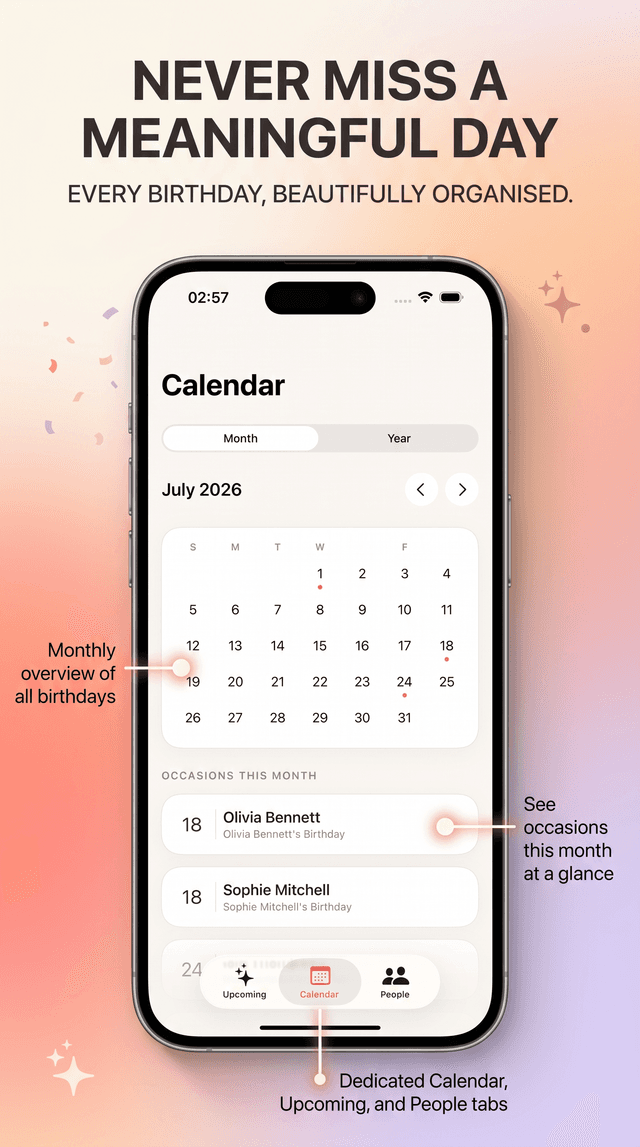
Birthday Reminder provides countdowns, advance reminders with per-occasion lead days and alert times, notes, gift ideas, and a Home Screen widget. Those tools can support different levels, but the app does not decide the relationship for you. Add only the people you have chosen, then set the reminder schedule that matches your intended action.
For maintaining confirmed dates and avoiding duplicates, follow the separate guide to building an accurate birthday list.
Review the decision when something changes
You do not need to re-rank everyone each month. Update a person's level when:
- A relationship becomes closer or more distant.
- Someone joins the family or takes on a new role in your life.
- A workplace or family responsibility begins or ends.
- The person asks for more, less, or no birthday attention.
- An alert repeatedly arrives without leading to any action.
A brief annual scan can catch quiet changes you missed. If an alert has been dismissed untouched for two years, make a fresh decision rather than leaving it as permanent noise.
Frequently asked questions
Should I track every family birthday?
Not automatically. Track family dates connected to a genuine relationship, tradition, or responsibility. A household-wide family default is also reasonable if everyone understands what acknowledgment it creates.
How many birthdays should I remember?
There is no fixed maximum. Keep a birthday active when the reminder leads to a real action or meaningful private observance. A long purposeful list is better than a short arbitrary one.
Should I remember coworkers' birthdays?
Track coworkers personally when the relationship extends beyond a directory entry or you genuinely want to acknowledge them. Keep voluntary workplace routines separate where possible, and respect anyone who opts out.
Should I keep an ex-partner's birthday?
Keep it only when contact remains mutual, welcome, and consistent with your current boundaries. Otherwise, disable the reminder. You do not have to delete the entire contact.
What if I care about someone but do not know the date?
Keep their name on a short confirmation list and ask for the month and day when appropriate. Do not guess the date or search for personal information they have not chosen to share.
Is it wrong to leave someone off the list?
No. A reminder list is a planning tool, not a statement of anyone's worth. Leaving off a date is appropriate when there is no intended action, the person prefers privacy, or contact would be unwelcome.
The best birthday list is not the largest one. It is the one that helps you follow through on real relationships and commitments without turning every saved contact into an obligation. Browse the other Birthday Reminder guides for help with timing, accuracy, privacy, and maintenance, or read our editorial policy for how product claims are checked.