
To track multiple habits separately, give each habit its own goal, measurement unit, status rule, event log, and safety plan. You can use the same context fields, such as time, place, cue, and what happened next, but do not combine unlike totals into one score.
Review each record on its own first. Only then compare them for genuine connections, such as drinking repeatedly preceding smoking. This preserves the detail without pretending the habits are unrelated.
Why one combined score is not enough
Suppose you are reducing drinking and late-night scrolling. A daily entry that says only “good” or “bad” cannot show that drinking fell from five evenings a week to two while scrolling increased on the other evenings.
A combined score also creates three practical problems:
- The units differ. Drinks, cigarettes, money staked, and minutes online cannot be added meaningfully.
- The goals differ. You may want to stop one habit while setting a weekly limit for another.
- The risks differ. Alcohol withdrawal, gambling-related debt, and lost sleep require different responses.
NIAAA recommends tracking every drink when cutting down because the record can reveal drinking patterns. That principle supports keeping a precise alcohol count, but an alcohol measure should not become a general score for unrelated habits.
Define one record for each habit
Before logging, write five short lines for every habit:
- Goal: stop, reduce, or stay within a clearly stated limit.
- Unit: what you will count.
- Status rule: what counts as use-free, within plan, or outside the plan.
- Reason: why you want to change this particular habit.
- Safety plan: what would require professional or urgent help.
Make the unit unambiguous. For gambling, money deposited, staked, and lost are different measures. For gaming or scrolling, decide whether you are recording sessions, total minutes, or minutes after a particular hour. For alcohol, use one consistent drink or unit definition rather than switching between measures.
Do not force every habit into a streak. A use-free-day count can sit beside weekly frequency, time, spending, or another measure that fits the goal.
Use common context fields but separate totals
A consistent entry template makes records easier to review:
- date and time,
- place or situation,
- what happened immediately before,
- urge strength on your own simple scale,
- what you did next,
- the habit-specific amount.
Enter the amount only in the record where it belongs. Ten pounds staked belongs in the gambling total, while two drinks belong in the alcohol total.
The Alcohol and Drug Foundation advises alcohol-diary users to record every day, including days without drinking, strong urges that did not lead to drinking, coping responses, spending, and comparisons with previous weeks. Those are useful ideas to adapt, but each habit still needs its own relevant fields.
If immediate logging would be unsafe, distracting, or exposing, record the event later. Do not log while driving or when you need urgent help.
Keep each habit's time pattern separate
Smoking, drinking, gambling, gaming, and scrolling may peak at different times. Combining their entries can turn a specific pattern into the vague conclusion that “evenings are difficult.”
Count each habit's entries separately by weekday and time window. One record might point to Saturday afternoons, while another points to the hour after a late shift.
Smokefree.gov describes emotional, pattern, social, and withdrawal triggers for smoking and notes that triggers differ between people. Use categories like these as prompts, not as proof that every habit works the same way.
Treat early patterns as questions rather than predictions. The method in how to identify your craving triggers and difficult times explains how to review repeated combinations without treating one event as destiny.
Record interactions without combining the counts
Separate records should still show when habits connect. Smokefree.gov lists drinking alcohol as one possible pattern trigger for smoking.
If drinking preceded smoking, add a short cross-reference to both records:
- Alcohol record: “Third drink; joined the group outside.”
- Smoking record: “After third drink; smoked outside.”
Count the drinks only in the alcohol total and the cigarette only in the smoking total. The shared note preserves the sequence without creating a mixed unit.
Also watch for opposite movement. If one habit decreases while another increases, record the timing and context. That pattern may deserve attention, but it does not by itself prove that one habit replaced the other.
Decide whether to change both habits now
Tracking two habits does not require changing both on the same day.
A 2016 systematic review found only six randomised trials directly comparing simultaneous and sequential multiple-behaviour interventions. The trials covered smoking, diet, physical activity, and alcohol. The reviewers found limited evidence of a difference overall and considered both approaches similarly effective, but the small and varied evidence base cannot decide what is best for one person.
Practical options include:
- track and change both habits,
- track both while actively changing one,
- address the more urgent or harmful habit first,
- follow a sequence agreed with a clinician or support service.
Tracking can provide a baseline, but it does not make an unsafe stopping plan safe.
Review one record at a time
Set aside a short weekly review. For each habit, ask:
- How many use-free or within-plan days were there?
- How many events occurred?
- What was the total in that habit's unit?
- Which time or situation appeared repeatedly?
- What helped on days that went differently?
- Is frequency, amount, spending, or harm increasing?
Only after reviewing each record separately should you compare them. Look for shared times, one habit repeatedly preceding another, or changes moving in opposite directions.
Keep more than one progress measure. “21 of 30 days use-free, spending lower, urges more frequent” is more informative than a single streak.
If a difficult event occurs, keep it in the record. What to do after a slip without erasing your progress explains how to update the plan without deleting earlier progress.
Keep safety plans separate too
Each record should state what would make that habit urgent.
- Alcohol: The NHS warns that suddenly stopping can be dangerous when someone is dependent. Get medical help before trying to stop or reduce if withdrawal symptoms occur. Visible shaking, severe agitation, confusion, hallucinations, or a seizure after stopping require emergency help.
- Benzodiazepines: The FDA warns that abrupt stopping or reducing too quickly can cause serious withdrawal reactions. Ask the prescriber or another qualified clinician how to reduce safely.
- Smoking or vaping: A clinician or official cessation service can explain evidence-based support and whether medication is appropriate.
- Gambling: Self-exclusion, restricting access to money, and specialist gambling or debt support may be more important than tracking alone.
- Other behaviours: A log can describe frequency and context, but it cannot diagnose a condition or decide what level of care is needed.
Seek urgent help for self-harm thoughts, violence, severe withdrawal, or another immediate danger. The Daily Life Apps editorial policy explains the boundary between general information and medical care.
How Hard Bit keeps habits separate
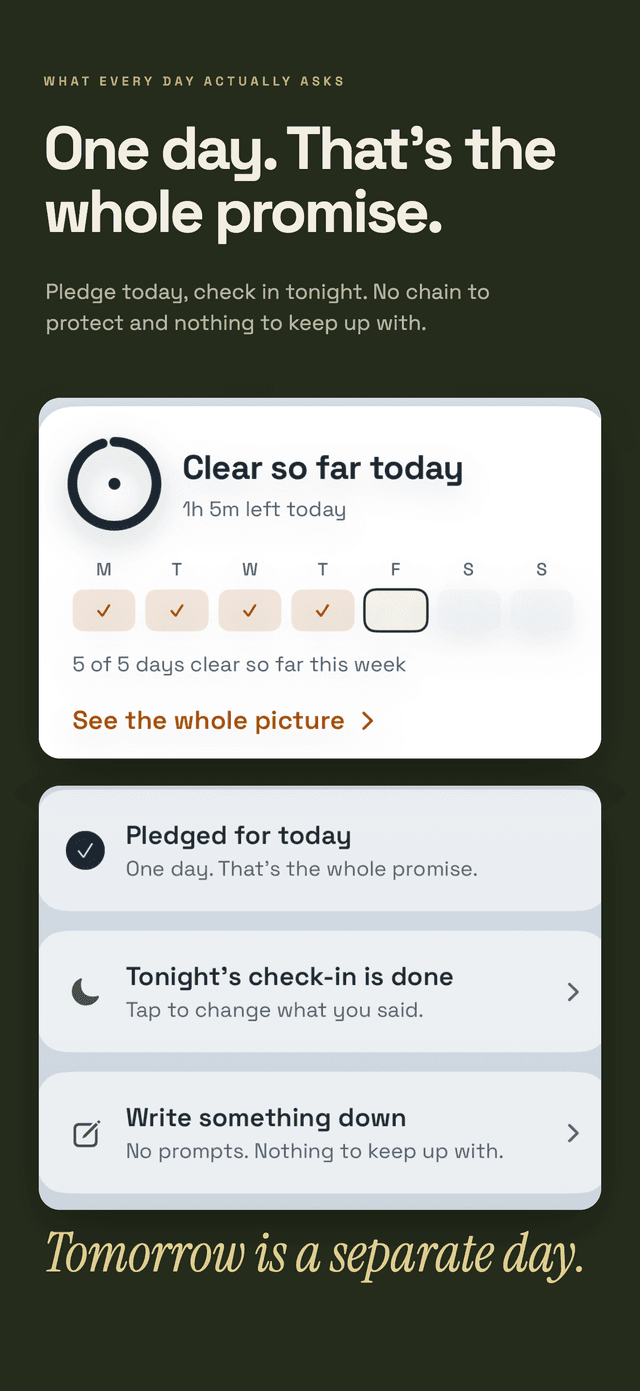
Hard Bit is an iPhone craving tracker that can hold more than one habit. Each habit keeps its own counter, logs, reason for changing, and difficult-hour record. You can choose to stop or cut down separately for each one.
Logging, the counter, journal, hard-moment flow, and export and deletion controls are free. Hard Bit Plus adds the forecast, warning message, patterns, calendar, widgets, and short reads.
The forecast is calculated on the device from the entries for that habit. It makes no prediction below five entries and relies more fully on personal history at around twenty. One newly added habit does not inherit another habit's pattern.
There is no account or social feed, and entries remain on the device. The Hard Bit overview describes the product and privacy model. If you need to correct or remove an entry, read how to delete a craving log you no longer want.
Frequently asked questions
How many habits should I track at once?
There is no universal number established by the sources reviewed here. Track only as many as you can record consistently. If entries become rushed or routinely missing, reduce the number under active review.
Do I need a different app or notebook for each habit?
No. One app, spreadsheet, or notebook can work if it gives every habit a distinct section, unit, goal, and history. The problem is not sharing a tool; it is sharing an undifferentiated total.
What if one habit triggers another?
Record the sequence in both logs, then look for the earliest changeable point. Keep each event in its own total. Consider professional support if the interaction increases medical, financial, or personal risk.
Can I track a habit before deciding whether to change it?
Yes, if tracking is safe for you. A baseline can show frequency, timing, and context. It does not oblige you to stop immediately, and it should not replace medical advice where withdrawal may be possible.
More practical articles are available in the Hard Bit guide library.