
To identify craving triggers, collect small facts close to each urge: the time, place, people, activity, feeling, and event immediately before it. Review those notes once a week. Look for combinations that repeat, such as “Friday, after work, alone, phone in hand,” rather than searching for one grand explanation.
A trigger is not proof that you will act. It is advance information. The practical goal is to notice a repeatable situation early enough to prepare a different next step.
Understand what a trigger can be
WithYou describes triggers as reminders of drug or alcohol use that can be outside us or inside us. Smokefree.gov similarly groups smoking triggers around moods, routines, social situations, and withdrawal. That broad view is useful beyond one habit.
External triggers can include:
- a place, route, room, shop, or website,
- a person or group,
- seeing a substance, device, advert, balance, or notification,
- an activity such as driving, cooking, gaming, watching sport, or going to bed,
- a particular day, payday, shift ending, or empty evening.
Internal triggers can include:
- stress, anger, loneliness, boredom, excitement, or shame,
- tiredness, hunger, pain, or restlessness,
- a thought such as “I deserve this” or “today is already ruined,”
- physical withdrawal symptoms.
Do not force every urge into a psychological story. Sometimes the strongest clue is an ordinary routine repeated at the same hour.
Use a log small enough to keep
A detailed diary can become another task you avoid. Start with six fields:
- Time and day
- Place
- What happened just before
- What you felt
- Urge intensity
- What you did next
One entry might read: “Saturday 9:20pm; sofa; football ended; restless; 8/10; opened betting app, then called my brother.” Another might say: “Weekday 7:40am; kitchen; coffee poured; automatic reach for vape; 6/10; walked outside without it.”
Use the same simple scale each time. The number does not need scientific precision. It only helps you compare your own entries.
If logging in the moment would make the situation less safe, do it later. Do not type while driving, during conflict, or when you need urgent help.
Include the quiet days as well
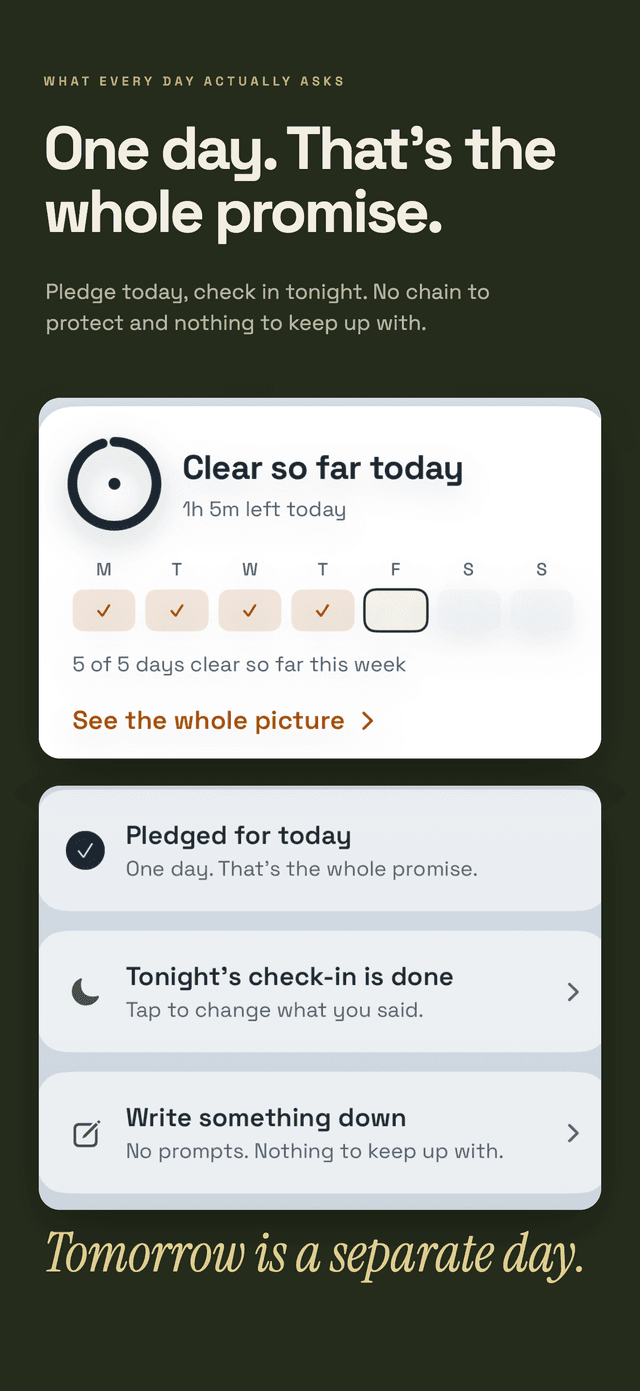
Only recording slips can distort the picture. Add a short daily check-in even when nothing dramatic happened:
- Was the day clear?
- Was there an urge?
- What time was hardest?
- What helped?
Clear days show protective conditions. You may discover that the same Friday evening goes differently when you eat before leaving work, avoid a particular route, or arrange to call someone.
Hard Bit is designed around this difference between an isolated event and a personal timetable. It keeps each habit's record separate and learns the difficult weekday and hour from logged history. The Hard Bit overview explains the on-device forecast and why it waits for real entries instead of inventing a prediction during setup.
Review combinations, not isolated clues
After a week, group entries by:
- weekday,
- hour or part of day,
- place,
- preceding activity,
- emotion or physical state,
- people present,
- device or access point.
One clue may be too broad. “Stress” happens in many settings. “Stress after the late shift, before dinner, while walking past the shop” is a combination you can work with.
Also look for sequences. A scrolling urge may begin with a work message, continue with opening one social app, and end in an hour of feeds. A gambling urge may begin with a match notification, then an odds advert, then checking a balance. The action you can change may occur before the point you previously called “the trigger.”
For a practical response sequence, read How to Handle a Craving in the Moment.
Find the difficult time without pretending it is destiny
Time patterns can be useful because they are concrete. Count how often an urge or use appears in each broad window:
- early morning,
- late morning,
- afternoon,
- early evening,
- late evening,
- overnight.
Then compare weekdays. You might find that the general statement “evenings are hard” is really “Thursday and Saturday between 9pm and 11pm.” That narrower pattern creates more options.
Treat an early pattern as provisional. A few entries can suggest a question, not establish a rule. Holidays, illness, travel, shift changes, and unusual events can temporarily change the shape. Keep the language honest: “This hour has appeared several times,” not “This hour will make me fail.”
Hard Bit makes no forecast below five entries and relies more fully on the user's own record at about twenty. Even without an app, use the same restraint. More observations should increase confidence gradually.
Turn one pattern into one preparation
Choose the clearest repeated combination and write a response before it returns:
- When: Saturday around 9pm
- Cue: alone after the match
- Early sign: checking scores again
- Change: put the phone on charge in the kitchen
- Alternative: shower and make food
- Support: text a friend before the final whistle
This is more useful than a generic promise to “be stronger.” It changes the route between cue and action.
Make the alternative realistic for that hour. A plan that requires a gym, an open shop, or high concentration may fail late at night. The best replacement activity fits the actual location, energy level, money, privacy, and responsibilities involved.
Notice when the pattern points to more support
A log may show worsening frequency, escalating spending, withdrawal symptoms, dangerous situations, or repeated inability to follow a safety plan. That is not a reason to hide the entries. It is a reason to seek qualified support.
If alcohol or sedative withdrawal may be possible, ask for medical guidance rather than attempting an abrupt stop based on a tracker. If gambling is creating debt or immediate financial risk, specialist services and practical financial barriers may be urgent. If you are at risk of harming yourself or someone else, contact emergency services.
A log can help you explain what has been happening. It cannot make a diagnosis or decide what level of care you need.
Keep the review compassionate and useful
Review the record as if you were studying a route, not prosecuting a case. Replace “Why did I do that again?” with:
- What happened first?
- What was different on the clear day?
- Which part could I change earlier?
- What support was missing?
- Is my current goal realistic and safe?
If a slip is part of the week, keep it in context. What to Do After a Slip Without Erasing Your Progress explains how to update the plan without deleting every clear day.
Our editorial policy describes how health-related claims and product facts are separated and reviewed.
Frequently asked questions
How many entries do I need to identify a trigger?
There is no universal number. One entry can reveal an obvious cue, but repeated entries make time and routine patterns more credible. Treat early findings as hypotheses and keep updating them.
Is stress always the real trigger?
No. Stress may matter, but so can tiredness, access, routine, social context, withdrawal, time of day, and learned associations. Record what happened rather than choosing an explanation in advance.
Should I avoid every trigger?
Avoidance can be sensible for high-risk situations, especially early in a change. Other triggers cannot be removed permanently and may need planning, support, or professional help. Safety comes before proving that you can tolerate a cue.
Can I track several habits together?
You can observe interactions, but keep separate records for each habit. One may cost money, another time; one may peak in the morning, another at night. A single score can hide those differences. More guides are available in the Hard Bit guide library.