Use Apple Contacts birthdays when the person already belongs in your address book and a single default birthday alert works for everyone. Use a dedicated birthday app when you want a smaller, separate list with different reminder timing, countdowns, or notes for each occasion.
The important difference is not simply which app sends a notification. It is where the birthday record lives. Contacts attaches the date to an address-book card. A dedicated app creates another record designed around birthdays and other occasions.
This article focuses on that record-keeping choice. For a feature-by-feature comparison centered on Calendar, widgets, and alerts, read Birthday Reminder app vs Apple Calendar.
Disclosure: Daily Life Apps publishes Birthday Reminder: Tracker. Apple claims below were checked against current Apple Support documentation, while product claims were checked against the app's public listing and privacy policy on 16 August 2026. Our editorial policy explains how we review comparisons involving our apps.
Quick verdict
Choose Apple Contacts if:
- The person is already saved for calls, messages, or email.
- You want one maintained record for their details and birthday.
- The same default alert timing works for most birthdays.
- You are comfortable seeing birthdays with other Calendar events.
Choose a dedicated birthday app if:
- You want to remember someone without keeping them in your everyday address book.
- Different birthdays need different preparation time.
- You want a countdown, gift idea, favourite, or planning note.
- You prefer a focused upcoming-birthdays list.
Neither approach makes an incorrect date accurate. Whichever system you choose, confirm the date and know where it must be corrected later.
The central difference: one contact card or a separate record
A Contacts birthday is a field on a person's contact card. The card may also contain a phone number, email address, photo, postal address, or other details, although it can remain minimal.
That structure is efficient when the person already belongs in Contacts. You update one card, and iPhone can display its birthday through Calendar's built-in Birthdays layer.
A dedicated birthday app uses a different model. The person or occasion exists in a focused list even if no matching contact card exists. That separation makes room for birthday-specific features, but it also means the app record must be maintained as its own copy.
This distinction matters more than the number of features. It determines whether adding a birthday also means adding someone to your general address book.
How Apple Contacts birthdays work
Apple's documented workflow is straightforward:
- Open Contacts and select the person.
- Tap Edit.
- Add or update the birthday.
- Tap Done.
To display the date in Calendar, open Calendar, tap Calendars, and select Birthdays. Apple says this includes birthdays from Contacts with your other events.
The default alert setting is under:
Settings > Apps > Calendar > Default Alert Times > Birthdays
This is a category-level choice. Apple does not document a different alert schedule for each birthday generated from a contact card.
For complete setup instructions, use the guide to add a birthday to iPhone Contacts or the broader walkthrough for adding birthdays to iPhone Calendar and getting reminders.
Where the Contacts model creates friction
Contacts is a communication directory, not a curated birthday list. That creates three practical trade-offs.
The person joins your general address book
You do not need to add a phone number merely to record a birthday, but the person still appears as a contact. That may be unnecessary for a friend's child, former teacher, distant relative, or anyone you want to acknowledge annually without keeping in your everyday directory.
Alert timing is shared
Apple provides one default alert choice for the Birthdays category. That works when most birthdays receive the same response.
It is less useful when one person needs a same-day message, another needs a card posted a week early, and a milestone birthday requires a month of preparation. You can create separate events or tasks for those actions, but doing so introduces additional records to maintain.
Duplicate and linked cards need inspection
Apple says iPhone can identify cards with the same first and last name and offer to merge them. It also allows cards from different accounts to be linked so they appear as one unified contact.
Linked cards are not merged. Apple states that when information is changed or added in a unified contact, changes are copied to each source account where that information already exists. That qualification matters: linking does not create one new authoritative source card.
If a birthday looks wrong, inspect the linked source cards before correcting or deleting anything. The guide to correcting a wrong birthday date on iPhone covers that diagnosis in more detail.
What a dedicated birthday app changes
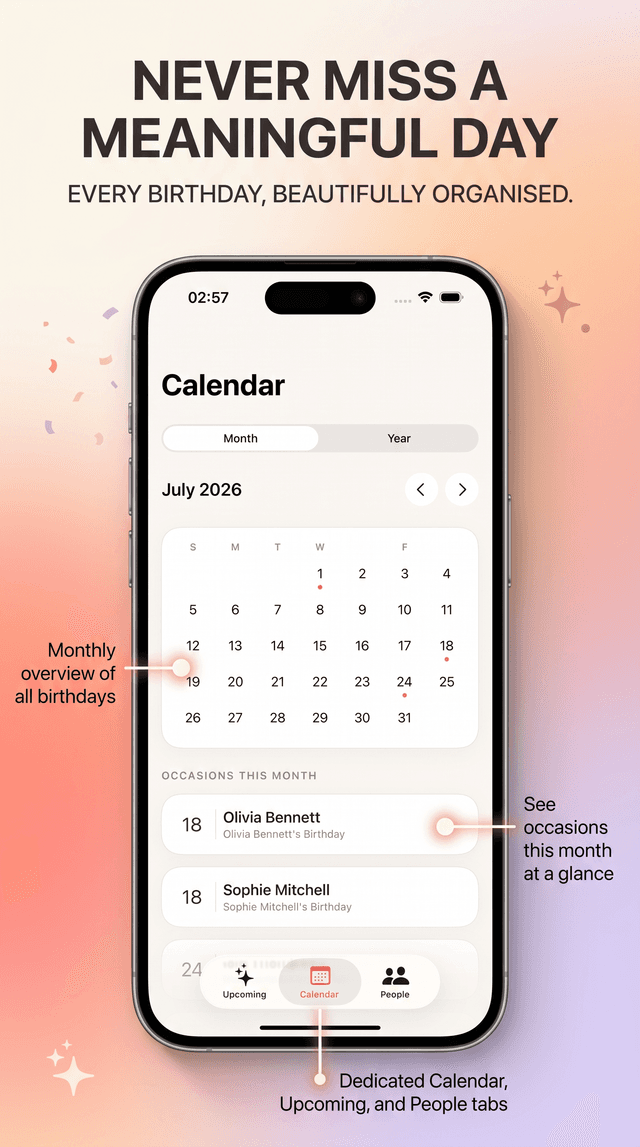
Dedicated apps vary, so their capabilities must be checked individually. Birthday Reminder: Tracker provides one concrete example.
Its current App Store listing confirms:
- Countdowns for upcoming birthdays and occasions.
- Custom lead days and alert time for each occasion.
- Personal notes and gift ideas.
- Favourites.
- Optional importing from Contacts.
- A Home Screen widget.
- No required account.
You can enter someone manually instead of importing them. This creates a focused birthday record without adding or changing a card in Contacts.
The trade-off is independence. If the same birthday exists in Contacts and the app, there are now two records. The public listing confirms import but does not promise continuous synchronization after import, so a later correction should be checked in both places.
Apple Contacts vs a dedicated app at a glance
| Factor | Apple Contacts birthdays | Birthday Reminder example |
|---|---|---|
| Primary record | Contact card | Separate person or occasion record |
| Address-book entry required | Yes | No; manual entry is available |
| Calendar visibility | Built-in Birthdays calendar | Focused upcoming list and countdown |
| Alert control | One default choice for the Birthdays category | Lead days and alert time per occasion |
| Planning context | General contact fields | Notes, gift ideas, and favourites |
| Contact import | Not applicable; Contacts is the source | Optional |
| Main maintenance risk | Duplicate or linked contact cards | A separate copy can drift from Contacts |
This is not a claim that one storage model is inherently more accurate. Accuracy depends on the date you enter and whether you update the correct record later.
Which setup fits each person?
Use these questions rather than choosing one system for everyone:
- Would I keep this person in Contacts even without their birthday?
- Does this birthday need different preparation time from most others?
- Would a countdown or short planning note change what I do?
- Am I willing to maintain a separate record if the date changes?
If the first answer is yes and the others are no, Contacts is probably sufficient.
If the person does not otherwise belong in your address book, or the birthday needs individual preparation, a dedicated record is more useful.
A practical boundary could be:
- Keep regular callers and message contacts in Contacts.
- Keep birthday-only relationships in a dedicated app.
- Use individual reminders for birthdays involving cards, gifts, reservations, or travel.
- Avoid storing the same person twice unless each copy has a clear purpose.
The birthday reminder timing guide helps translate each intended action into a useful lead time.
Can you use both systems?
Yes, but decide what each system owns.
One restrained setup is:
- Keep confirmed dates in Contacts for people already in your address book.
- Import only birthdays that need countdowns, notes, or individual timing.
- Add birthday-only relationships manually in the dedicated app.
- Choose which system should send the active alert.
- Check every separate copy when a date changes.
Do not assume import creates a live connection. Treat it as a copy unless the app explicitly documents ongoing synchronization.
For a controlled workflow, read how to import birthdays from Contacts without creating clutter. The simple birthday planning system can then help separate remembering the date from preparing the next action.
Privacy depends on the record, not the category name
A dedicated app is not automatically more private than Contacts, and Contacts is not automatically safer because it is built in. The relevant questions are where the record is stored, which accounts or permissions are involved, and whether data leaves the device.
Birthday Reminder's privacy policy states that added information is stored locally on the device through an Apple App Group container. Contact access is optional, and selected imported information is stored locally and not sent to Daily Life Apps.
Keep notes minimal in either system. A birthday reminder rarely needs sensitive personal history.
Frequently asked questions
Do I need a phone number to save a birthday in Contacts?
The birthday belongs to a contact card, but the card can remain minimal. The person will still appear in the Contacts app rather than in a birthday-only list.
Can every Contacts birthday have different alert timing?
Not through Apple's documented Birthdays-calendar workflow. Calendar provides one Default Alert Times choice for the Birthdays category. Separate recurring events or reminders are different records and require their own maintenance.
Does merging contacts guarantee the birthday is correct?
No. Merging can resolve duplicate cards, but it cannot determine whether the stored date is accurate. Review the birthday after merging and confirm it from a reliable source if necessary.
Will an imported birthday stay synchronized with Contacts?
Do not assume so. Birthday Reminder's listing confirms optional contact import but does not promise continuous synchronization. Check both records after changing a date.
Is a dedicated birthday app more private?
Not universally. Birthday Reminder documents local storage, optional contact access, and no required account. A fair comparison still depends on the current privacy policy and permissions of the specific app.
Should I move every birthday out of Contacts?
No. Leave a birthday in Contacts when that card is already useful and Apple's shared alert meets your needs. Create a separate app record only when the focused list or additional controls solve a real problem.
Apple Contacts is the simpler home for birthdays attached to people already in your address book. A dedicated app is the better fit for a separate birthday list, individual timing, countdowns, and planning notes.
Visit the Birthday Reminder app page to review its current features, or browse all Birthday Reminder guides for related setup and planning advice.