
The best group birthday card messages add something the card does not already contain. Before writing, read the other entries and choose one useful contribution: a specific thank-you, a shared memory, an observed quality, a fitting wish, or a joke that remains comfortable in a shared setting.
On a paper card, one or two lines is usually enough. On a digital card, space may be unlimited, but the message is still part of a collection. The goal is not to write the card's grand finale. It is to leave one recognizable thought that works beside everyone else's.
Use the Read-Pick-Write Method
A blank space becomes easier to fill when each step has one job.
- Read: Check which wishes, memories, and jokes have already appeared.
- Pick: Choose a type of contribution nobody else has used.
- Write: Add a greeting, one specific thought, and your sign-off.
Kudoboard describes a group-card message with the same basic structure: greeting, main content, and sign-off. The important group-specific step is reading first. If three people have already praised the recipient's humor, a fourth version adds less than a brief thank-you or a wish tied to something currently happening in their life.
Use this test before signing:
Does my line give the recipient one thought they have not already read?
It does not need to be profound. It only needs to be true, suitable for the shared audience, and different enough to earn its space.
Pick a Message Role Nobody Else Has Used
Instead of searching for a grand sentiment, choose a lane:
| Message role | Use it when | Prompt |
|---|---|---|
| Specific thanks | The person helped you or the group | “Thanks for always…” |
| Observed quality | You know them through a shared setting | “I appreciate how you…” |
| Shared memory | You have a safe story others can read | “I still smile about…” |
| Forward-looking wish | They have a known interest or plan | “I hope this year brings…” |
| Light humor | You know the joke will land kindly | “Another year of…” |
A useful message can be as simple as:
Happy birthday, Mina. Thanks for making every new person feel included from day one. Hope you have a brilliant celebration.
The first and last sentences could appear in many cards. The middle sentence makes this one Mina's.
If you want a broader method for collecting personal details before a birthday, use the guide to planning birthday messages without making them generic. This guide stays focused on the different problem of contributing to a shared card.
Group Birthday Card Messages to Adapt
Treat these as patterns rather than finished scripts. Replace every invented detail with something you know is true.
When the Card Already Has Plenty of General Wishes
If the page is full of “have a great day” messages, add evidence instead of another variation.
Happy birthday, Alex. Thanks for being the person who notices when someone needs a hand before they have to ask.
Happy birthday! Your calm explanation rescued more than one confusing afternoon this year. I appreciate it.
Wishing you a great birthday. I hope this is the year you finally get enough weekends for all those hiking plans.
When You Know the Recipient Well
Choose a small memory or familiar habit that is safe for the whole group to see.
Happy birthday, Jo. I still laugh about the picnic that lasted twelve minutes before the rain arrived. Here's to better weather next time.
Happy birthday to the person who always remembers everybody's coffee order. Today, somebody else should be bringing yours.
Another year of excellent stories and deeply questionable board-game tactics. I would not change either.
An inside reference does not have to make every signer laugh. It does need to avoid embarrassing the recipient or exposing something private.
When You Barely Know the Recipient
Do not invent intimacy. Use a modest observation from the context you share.
Happy birthday, Priya. It has been lovely getting to know you during this project. Hope you get time to celebrate properly.
Wishing you a very happy birthday and plenty of good things in the year ahead.
Happy birthday! Thanks for making me feel welcome when I joined the group.
A simple sincere line is better than a detailed claim you cannot support.
For a Workplace or Team Card
Keep praise human rather than turning the message into a performance review.
Happy birthday, Dan. Your lunch recommendations have improved this office considerably. Hope today's choice is a good one.
Wishing you a great birthday and a day with fewer meetings than usual.
Happy birthday! Thanks for answering all my supposedly quick questions with such patience.
Avoid comments about salary, promotion, workload, age, attendance, or performance. Even positive feedback can feel awkward when placed in a social card signed by colleagues.
For a Family or Friend Group
Use shared traditions, harmless history, or plans that are already real.
Happy birthday, Grandpa. Thanks for another year of stories that somehow become more dramatic each time.
Happy birthday! Sunday dinners would be much quieter without you, though not necessarily more orderly.
Another year, another strong chance that you will choose the restaurant for all of us. I cannot wait to celebrate on Saturday.
For one-on-one messages organized by parent, partner, sibling, friend, and coworker, use the separate guide to birthday card message examples by relationship.
Keep the Message Safe for a Shared Audience
Thankbox notes that a group-card message is visible to the other contributors, not only the recipient. Read your line as though it might be repeated aloud when the card is presented.
Usually leave out:
- Private health, relationship, financial, or family information.
- A joke that makes the recipient or another person the target.
- Criticism disguised as teasing.
- Work complaints or feedback.
- An unannounced surprise that the card could reveal.
- A promise or future plan that has not been arranged.
- A memory another signer has already used.
“Shared” does not have to mean bland. A specific detail can remain warm and recognizable without being confidential.
Use Paper Space Without Making It Awkward
When signing early, do not claim the center of the card or compress your message into a tiny corner. Thankbox recommends leaving enough room for others while still writing at a readable size.
A practical approach is to:
- Choose a normal-sized block away from the center.
- Keep the message to one or two lines if many people still need to sign.
- Leave clear blank areas rather than scattering words across the page.
- Sign your name legibly so the recipient knows who wrote it.
- Put a longer, private message in a separate card or text.
If only a narrow gap remains, a greeting and your name are enough. Do not write over another message or force a paragraph into unreadable handwriting.
Adapt the Method for a Digital Group Card
A digital card removes the fixed-space problem, but not the need to contribute something distinct. Scroll through the existing entries before posting. Check the audience, particularly if colleagues, relatives, or several generations can view the same board.
If the service supports photos, video, GIFs, or other media, use them only when they add a safe shared memory. A photo the recipient would happily display can be useful. An embarrassing image that depends on surprise is better kept private.
Unlimited space is also not a reason to write an essay. A concise entry is easier to read as part of a card containing many voices.
Organize Signers Without Chasing Everyone at the Last Minute
If you are arranging the card, decide who should be invited and set one clear internal deadline before the card must be delivered. Thankbox recommends sending a final call a few days before that deadline.
For a physical card, keep a simple list of invited contributors and mark each person off after they sign. For a remote group, a shared note can track who has contributed without exposing the card to the recipient.
Apple confirms that an iCloud note can be shared by link, with access limited to chosen people or anyone with the link and permissions set to edit or view. Participants see changes in real time. They must be signed in to an Apple Account and have Notes enabled in iCloud, so use another shared tool when that requirement does not fit the group.
Keep the organizer list minimal:
- Invited
- Signed
- Needs a reminder
- Card delivery owner
- Delivery date
Do not ask everyone to submit their full message to the tracking note. That creates unnecessary exposure and turns a simple birthday gesture into an approval process.
The birthday reminder timing guide helps you choose a start date when the card must travel between desks, be posted, or reach remote contributors. The more specific birthday card planning guide covers buying, writing, addressing, and mailing a physical card.
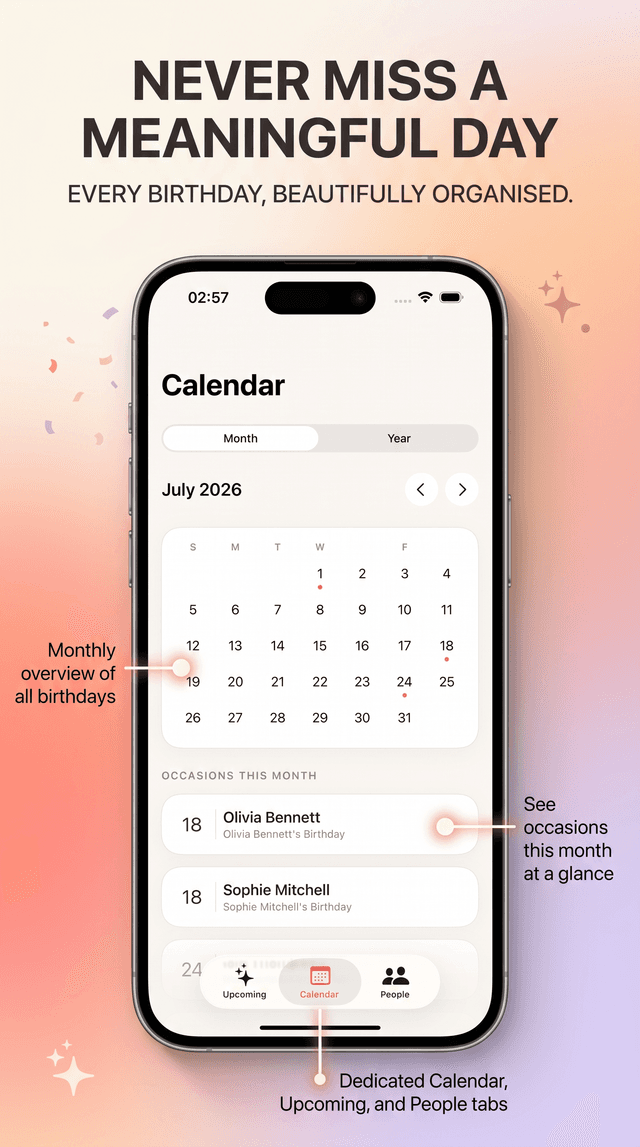
Birthday Reminder can hold the birthday, a short planning note such as “start team card,” and a per-occasion reminder with chosen lead days and alert time. Use that alert for the first organizing action, then use a shared note or task list for contributor status. The app also provides countdowns and a Home Screen widget without requiring an account.
Frequently Asked Questions
What should I write when everybody else has already said happy birthday?
Add a different kind of contribution. Thank the recipient for one concrete action, mention a safe memory, name a quality you have observed, or make a wish connected to a real interest.
Is it acceptable to write only “happy birthday” and my name?
Yes. That is appropriate when you do not know the person well or when the card is almost full. A short sincere entry is better than invented familiarity.
How long should a group birthday card message be?
For a paper card with many signers, one or two lines is a useful default. A digital entry can be longer, but it should still work as one part of a collection rather than dominate it.
Can I use an inside joke?
Use it when the recipient will enjoy it and the wording remains comfortable for everyone else to see. Avoid jokes that expose private information, embarrass someone, or require another person to be the target.
Who should write in the center of a group card?
There is no required person. When signing early, leave the center and other usable areas open rather than claiming the most prominent space. The organizer can decide whether a collective note, illustration, or longer message belongs there.
What if someone has already written the memory I planned to use?
Choose another detail rather than merely rephrasing the same story. If that is your only shared memory, write what the event showed you about the person, such as their patience, humor, or generosity.
A strong group-card message fits beside other people's words. Read first, choose an unclaimed contribution, write one true detail, and leave room for the next person.
Visit the Birthday Reminder app page to see how countdowns, notes, flexible reminders, and a Home Screen widget can help start the card on time. You can also browse the other Birthday Reminder guides or read our editorial policy.