If push alerts make you delete reminder apps, the answer is not another app promising even more reminders. A birthday reminder app without notification overload should remain useful when alerts are reduced or disabled. It should also let important birthdays use different timing from routine ones.
The quietest arrangement is a visible widget with notifications off. A more dependable compromise is one carefully timed alert, with sounds, banners, and badges removed if you do not need them. Before changing either, remove duplicate birthday schedules so several apps are not notifying you about the same person.
This article compares notification strategies rather than ranking every birthday product. For feature-by-feature alternatives, use the birthday reminder apps for iPhone comparison.
Disclosure: Daily Life Apps publishes Birthday Reminder: Tracker. Its product claims below were checked against its current App Store listing, using the same standard applied to platform claims. Our editorial policy explains that process.
Quick verdict: choose how quiet you want the system
| Setup | What you notice | Best for | Main risk |
|---|---|---|---|
| Widget only | Upcoming birthdays when you look at the screen | People who want no push alerts | Easy to miss if the widget is rarely visible |
| Notification Center only | A quiet entry you can review later | People who want an alert without interruption | Can accumulate with other notifications |
| Scheduled Summary | Birthday notices at chosen summary times | Early planning reminders | A same-day notice may arrive too late |
| One direct alert | A banner or sound at a chosen time | Important or time-sensitive gestures | Becomes noisy if duplicated across apps |
| Several alerts | Separate preparation deadlines | Gifts, bookings, travel, or group plans | Repeated generic alerts train you to dismiss them |
Start with the quietest row you can reliably act on. More notifications are justified only when each one has a different job.
What actually causes birthday notification overload
The number of people in your list is only part of the problem. Noise usually comes from configuration.
Duplicate records are the most common avoidable cause. The same birthday may exist in Contacts, a recurring Calendar event, Reminders, and a dedicated app. Each source can create its own alert.
Category-wide timing can also be a poor fit. Apple provides one Default Alert Times > Birthdays setting for the Birthdays category. That is convenient when everyone needs the same notice, but it is not documented as a separate schedule for every contact.
Too many delivery surfaces make one notification feel like several. A birthday can create a sound, Lock Screen appearance, banner, Notification Center entry, and badge even though all five belong to one alert.
Finally, repeated alerts often lack separate purposes. “Birthday in seven days,” “birthday tomorrow,” and “birthday today” may be useful for one complex plan but excessive for a message that takes thirty seconds.
Compare the main iPhone birthday reminder approaches
Apple Contacts and the Birthdays calendar
A birthday stored in Contacts can appear in Apple's Birthdays calendar. Calendar settings provide a single default alert choice for that category.
This is the lowest-maintenance option when your contact records are accurate and one standard alert suits everyone. Its weakness is per-person control. A parent whose gift needs ordering and a colleague receiving a same-day message inherit the same category setting unless you create another task or event.
Choose it when you want basic annual awareness without maintaining another app. The broader birthday calendar versus reminder app comparison covers the maintenance trade-offs.
Apple Reminders
Apple Reminders supports a scheduled date and time, yearly repetition, and an Early Reminder. Each task can therefore have its own timing and wording.
That is useful when the real task is “post Maya's card” rather than merely “Maya's birthday.” The cost is manual upkeep: the task remains separate from the birthday in Contacts, and every person needs an individual reminder.
Choose it when only a few birthdays require preparation tasks and you already use Reminders consistently.
Dedicated birthday reminder apps
Dedicated apps can keep the person, date, countdown, notes, and reminder settings together. Their notification controls vary, so do not assume that every app supports per-person timing, widgets, or silent use.
Check four things before importing a large list:
- Can notifications be disabled while the list remains useful?
- Does the app provide a widget or upcoming view?
- Can timing vary by occasion?
- Does importing create a separate copy that could duplicate an existing alert?
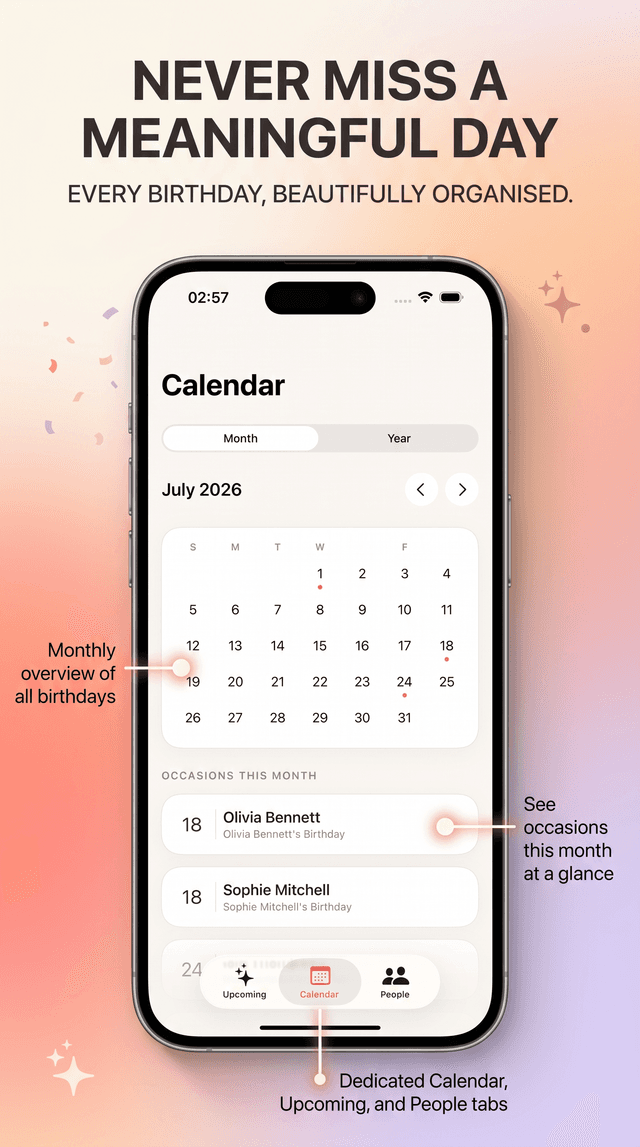
Birthday Reminder: Tracker's current App Store listing confirms a Home Screen widget, no required account, optional contact import, countdowns, and per-occasion lead days and alert times. The listing does not explicitly confirm a Lock Screen widget, so verify that format in the widget gallery if Lock Screen placement is essential.
Choose a quieter iOS delivery style
You do not have to choose between every alert and no app at all.
Silent: use a widget and disable notifications
Apple says widgets can show timely app information on the Home Screen, Lock Screen, or Today View when the app supplies the relevant format.
Add the birthday widget somewhere you already look, then open Settings > Apps > [app] > Notifications and turn off Allow Notifications. This changes notification permission rather than uninstalling the app.
A widget is only effective when it remains visible. Do not bury it on a rarely visited Home Screen page or inside a stack that seldom displays it.
Quiet: retain Notification Center but remove interruptions
If a widget alone feels too passive, leave notifications allowed but turn off the surfaces you dislike. Depending on the app and iOS version, you can remove sounds, banners, Lock Screen appearances, and badges while retaining Notification Center delivery.
This creates a reviewable alert without placing a banner over your current task. Test it with a temporary date because available notification controls can vary.
Batched: use Scheduled Summary
Scheduled Summary groups notifications from selected apps and delivers them at times you choose. It is suitable for notices such as “order the gift this week,” where immediate delivery is unnecessary.
Do not batch a birthday-morning reminder unless the summary arrives before you intend to call or message. Summary delivery controls interruption, not the underlying reminder time.
Protected hours: use Focus
A Focus can allow or silence notifications from selected apps during work, sleep, or another protected period.
The separate Time Sensitive Notifications option permits notifications classified as time sensitive to arrive immediately. Do not assume every birthday alert receives that classification. If an alert must arrive during a Focus, test the exact app and setup.
Build a low-noise birthday setup
Use this process before adding more reminders:
- Choose one alert owner. Decide whether Contacts and Calendar, Reminders, or a dedicated app will send the primary birthday alert.
- Remove duplicates. Search each system for the same two or three people. The guide to finding duplicate birthday entries on iPhone provides a fuller audit.
- Assign a notification budget. Use zero push alerts for widget-only birthdays, one for ordinary gestures, and more only for separate deadlines.
- Match timing to the action. A message may need same-day notice. A card, delivery, booking, or journey needs longer. Use the birthday reminder timing guide for practical lead times.
- Choose the delivery style. Use widget-only, Notification Center, Scheduled Summary, or a direct alert.
- Test one temporary birthday. Confirm the alert, Focus behavior, summary timing, and widget update before relying on the setup.
- Review after one month. Remove anything you dismissed automatically and strengthen only signals you genuinely missed.
This keeps notification volume tied to real actions rather than the number of features an app offers.
Diagnose repeated or unexpected birthday alerts
When two alerts appear for one person, compare their app icons and wording before dismissing them. They may come from different records.
Check:
- The Birthdays calendar alert setting.
- Manually created recurring Calendar events.
- Yearly tasks in Reminders.
- Every installed birthday app.
- Old imports that remain after you changed systems.
Turning off one app's notifications can hide the symptom, but deleting or disabling the duplicate schedule is cleaner. Keep one accurate source of truth and record where future corrections should be made.
If you prefer an intentionally small system, the minimal birthday reminder workflow shows how to limit both the list and its maintenance.
Frequently asked questions
Can I use a birthday app with no push notifications?
Yes, if the app provides another useful view. Turn off Allow Notifications for that app and use its Home Screen widget or in-app upcoming list. Test whether you look at that surface often enough before depending on it.
Will turning off notifications delete my birthdays?
No. Apple's control changes whether the app may send notifications; it does not uninstall the app. Your storage and backup arrangements remain separate questions.
Is a widget the same as a notification?
No. A widget displays information when you view the relevant screen. It does not guarantee an interruption or require you to acknowledge anything.
Why does Apple Calendar use the same birthday alert for everyone?
Apple documents one Default Alert Times control for the Birthdays category. For individual timing, use separate Reminders tasks, ordinary events, or a dedicated app that explicitly supports per-occasion settings.
Is Focus better than Scheduled Summary?
They solve different problems. Focus protects particular activities or hours by allowing or silencing selected apps. Scheduled Summary batches eligible notifications for delivery at scheduled times. Use Focus for boundaries and Summary for non-urgent notices.
How many alerts should one birthday have?
Use one primary signal for a routine message or call. Add another only when it represents a different action, such as ordering a gift or confirming a booking. Several generic countdown alerts usually create noise without improving preparation.
Which quiet birthday app should I choose?
Choose one that remains useful with notifications disabled, documents the widget surface you need, supports suitable occasion-level timing, and does not force you to duplicate records. Verify those capabilities in a current first-party listing rather than relying only on screenshots or reviews.
A quiet birthday system should surface a person when there is something useful to do, then get out of the way. Start with a widget or one restrained alert and add complexity only when a real deadline requires it.
Visit Birthday Reminder to review its current countdown, reminder, and widget features, or browse all Birthday Reminder guides for related setup and planning advice.