A birthday reminder app with widgets should do more than place a pleasant countdown on your iPhone. Its first job is to deliver the right alert early enough for you to act. The widget should then make the same birthday easy to notice between alerts.
Choose the reminder system first. Confirm the exact widget formats second. A strong option lets you set useful timing for each person, keeps edited dates consistent across the app and widget, and shows enough context to identify the next birthday at a glance.
This guide evaluates that combination rather than ranking decorative countdown apps. For named widget recommendations, use the ranked birthday countdown widget comparison.
Disclosure: Daily Life Apps publishes Birthday Reminder: Tracker, discussed below. Our editorial policy explains how we verify claims about our own products.
Decide whether you need a reminder or decoration
Start by defining the job.
A decorative countdown app may be ideal when you want one large number for your own birthday, a party, or another event. A birthday reminder app is designed for a different problem: remembering several people and acting at an appropriate time for each one.
Ask what would make the app fail for you:
- Missing the alert entirely.
- Receiving it too late to post a card or order a gift.
- Seeing a countdown without knowing whose birthday it is.
- Editing a date while the old date remains visible.
- Discovering that the advertised widget is unavailable on your preferred screen.
If alert timing and a multi-person list matter, do not let an attractive widget compensate for a weak reminder workflow. The broader guide to birthday countdown apps and widgets covers the separate choice between single-event countdowns and complete birthday trackers.
Use a reminder-first scorecard
Score every candidate with the same priorities:
| Criterion | Weight | What to verify |
|---|---|---|
| Reminder control | 30 | Lead days, alert time, notification permission, and whether settings can vary by person |
| Record consistency | 20 | Date edits, upcoming order, age calculation, and widget content agree |
| Widget usefulness | 20 | Supported screens, readable names, countdowns, dates, and useful sizes |
| Privacy and permissions | 15 | Account requirement, contact access, storage explanation, and privacy policy |
| Setup and maintenance | 10 | Manual entry, editing, importing, troubleshooting, and device-transfer options |
| Appearance | 5 | Legibility, contrast, and themes that do not crowd out information |
This weighting is deliberately unfriendly to apps that lead with dozens of themes but say little about alerts. A widget is useful because it supports the birthday system, not because it raises the total feature count.
For reminder lead times, compare each app against the practical schedules in the birthday reminder timing guide.
Verify the exact iPhone surface
“Widgets included” is not specific enough.
Apple documents separate user steps for adding widgets to the Home Screen, Lock Screen, and Today View. Its design guidance also distinguishes the formats used in those places:
| Surface | Format to look for | Best birthday use |
|---|---|---|
| Home Screen | Small, medium, or large system widget | One countdown or a short upcoming list |
| Today View | Small, medium, or large system widget | Birthday visibility without permanent Home Screen space |
| Lock Screen | Circular, inline, or rectangular accessory widget | One compact name, date, or countdown |
| StandBy | A small system widget scaled for the charging display | A readable desk or bedside countdown |
Lock Screen support requires an appropriate accessory format, so a Home Screen widget does not establish that a Lock Screen version exists.
StandBy is different. Apple says an app's small system widget can be selected there and scaled to half the screen. Developers still need to make that layout readable with larger type and a removable background. Test the result rather than assuming that every small Home Screen design will look good from across a room.
To start StandBy, enable it in Settings, connect the iPhone to a charger, place it stationary on its side, and press the side button.
Test whether edits stay consistent
You cannot inspect an app's internal architecture from its store listing. You can test the outcome.
Create a temporary birthday, add the widget, and then change the date. Check these three places:
- The person's record inside the app.
- The order of birthdays in the upcoming list.
- The name, date, age, or countdown displayed by the widget.
They should eventually agree. Also edit the reminder lead time and confirm that the new setting was saved. The widget does not need to display notification settings, and turning off a notification should not necessarily hide the birthday. Those are separate choices.
This test is more meaningful than counting layouts because it checks whether the visible widget remains dependable after ordinary maintenance.
Understand refresh limits without excusing stale data
Widgets are not continuously running miniature apps. Apple says WidgetKit renders them in a separate process and manages reloads through a changing system budget.
For a frequently viewed widget, Apple says that budget typically includes about 40 to 70 refreshes over 24 hours. It roughly corresponds to reloads every 15 to 60 minutes, but the actual interval varies with visibility, usage, app activity, and system decisions. It is not a delivery promise from Apple or the app developer.
Apple also lets developers use dynamic dates that the system updates between full reloads. A countdown can therefore change without the widget extension running constantly, but the app must implement that behavior.
After editing a birthday, allow time for iOS to update the widget. Follow the developer's support instructions if it remains wrong. Do not accept an exact “updates every 15 minutes” claim unless the publisher explains that iOS still controls the final schedule.
Review what the widget reveals
A widget makes birthday information easier for you to see and potentially easier for someone nearby to see.
Before placing it, consider:
- Whether it shows a full name, photo, birth date, age, or only days remaining.
- Whether the Lock Screen is visible while the phone is locked.
- Whether StandBy faces a shared room, workplace, or bedside area.
- Whether a less exposed Home Screen or Today View placement would be sufficient.
Check the App Store privacy section as well, but understand its limits. Apple says privacy information is self-reported by the developer. App listings may also state explicitly that Apple has not verified the declaration.
If your phone is shared or regularly handled by other people, read the guide to keeping birthday reminders private on a shared iPhone.
Compare the three main approaches
| Approach | Main advantage | Main limitation |
|---|---|---|
| Apple Contacts and Calendar | No additional app; general Calendar widgets are available | One default alert choice for the Birthdays event type and no documented numerical birthday countdown |
| Decorative countdown app | Strong visual treatment for one event | May lack a multi-person list or per-person reminder controls |
| Dedicated birthday reminder app | Combines upcoming birthdays, alerts, countdowns, and planning details | Requires setup and careful comparison of widget formats |
Apple Calendar is a sensible baseline when a standard birthday alert is enough. Its settings provide one default alert selection for Birthdays rather than a separate schedule for each person.
For a wider comparison that is not limited to widgets, see the best birthday reminder apps for iPhone.
Run a two-birthday acceptance test
Before importing contacts or paying for extra layouts:
- Add two birthdays manually, one with a birth year and one without.
- Give them different reminder lead days and alert times.
- Add the Home Screen widget and note which sizes are available.
- Check the Lock Screen gallery separately.
- Test StandBy while charging if you intend to use it.
- Edit one birthday and confirm that the list and widget eventually agree.
- Verify notification permission in iPhone Settings.
- Read the privacy policy and App Store privacy section.
- Import more people only after the app passes.
A good result is simple: you can identify the next person at a glance, the countdown is correct, and each reminder setting matches what you saved.
Where Birthday Reminder fits
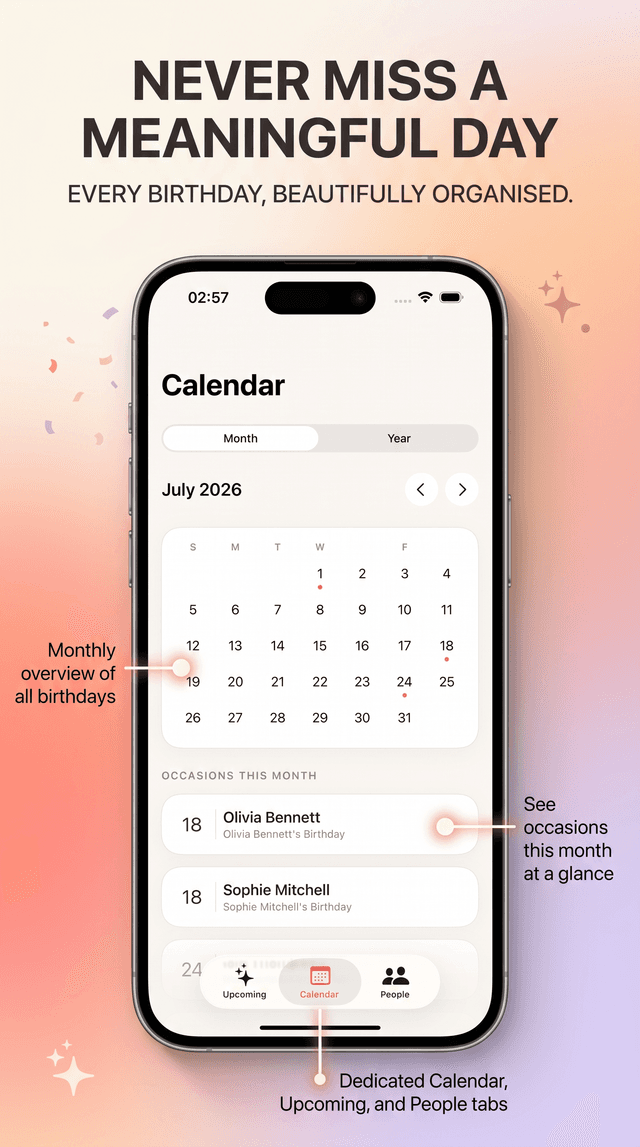
As checked on September 5, 2026, the Birthday Reminder: Tracker App Store listing confirms birthday and occasion countdowns, per-occasion reminder lead days and alert times, optional contact import, notes, gift ideas, favourites, upcoming-age calculations, and no required account.
The listing explicitly names a Home Screen widget. It does not explicitly name a Lock Screen or StandBy widget, so verify either format in the relevant gallery if it is important to your decision.
The listing also says birthday information stays on the device and displays a developer-declared Data Not Collected label. Apple states on the listing that this privacy information has not been verified by Apple.
Visit the Birthday Reminder app page for its current feature summary and App Store link.
Frequently asked questions
What matters most in a birthday reminder app with widgets?
Reminder control matters most. Confirm that you can choose a useful lead time and alert time, then test whether the widget accurately shows the birthdays stored in the app.
Does a Home Screen widget guarantee Lock Screen support?
No. The Lock Screen uses accessory widget formats that the app must provide. Search for the app in the Lock Screen widget gallery.
Does every small widget work in StandBy?
Apple allows small system widgets to appear in StandBy, but the layout still needs to be readable in that context. Test the app while the phone is charging on its side.
Why did my widget not change immediately after an edit?
WidgetKit reloads widgets on a variable, system-managed schedule. Open the app and follow its support guidance if the old information persists, but do not expect a guaranteed minute-by-minute refresh.
Should a birthday widget show several people?
A medium or large Home Screen widget can usefully show several upcoming names. Compact and Lock Screen formats usually work better when they clearly identify one nearest birthday.
Do I need to import contacts?
No. Test manual entry first when an app offers it. Grant contact access only if importing will save enough work and the app clearly explains which information it uses.
The best widget is not the one with the most themes. It is the one that supports a reliable reminder system, identifies the right person quickly, and remains useful on the screen you actually check.
Browse all Birthday Reminder guides for related setup, comparison, and planning advice.