In a birthday widget vs notification comparison, neither option is universally more reliable. They ask for attention in different ways.
A widget displays upcoming birthdays when you view the Home Screen, Lock Screen, or Today View where it has been placed. A notification is scheduled for a specific time and can appear without you opening the birthday app. The notification still depends on permission, delivery settings, and Focus rules.
Use a widget for continuing awareness. Use a notification when you need to order a gift, post a card, make a booking, call, or send a message at a useful time.
Quick verdict
Choose a birthday widget when:
- You look at the same Home Screen or Lock Screen frequently.
- You want the next birthday or countdown visible without another alert.
- You prefer passive information that does not need to be dismissed.
- Missing one glance would not leave you without time to act.
Choose a birthday notification when:
- You need a prompt on a particular day or at a particular time.
- The birthday involves a deadline, such as ordering, posting, or booking.
- You rarely notice widgets during normal phone use.
- You want a final prompt to call or message.
For most important birthdays, use both. The widget keeps the date familiar, while the notification prompts the next action.
If your main concern is reducing interruptions, see the guide to birthday reminders without notification overload. For layout and placement advice, use these practical birthday countdown widget ideas.
The fundamental difference: visibility versus delivery
Apple describes widgets as a way to see timely app information at a glance. iPhone supports widget locations on the Home Screen, Lock Screen, and Today View, but an individual app must provide a suitable format for each location.
A widget does not announce that it has new information. It occupies a chosen screen position until you remove or replace it, and its displayed content can change as dates approach. You still need to view that screen and interpret what it shows.
A notification follows a different path. An app schedules an alert, and iOS presents it according to the permission and display settings you have chosen. It may appear on the Lock Screen, as a banner, or in Notification Center. It can also be grouped, muted, cleared, or silenced during a Focus.
That makes the distinction simple:
- Widget: information available when you look.
- Notification: information scheduled to seek your attention.
Birthday widgets vs notifications side by side
| Question | Birthday widget | Birthday notification |
|---|---|---|
| When is it useful? | When you view its screen | When the scheduled alert is delivered |
| Does it require notification permission? | No | Yes |
| Does Focus silence it as a notification? | No | It can |
| Does it interrupt you? | No | It can, depending on alert settings |
| Best job | Ongoing awareness | A time-specific action |
| Main failure | You stop noticing or viewing it | It is muted, cleared, grouped, or silenced |
| How long does it remain available? | It stays in its screen position until changed or removed | A banner is temporary; the alert may remain in Notification Center until cleared |
The best choice depends less on which technology sounds stronger and more on which failure you are likely to notice.
When a widget is the better choice
A widget works well when the birthday is approaching but no action is urgent yet.
For example, seeing “Maya · 12 days” several times during the week can keep the date familiar without generating twelve days of alerts. A larger widget may show the next few birthdays, while a compact format may focus on only the nearest one.
Widgets are particularly useful when:
- You want a quiet overview of the next one to three birthdays.
- You already look at the same Home Screen page several times a day.
- You want birthday visibility while an app’s notifications are disabled.
- You are monitoring a countdown between meaningful preparation alerts.
Placement matters. A Home Screen widget on a page you rarely visit is not meaningfully visible. A widget inside a large rotating stack may also be absent when you glance at it.
Lock Screen support must be checked separately. Apple supports Lock Screen widgets, but a Home Screen widget does not automatically work there. The app must supply a Lock Screen format.
When a notification is the better choice
A notification is more useful when timing changes what you can do.
Good examples include:
- Ordering a gift before a delivery deadline.
- Posting a card while it can still arrive on time.
- Confirming a restaurant or travel booking.
- Calling someone in another time zone.
- Sending a message on the birthday morning.
The alert should name the action rather than repeat the date. “Order Maya’s photo book today” is more useful than “Maya’s birthday in seven days.”
Choose the first notification by working backwards from the intended action. The birthday reminder timing guide provides starting points for messages, cards, gifts, international delivery, bookings, and travel.
A notification is not guaranteed attention. Apple allows notifications to be displayed as a count, stack, or list, grouped by app, muted for an hour or for the day, and filtered by Focus. A silent entry in Notification Center behaves very differently from a banner with sound.
How each option can fail
A widget usually fails quietly. You may stop visiting its Home Screen page, overlook it as part of the background, or see the countdown without deciding what to do.
A notification can fail at several stages:
- Permission is off. The app cannot present ordinary notifications.
- The expected surface is disabled. The alert may reach Notification Center without appearing as a Lock Screen alert or banner.
- A Focus silences the app. Apple lets each Focus allow or silence notifications from selected apps.
- The app was muted. iPhone provides controls to mute an app for an hour or for the day.
- The alert is grouped or cleared. It may disappear with several notifications from the same app.
- The wording is too vague. You see the birthday but still do not take the intended action.
For a notification sent by a birthday app, review that app under the Focus’s Apps settings. Allowing communications from the birthday person is not the same as allowing an alert generated by a separate app.
If alerts are already missing, follow the full checklist for iPhone birthday reminders that are not working.
Build a dependable two-signal setup
A useful system gives each signal one job:
- Put one birthday widget somewhere you naturally look. Prefer a visible Home Screen position over a page or stack you seldom see.
- Use the widget for awareness. Let it show the nearest birthday or a short upcoming list.
- Set one preparation notification when action is required. Tie it to ordering, posting, booking, or coordinating.
- Add a final alert only when it serves another purpose. A same-day call or message is different from the earlier preparation task.
- Check notification permission and Focus. Confirm the app can use the delivery surfaces you expect.
- Remove duplicate alert sources. Contacts, Calendar, Reminders, and a birthday app can all notify you about the same person.
- Test the setup. Create a temporary birthday, check the widget, and wait for a near-term test notification before relying on it.
Avoid adding alerts merely because an app permits them. Two notifications with different jobs can be useful. Four generic countdown alerts usually teach you to dismiss the app.
This division matches the simple birthday planning system: the widget supports remembering, an early notification supports preparation, and a final notification supports the birthday-day gesture.
If the underlying dates are still scattered across feeds and message threads, first create one trusted list with the social-media-free birthday workflow.
Where Birthday Reminder fits
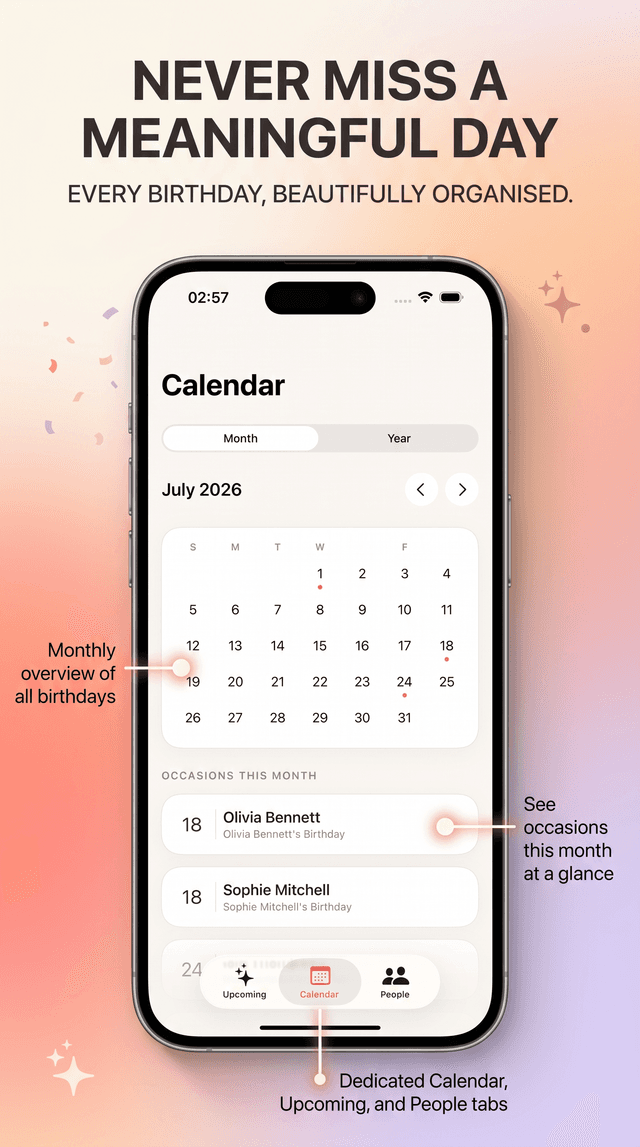
Daily Life Apps publishes Birthday Reminder: Tracker.
Its current App Store listing confirms:
- Upcoming birthday countdowns.
- A Home Screen widget.
- Reminder lead days and alert times chosen for each occasion.
- Optional contact import.
- Notes and gift ideas.
- Use without a required account.
That feature set supports the two-signal approach: use the Home Screen widget for awareness and per-occasion notifications for actions.
The App Store description explicitly names only a Home Screen widget. Although Apple supports Lock Screen widgets generally, verify that Birthday Reminder appears in the Lock Screen widget gallery before making that placement essential to your setup.
Visit the Birthday Reminder app page for its current feature summary. Our editorial policy explains how we review product claims involving our own apps.
Frequently asked questions
Do I need a notification if I already have a birthday widget?
Not always. A widget may be sufficient when you look at it regularly and the birthday needs only a quick message. Add a notification when missing the date would leave too little time for a gift, card, booking, journey, or planned call.
Why did my birthday notification not appear?
Check whether notifications are allowed for the app, whether the expected Lock Screen or banner surface is enabled, whether an active Focus silences the app, and whether the app was muted. Also inspect Notification Center in case the alert was grouped or delivered quietly.
Can a Home Screen birthday widget also go on the Lock Screen?
Not automatically. Apple supports both locations, but the app must provide separate compatible formats. Check the Lock Screen widget gallery rather than assuming a Home Screen widget will appear there.
Does adding a widget turn on notifications?
No. Adding a widget and granting notification permission are separate iPhone controls. You can use a supported widget while leaving that app’s notifications disabled.
Which is more reliable, a widget or a notification?
Neither is universally more reliable. A widget cannot be silenced by notification Focus rules, but it depends on you viewing its screen. A notification actively arrives at a scheduled time, but settings can make it quiet, delayed, grouped, or invisible on the surface you expected.
How many birthday notifications should I use?
Use one for a routine birthday-day action. Add an earlier notification only when it represents a separate preparation task. Complex travel or group plans may justify more alerts when each one corresponds to a real deadline.
A birthday widget and a birthday notification are complementary signals. Keep the next dates visible, then reserve notifications for moments when there is something useful to do.
Browse all Birthday Reminder guides for related widget, notification, and birthday-planning advice.