
The best birthday wishes for someone who is ill celebrate the person without pretending to know what will happen medically. If recovery is expected, a gentle wish for healing can fit. If treatment is uncertain or the condition is ongoing, focus on comfort, companionship, and the day in front of them.
Keep the message easy to receive. Add one detail that belongs to the recipient, and do not make them perform gratitude, optimism, or conversation in return.
First decide what you actually know
Do not diagnose the situation from a distance. Use what the person has told you.
- Recovery is expected: They describe themselves as recovering from an infection, injury, operation, or another temporary setback.
- Treatment or recovery is uncertain: They are in hospital, undergoing treatment, or waiting for answers. Do not promise a quick return to normal.
- The condition is ongoing: They live with a chronic illness, disability, or condition without a simple recovery endpoint.
- You do not know: Keep the health reference neutral and let the birthday remain the focus.
A first-person Healthline article explains why “get well soon” may ring false for someone with a lifelong condition. That experience should not be treated as a rule for everyone, but it shows why the recipient's own description matters.
If illness is only one part of a broader hard period, the guide to birthday wishes during a difficult year covers other circumstances without turning them into health issues.
Build the message from four small parts
A useful structure is:
- Say happy birthday plainly.
- Acknowledge the situation only if appropriate.
- Add one true detail about the person.
- Close with a modest wish and no pressure.
For example:
Happy birthday, Maya. I know recovery has taken longer than you hoped. Your voice note about the garden still made me laugh this week. I hope today brings a comfortable afternoon and some time with your new book. No need to reply.
The personal detail stops the message from sounding like a sympathy card with “happy birthday” added to it.
CaringBridge recommends making a card personal with a memory, photo, familiar phrase, or another unique touch. Before sending, ask:
- Would they recognize this detail as theirs?
- Am I mentioning information they shared with me?
- Is the detail suitable for everyone who might see this message?
- Does my wording leave room for how they actually feel?
For more prompts, use the birthday message personalization guide.
Birthday wishes when recovery is expected
These examples suit a temporary illness, injury, or operation when the recipient expects to recover.
Warm and encouraging
- “Happy birthday, Lena. I know recovery has required patience. I hope today brings more comfort, good company, and a proper rest.”
- “Happy birthday. I'm glad you're on the mend, and even gladder that I get another year of your excellent stories.”
- “Wishing you a gentle birthday now and plenty of energy for the celebration you want later.”
Light, if humor already fits
- “Your birthday plan has one official item: doing exactly as much as you feel like doing.”
- “Happy birthday. This year's celebration may be quieter, but the cake still has important work to do.”
- “Consider this a birthday rain check for something more adventurous when you're ready.”
Do not use humor to dismiss pain or frustration. Let the illness be the setting, not the punchline.
Birthday wishes during treatment or a hospital stay
When the outcome or timeline is uncertain, avoid predicting recovery. Acknowledge the unusual birthday without forcing cheerfulness.
Short and low-pressure
- “Happy birthday, Amir. No big speech and no need to reply. I just wanted you to know I remembered.”
- “Thinking of you on your birthday and wishing you one easy hour at a time.”
- “Happy birthday. Whatever today looks like, you are important to me.”
Personal and acknowledging
- “Happy birthday, Jo. This is not where you expected to spend the day, but I hope your favorite playlist and our terrible jokes make some of it feel familiar.”
- “Happy birthday. I know treatment has taken over much of the calendar. Today, I wanted to celebrate your curiosity, your kindness, and the fact that you still beat me at every quiz.”
- “You have had to think about medical things all week, so this message is about you: happy birthday to my thoughtful, funny friend.”
With a specific offer
- “Happy birthday. I can leave dinner at your door at six tomorrow if that would help. A thumbs-up is enough; no hosting required.”
- “Happy birthday, Nina. I can bring your headphones and charger when I visit Thursday, if you still want them.”
- “Thinking of you today. I am free to drive you to Friday's appointment, and it is completely fine to say no.”
Offer only something you can do, and make declining easy.
Birthday wishes for a chronic or long-term condition
Do not make recovery the price of a good birthday. Focus on the recipient, their interests, and a realistic wish for the day.
Direct and understanding
- “I'm not going to tell you to get well soon, because I know it is not that simple. Happy birthday. I'm glad you're here.”
- “No cure talk today, just a wish for more comfort, fewer demands, and time for what you enjoy.”
- “Happy birthday. I know good and difficult days can sit close together. I hope today contains something genuinely good.”
Warm and person-centered
- “Happy birthday, Rosa. Your messages about books have brightened my year. I hope today includes a quiet chapter and your favorite tea.”
- “Here's to another year of your dry humor, careful advice, and refusal to accept bad coffee.”
- “Happy birthday. Your condition is part of your life, but it is not the only thing worth mentioning about you. I hope today feels like yours.”
Avoid automatically praising someone as “strong” or “inspiring.” Those words can feel like another role they must perform. If you offer praise, name something you genuinely observed.
Adjust the tone to the relationship
Closeness permits more detail, not more certainty.
| Relationship | Useful approach |
|---|---|
| Partner, parent, or close friend | Name the situation if they discuss it openly, then include a shared detail |
| Coworker | Keep health references general and do not ask for medical information |
| Acquaintance | Use a brief greeting without implying intimacy |
| Group card | Include only details the recipient has shared with the group |
| Public post | Avoid mentioning the illness unless they have made it public and welcome the reference |
A coworker message might be:
Happy birthday, Daniel. Thinking of you and wishing you a comfortable day. No need to respond.
A close friend might receive:
Happy birthday, Daniel. I miss our Saturday breakfasts and your very firm opinions about pancakes. I hope we can resume them whenever you feel ready.
The difference comes from shared history, not a more dramatic claim about the illness.
Replace phrases that can land badly
AARP's interviews with therapists support avoiding minimizing language, comparisons, guarantees, and vague offers that shift work back to the person who is ill.
| Avoid | Try instead |
|---|---|
| “At least...” | “I'm sorry this is hard. I'm thinking of you today.” |
| “Everything will be OK.” | “I do not know what comes next, but I care about you.” |
| “My cousin had the same thing.” | “I will not assume your experience is like anyone else's.” |
| “Call me if you need anything.” | “I can bring dinner Wednesday. Would that be useful?” |
| “Stay positive.” | “You do not have to sound upbeat with me.” |
Also avoid unsolicited medical advice, questions about private details, and “fighter” language unless the recipient uses it for themselves.
Choose a low-pressure way to send it
AARP notes that a card can be read when the recipient is ready, while a call demands more immediate attention. A text is convenient but can also create pressure to respond.
Use the person's habits as your guide:
- Send a card when they enjoy tangible messages or need flexibility.
- Call when calls are normal in your relationship and likely to be welcome.
- Add “no need to reply” to a text only when you genuinely mean it.
- Do not arrange a surprise visit, video call, or gathering without asking.
- If they have shared a treatment or rest schedule, work around it rather than choosing an arbitrary time.
Apple confirms that the iPhone Reminders app lets you create a reminder with a title, date, and time. The birthday reminder timing guide explains how much lead time a card or planned gesture may require.
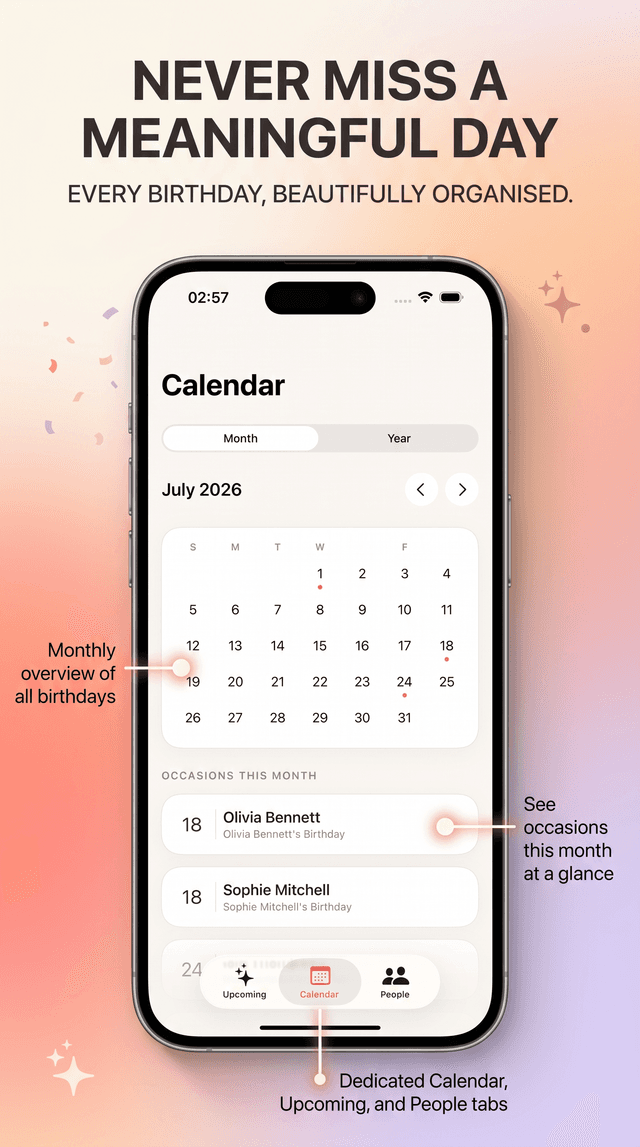
Birthday Reminder can keep a birthday, countdown, short note, and flexible alert together. Save a respectful cue such as “private text,” “no reply needed,” or “mention her garden,” rather than a detailed diagnosis. The simple birthday planning system shows how to turn that reminder into one useful action.
Frequently asked questions
Is it appropriate to say happy birthday to someone who is seriously ill?
Yes. A sincere birthday greeting does not deny the illness. Keep it easy to receive and avoid implying that the person must celebrate enthusiastically.
Should I mention the illness?
Mention it briefly if the recipient has discussed it with you and would probably welcome the acknowledgment. Otherwise, “thinking of you today” is enough. Never reveal private health information in a group card or public post.
Is “get well soon” acceptable in a birthday message?
It can fit when recovery is expected and the recipient uses similar language. Avoid it when the outcome is uncertain or the condition is ongoing. Wish for comfort, company, or a good part of the day instead.
What should I write to someone spending their birthday in hospital?
Acknowledge the unusual setting without making it the whole message. For example: “Happy birthday. I know this isn't where you wanted to spend it, but I'm thinking of you and sending love. No reply needed.”
What if the person is not expected to recover?
Do not predict improvement or avoid the birthday entirely. Follow their cues and focus on love, presence, and the day itself: “Happy birthday. I love you, and I'm grateful to be with you today.”
A thoughtful message cannot fix an illness, and it does not need to. Its job is to remember the birthday, recognize the person, and offer warmth without adding pressure.
Browse more Birthday Reminder guides, visit the Birthday Reminder app page, or read our editorial policy for how sensitive guidance and product claims are reviewed.