
The best birthday wishes during difficult times do two things at once: they mark the birthday honestly and leave room for a year that has genuinely been hard. Skip forced cheerfulness, add one real detail or offer, and let the person decide how much they want to celebrate.
A difficult year might involve a layoff, illness, breakup, caregiving strain, mental health struggle, or a run of setbacks. This guide covers those broad situations. A death or a conflict between you and the recipient calls for more specific wording.
Recognize what kind of hard year this has been
Hallmark treats “Birthday Wishes for Tough Times” as a distinct category and names illness, job loss, bereavement, and other challenging circumstances. Those situations should not all receive the same message.
- Job loss or financial strain: Avoid references to spending, vacations, or expensive plans unless you know they will land well.
- Illness or a health scare: Keep the message easy to read and answer. Do not predict recovery.
- A breakup or divorce: Center the recipient rather than asking about the relationship that ended.
- Caregiving strain: Recognize that their own birthday may be overlooked while they care for someone else.
- A mental health struggle: Acknowledge what they have shared without diagnosing them or offering unsolicited treatment advice.
- A setback or run of bad luck: Resist explaining why it happened or insisting there must be a lesson in it.
If the year involved a death, use the guide to birthday wishes after a bereavement. If the difficulty is an unresolved rift between you, see birthday wishes after an argument.
Decide how directly to mention the hardship
Personalization does not require naming every painful detail. Choose the level of directness from what the person has told you, how close you are, and where the message will appear.
| Situation | Safer approach |
|---|---|
| They discussed the hardship with you privately | Briefly acknowledge it without retelling it |
| You know something is wrong but lack details | Use “this has been a hard stretch” |
| You are a coworker or acquaintance | Keep the wish warm and general |
| The card or post is public | Leave out details they have not shared publicly |
| You are unsure whether they want to discuss it | Acknowledge the birthday and offer quiet support |
Compare these two messages:
Happy birthday. I know this year has been a lot, and I'm thinking of you today.
Happy birthday. I know the treatment schedule has taken over most of your month, and I hope today gives you one quiet hour.
The second is more personal, but it is appropriate only when the detail was shared with you and the message is private.
Skip forced positivity
Psychology Today defines toxic positivity as avoiding, suppressing, or rejecting negative emotions in favor of insisted-upon positive thinking. It contrasts dismissive responses with acknowledgment such as, “I'm sorry—that sounds hard.”
In a birthday message, avoid lines like:
- “Everything happens for a reason.”
- “At least it's not worse.”
- “This year will make you stronger.”
- “Just stay positive!”
These phrases tell the recipient how to interpret the year or how to feel. A short acknowledgment usually does more good.
The source also notes that toxic positivity is not a diagnosis and that the label can be overused. Hope itself is not the problem. The practical question is whether your hopeful sentence leaves room for the person's real feelings or dismisses them.
Build the message in three honest parts
A dependable structure has three parts:
- A plain birthday greeting: Say happy birthday without apologizing for the occasion.
- One true sentence: Acknowledge the year, mention a quality you observed, or make a specific offer.
- A low-pressure close: Wish them something modest without demanding a reply or celebration.
For example:
Happy birthday, Priya. This year has thrown a lot at you, and I've noticed how steadily you've handled one day at a time. I hope today gives you a few easy hours.
This does not summarize the hardship, give advice, or promise improvement. It simply shows that the sender has paid attention.
Birthday wishes by tone
Use these as starting points. Replace the general wording with something the recipient will recognize.
Warm and validating
- “Happy birthday. This has been a genuinely hard year, and I want you to know I've seen how much you've been carrying.”
- “Happy birthday, [Name]. You do not need to have everything figured out today. I'm thinking of you.”
- “Wishing you a birthday that asks nothing of you except, perhaps, choosing the cake.”
Light and hopeful
- “Happy birthday. I will not pretend this year has been easy, but I hope there is room for one good moment today.”
- “Here's to a birthday that becomes a small bright spot in a rough stretch.”
- “Happy birthday. Whatever else is happening, I hope today has a little more ease in it.”
Practical and supportive
- “Happy birthday. I can leave dinner at your door on Wednesday if that would be useful. No hosting required.”
- “Happy birthday, [Name]. I'm free Thursday evening if you want company, quiet or talkative. Your call.”
- “Happy birthday. I can drive you to Tuesday's appointment if that would help; you do not need to decide today.”
Short and low-pressure
- “Happy birthday. Thinking of you today.”
- “Happy birthday, [Name]. Sending you an easy day.”
- “Happy birthday. No reply needed; I just wanted you to know I remembered.”
Birthday wishes for specific situations
After a job loss or financial setback
Avoid framing the birthday around money or telling the person a better job is certain to appear.
Happy birthday. I know the last few months have been unsettled. I hope today gives you a break from applications and decisions, even briefly.
During an illness or health scare
Do not promise recovery or praise someone for “fighting” unless that is language they use themselves.
Happy birthday. However you are feeling today, I hope there is a comfortable hour somewhere in it. I'm thinking of you.
After a breakup or divorce
Keep the former partner out of the message.
Happy birthday, [Name]. This has been a big year of change. I hope today feels like it belongs entirely to you.
While caring for someone else
Acknowledge the work without turning the recipient into a symbol of selflessness.
Happy birthday. I know much of this year has gone toward caring for someone else. I hope a little of today can be just for you.
During a mental health struggle
Use only what the person has shared. Do not diagnose, assess their progress, or imply a crisis.
Happy birthday. I know things have felt heavy lately. You matter to me, and there is no pressure to be upbeat or reply today.
What to leave out of the message
- Unsolicited advice: A birthday card is not the place to prescribe therapy, a diet, a job lead, or a new outlook.
- Comparisons: “At least you still have...” minimizes the difficulty.
- Surprise plans: Ask before arranging visitors, a party, or a public tribute.
- A demand to celebrate: “You deserve to have fun today” can feel like another obligation.
- Promises about the future: Do not guarantee that the coming year will be better.
- A long account of your feelings: Keep the focus on the recipient.
- Private details in public: Do not reveal health, work, relationship, or financial information in a group card or post.
Mayo Clinic Health System's guidance for supporting someone with depression recommends listening without judgment and suggesting specific tasks you can perform rather than giving excessive advice. That clinical article addresses depression, not every difficult year, but its communication principle is useful here: “I can bring dinner Wednesday” is easier to understand and accept than “let me know if you need anything.”
Make only offers you can fulfill, and leave the recipient free to decline.
Personalize an example in under a minute
Start with:
Happy birthday. Thinking of you.
Then add exactly one of these:
- A quality you directly observed this year.
- A concrete offer you can keep.
- A brief acknowledgment that this has been a hard stretch.
- An ordinary detail unrelated to the hardship, such as a show, hobby, or plan they mentioned.
For example:
Happy birthday. Thinking of you, and I've noticed how patiently you've handled all the changes at home. I hope today is kinder than most.
Run three checks before sending:
- Truth: Did the recipient tell you this, or did you observe it yourself?
- Pressure: Does the message demand cheerfulness, plans, or a reply?
- Swap: Could the same wording go to anyone after changing the name?
The birthday message formula offers a broader method for everyday cards. Here, restraint matters as much as specificity.
Save a respectful prompt for next year
If someone has had a difficult year, a private note can help you remember the right approach next time. Keep it practical, such as “message privately,” “no surprise plans,” or “offer dinner,” rather than recording a detailed account of what happened.
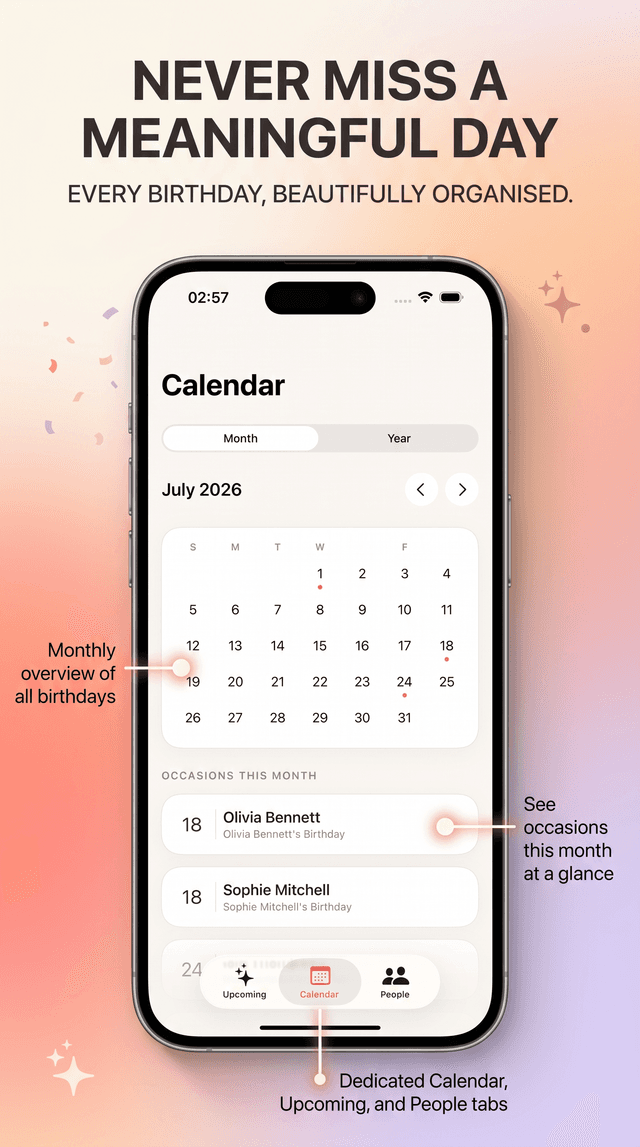
The current App Store listing for Birthday Reminder: Tracker says the app supports personal notes and gift ideas, customizable reminder lead days and alert times, on-device information, and use without an account. A brief, non-sensitive prompt can therefore stay beside the date rather than disappearing into an old message thread.
The Birthday Reminder app page explains how notes and flexible alerts fit together. The birthday reminder timing guide can help you leave enough time to write thoughtfully, while the simple birthday planning system covers a broader remember, prepare, and celebrate workflow.
Frequently asked questions
Is it okay to say “happy birthday” during a hard year?
Yes. A plain, sincere greeting is appropriate. Add one honest sentence only if it feels natural; a short message is not a lesser one.
Should I mention the specific hardship?
Only when the recipient has discussed it with you and you are confident the reference will be welcome. Otherwise, use a general acknowledgment such as “this year has been a lot.”
What if I do not know what help to offer?
Choose something small that you can genuinely do, such as delivering dinner on a particular evening or providing a ride. Make it an option rather than an announcement.
Is it wrong to include humor?
No, if humor is already part of how the person copes and how you relate to each other. When unsure, choose warmth over a joke.
Should I predict that next year will be better?
Avoid guarantees. “I hope the coming year brings more ease” leaves room for hope without claiming to know what will happen.
How is this different from writing to someone who is grieving?
Bereavement may involve referencing the person who died and navigating significant dates. Use the dedicated guide to birthday wishes after a bereavement for that situation.
Birthday wishes during a difficult year do not need to fix anything. They need to recognize the person, offer something real when appropriate, and leave room for the day they are actually having.
Browse the other Birthday Reminder guides for more situational wishes. Our editorial policy explains how Daily Life Apps reviews sensitive topics and product claims.