
To turn a shared memory into a birthday message, do not retell the whole story. Choose one moment the recipient will recognize, point to one vivid detail, say why it still matters, and connect that meaning to a wish for today or the year ahead.
For example:
Happy birthday, Noor. I still laugh about the afternoon we got lost in Lisbon and pretended the blue tram was exactly where we meant to be. I hope this year brings you more good adventures, with slightly better directions.
The detail makes the memory recognizable. The final sentence brings it into the present.
Use a four-step memory method
Build the message in four short moves:
- Choose a memory you both experienced.
- Cue it with a place, action, object, or phrase.
- Connect it to what the moment means now.
- Wish for something that follows naturally from that meaning.
In shorthand:
Happy birthday, [name]. I still remember [specific moment]. [Why it matters now.] I hope [connected wish].
This is not a script. A short text may combine all four moves in two sentences, while a private card can give the memory more room.
The broader birthday message formula also works with observed qualities, achievements, and habits. This guide focuses only on the extra choices involved when the detail is a memory you share.
Why a shared memory can feel personal
A shared memory carries evidence of a particular relationship. “You are fun to travel with” could describe several people. “You insisted the flooded stairwell was still a suitable place to eat graduation cake” belongs to a smaller history.
Research on nostalgia provides context for that effect, although it was not conducted on birthday cards. Scientific American reports that nostalgic narratives often center on significant people. Its featured studies linked greater nostalgia proneness with larger close networks and stronger motivation to maintain relationships. Longitudinal data also found that participants higher in nostalgia proneness maintained their close networks more steadily over time. The researchers still cautioned that some of the evidence was correlational.
Research summarized by UC Berkeley’s Greater Good Magazine found that romantic partners prompted to recall or write about a nostalgic relationship experience reported temporarily greater closeness, commitment, love, and relationship satisfaction than comparison groups. The research focused mostly on young adults and romantic relationships, so it should not be treated as a guarantee about every recipient.
The practical conclusion is modest: a shared memory can give a message relational meaning that a general compliment lacks.
Choose a memory the recipient would welcome
A suitable birthday memory passes four checks:
- Shared: You both experienced the event directly.
- Recognizable: One short cue will bring it back.
- Comfortable: The recipient is unlikely to feel exposed or corrected.
- Relevant: You can connect it honestly to the relationship today.
Small moments often work well because they fit into a short message: a missed train, a cooking failure, a regular walk, or a joke from an ordinary afternoon.
Check uncertain facts before relying on them. If the exact year or place does not matter, leave it out. If uncertainty is part of the charm, acknowledge it:
I cannot remember whether it was our second or third disastrous camping trip, but I still remember you calmly rescuing breakfast from the rain.
Do not present a vague recollection as precise history merely to make the message sound polished.
Describe one detail, not the entire story
The recipient already knows the memory. Your job is to point toward it.
Compare:
I always remember our road trip.
I still remember the GPS sending us down that one-lane farm road while you insisted it was a shortcut.
The second version supplies a scene without explaining the route, destination, or aftermath. A place, object, line of dialogue, or small action is usually enough.
Use words that sound like you. Hallmark’s card-writing guidance recommends writing in your natural speaking voice and using private names or references when they fit. If you would say “that ridiculous farm road,” do not replace it with “our unforgettable journey” merely because the message is written.
Say what the memory means now
Without a present-day connection, a memory can read like an anecdote pasted into a birthday card. Add one sentence that explains why you chose it.
The meaning might be:
- What the moment showed you about the person.
- How they made you feel.
- What has remained true about the relationship.
- Why you still smile when you remember it.
Then make a wish that belongs with that meaning:
I still think about how calm you stayed when our flight was cancelled at midnight. You make difficult days feel manageable. I hope your birthday brings the opposite kind of surprise: something joyful, easy, and worth staying up for.
Avoid attaching an unrelated “best year ever” after a specific story. A smaller connected wish usually sounds more believable.
Turn raw memory cues into finished messages
These examples demonstrate the process rather than providing text to copy unchanged.
A funny mishap
Cue: Burned dinner, smoke alarm, first flat.
Message:
Happy birthday, Alex. I still think about that first dinner in the flat, when we burned everything except the salad and set off the smoke alarm anyway. I am glad we learned to laugh before we learned to cook. I hope this year gives us more stories, preferably with less smoke.
The message uses one comic detail, names its meaning, and carries the joke forward.
A moment of quiet support
Cue: Stayed after the event to help pack up.
Message:
Happy birthday, Maya. I have never forgotten you staying behind after everyone left to help me pack the hall. You notice when someone needs a hand without making them ask. I hope today gives some of that care back to you.
The memory supports the compliment instead of leaving it as a general claim.
A long-standing ritual
Cue: Saturday pancakes before football practice.
Message:
Happy birthday, Dad. Saturday pancakes before football practice felt ordinary then, but they are some of my clearest memories now. Thank you for making time together feel dependable. I hope today is slow, warm, and entirely free of early starts.
The message does not insist that the past was perfect. It identifies one part that still matters.
A two-sentence text
Cue: Wrong train after the concert.
Message:
Happy birthday! I still laugh about us taking the wrong train after that concert and ending up two towns away. Hope this year brings equally good stories and much better transport.
A memory-based message does not need to be sentimental or long.
Leave out memories that create pressure
Choose another memory when the story involves:
- Grief, illness, conflict, or trauma the recipient may not want revisited.
- An embarrassing detail that would be unsafe in a group card or public post.
- A disagreement about what happened or who was responsible.
- A private fact involving someone else.
- An inside joke that needs several sentences of explanation.
- A past closeness that no longer reflects the relationship.
A birthday is also a poor time to use a memory as evidence in an unresolved argument. If the relationship is complicated, a simple sincere greeting is safer than forced nostalgia.
Save a short cue before the birthday
You do not need to store a finished message months ahead. Save enough to recover the moment:
- “Lisbon, blue tram, got lost.”
- “Stayed to pack the hall.”
- “Dad’s Saturday pancakes.”
- “Wrong train after concert.”
Keep the cue short and non-sensitive. The separate guide to planning birthday messages without making them generic explains how to collect prompts during the year, while the guide to adding useful context to birthday reminders covers what is appropriate to store.
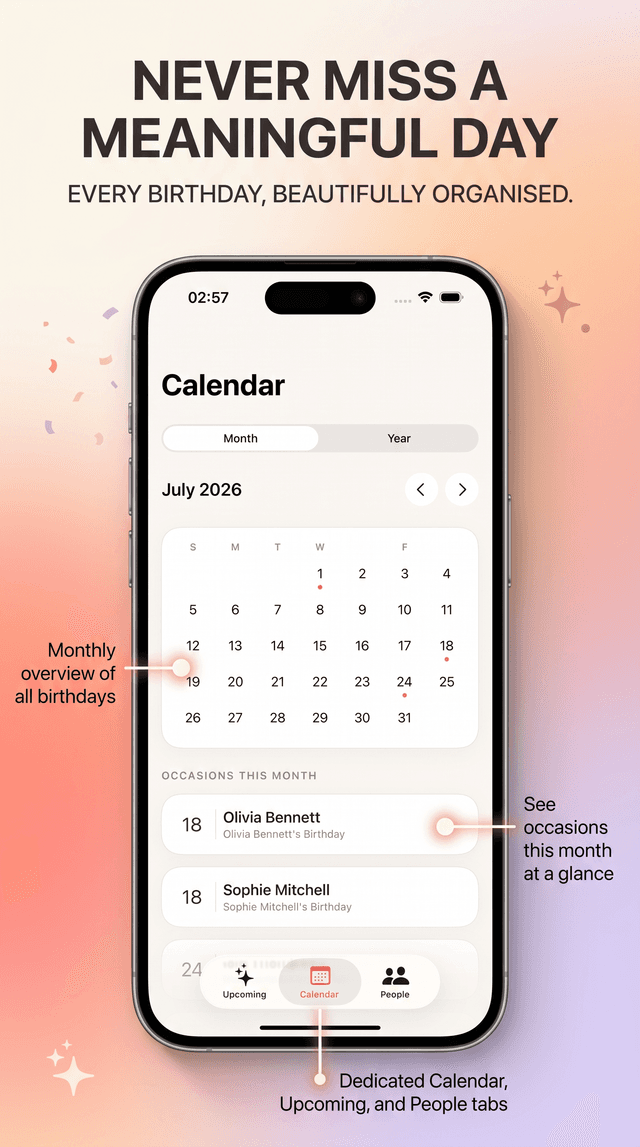
Apple confirms that iPhone Reminders can include notes and other details. Birthday Reminder supports personal notes, countdowns, and customizable reminders for each occasion, so the cue can stay with the birthday rather than in a disconnected message thread.
Set the alert early enough to check the memory and write without rushing. The birthday reminder timing guide explains how much notice to allow for a text, card, call, or delivery. The simple birthday planning system places that step in a wider remember, prepare, and celebrate routine.
Frequently asked questions
What if the other person remembers the event differently?
Avoid disputed details. Describe the part you know confidently or soften the wording with “I think,” “as I remember it,” or “I still picture.” If the disagreement could distract from the greeting, choose another memory.
Can I use a memory from many years ago?
Yes, if it remains comfortable and recognizable. Connect it to the present so the message celebrates the person now rather than treating the relationship as something that exists only in the past.
Can a shared-memory birthday message be funny?
Yes. Tease the situation rather than the recipient’s appearance, age, health, finances, or relationships. Use a private channel if the humour depends on an embarrassing detail.
What if the memory involves grief or a difficult year?
Use it only when the recipient has welcomed that subject and the message is private. Do not force a cheerful lesson onto a painful event. A gentler memory or simple acknowledgment may be more considerate.
How long should the memory be?
One or two sentences is usually enough. If the story requires a long setup, choose a smaller moment within it or save the full version for a call.
A good shared-memory birthday message does not need a dramatic story. It needs one true, recognizable moment and an honest reason for bringing it back today.
Visit the Birthday Reminder app page to see how notes and flexible reminders can keep a memory cue ready, or browse the other Birthday Reminder guides for more message-writing help.