
The best birthday wishes for father-in-law are not necessarily the most emotional. They are the ones that match how you actually know him. Choose an example below, replace the bracketed prompt with one true detail, and keep the wording you would naturally use in person.
Why a father-in-law message has its own rules
A father-in-law is family, but the relationship usually begins in adulthood and develops through your spouse. You may eventually become close, yet shared history and an easy form of address do not appear automatically.
A peer-reviewed study of early in-law relationships describes these ties as relationships formed in adulthood through a third person. It also found that early individual contact and positive feelings were associated with stronger ties after marriage. The interviews centered on couples and their mothers-in-law, so the findings should not be treated as a profile of fathers-in-law. The useful writing lesson is narrower: draw on the connection you have built directly with him.
Choose what the message should acknowledge
Start with the description that fits best:
- He feels like another parent. Affection and gratitude can be direct.
- You have your own friendship. Mention an activity, conversation, or running joke you share without your spouse.
- You mainly connect at family occasions. Thank him for a welcome, tradition, or contribution you have observed.
- You are new to the family. Emphasize appreciation and the relationship you are beginning to build.
- The relationship is formal or quiet. Use his name, a respectful wish, and one modest detail.
- The relationship is strained. A civil greeting is enough. Do not use the birthday to force reconciliation.
Use “Dad,” “Pop,” or another family title only if you already address him that way. Calling him Dad for the first time inside a birthday card can create pressure rather than warmth. If he genuinely has a parental role in your life, the prompts in birthday wishes for dad may also fit.
Use this three-part formula
Build the message from three pieces:
- Connection: Name something you experienced or noticed directly.
- Meaning: Say briefly why it mattered.
- Wish: Finish with something that suits his life now.
For example:
Happy birthday. Thanks for always making me feel welcome.
Becomes:
Happy birthday, Martin. I still remember you saving me a seat at my first enormous family Christmas. You made joining the family feel easy. I hope today brings good food and a much quieter table.
The detail does not need to be dramatic. A recipe he taught you, a lift to the airport, a shared match, or his ability to make newcomers comfortable can all work. For more help building from a blank page, use the four-part birthday message formula.
Short birthday wishes for your father-in-law
- “Happy birthday, [Name]. Hope today includes good food and plenty of time for [hobby].”
- “Wishing you a very happy birthday and more chances to enjoy [specific interest] this year.”
- “Happy birthday to a father-in-law who always makes room for one more at the table.”
- “Hope today feels relaxed, cheerful, and properly celebrated. Happy birthday!”
- “Happy birthday, [what you call him]. Looking forward to seeing you at [next family event].”
Warm and thankful messages
- “Happy birthday, [Name]. Thank you for making it easy to become part of this family. I have never taken that welcome for granted.”
- “You have a steady way of showing up when someone needs help. I have seen it many times, and it means a lot. Happy birthday.”
- “Happy birthday. I still use the advice you gave me about [specific subject], even if I did take a while to admit you were right.”
- “One of my favorite parts of family gatherings is talking with you about [shared interest]. I hope we have many more of those conversations.”
- “Happy birthday to a wonderful father-in-law and a very patient [grandfather/family role]. The care you give this family is easy to see.”
- “I admire the way you [specific action or quality]. Thank you for the example and for always treating me with kindness.”
Messages for a new or formal relationship
- “Happy birthday, [Name]. It has been a pleasure getting to know you, and I appreciate how warmly you have welcomed me.”
- “My first chance to wish you a happy birthday as your [daughter-in-law/son-in-law]! I hope the coming year treats you well.”
- “Wishing you a relaxed birthday and a happy year ahead. I look forward to seeing you at [event].”
- “Happy birthday. Thank you for sharing [family tradition or occasion] with me this year. It was good to feel included.”
- “Warmest birthday wishes, [Name]. I hope you get plenty of time for [hobby or plan] today.”
A newer relationship does not need borrowed intimacy. Hallmark advises letting the real relationship guide the tone, while American Greetings notes that a short, sincere message can still be meaningful.
Messages from a daughter-in-law or son-in-law
Being a daughter-in-law or son-in-law does not require a different emotional style. Use the role only when it adds something true.
- “Happy birthday from a grateful daughter-in-law. Thank you for always asking about [specific part of your life] and genuinely listening.”
- “Happy birthday from your son-in-law. I always enjoy our [walks, projects, matches, or conversations], and I hope we fit in more this year.”
- “One of the best parts of marrying [spouse’s name] was getting to know you as well. Happy birthday, [Name].”
- “[Spouse’s name] and I hope you have a brilliant birthday. We are looking forward to celebrating with you at [specific plan].”
If the card is from both of you, mention something you both share with him. If it is from you alone, write “I” and acknowledge your own relationship rather than hiding behind your spouse.
Funny birthday wishes without the in-law routine
Use humor only when joking is already part of your relationship.
- “Happy birthday! I checked the tire pressure before writing this, so clearly your influence is working.”
- “You have taught me the family recipes, the family rules, and which family rules can safely be ignored. Happy birthday.”
- “I asked [spouse’s name] what you wanted for your birthday. Apparently ‘peace and quiet’ means we deliver cake and leave promptly.”
- “Birthday privilege granted: full control of the [grill, remote, or playlist] and no helpful commentary from me.”
- “Another year older, another year of me pretending I do not need your help with [task]. Happy birthday!”
The safest jokes point toward yourself or a shared situation. Avoid jokes about his age, health, appearance, finances, or supposed regret about gaining an in-law.
Long-distance, belated, and complicated messages
- “Happy birthday from [city]. I wish we could celebrate in person, but I will be thinking of you today.”
- “The miles are inconvenient, but the birthday call is booked for [time]. Hope you have a great day until then.”
- “This is late, and I am sorry I missed the day. Happy belated birthday, [Name]. I hope it was a good one.”
- “Thinking of you on your birthday and wishing you a peaceful, enjoyable day.”
- “I know this has been a demanding year. I hope your birthday gives you some welcome time to rest and enjoy [something comforting].”
For recent conflict or limited contact, do not attach an apology, demand, or relationship discussion to the greeting. The guide to birthday wishes after an argument covers that situation more carefully.
Address and sign the card naturally
“Father-in-law” is useful for describing the relationship, but it can sound stiff as a greeting. Open with the name or title you normally use.
For a joint card, sign both names and use “we” only for experiences you genuinely shared. For a message from you alone, write in your own voice. Naming your spouse in every sentence can make the message seem as though you have no connection with him outside that relationship.
Before sending, ask one question: could this exact message go to another father-in-law unchanged? If so, add a detail.
What to avoid
- Calling him Dad when that name has never been established.
- Thanking him only for raising your spouse, as though that is his entire role.
- Jokes about granting permission to marry or “surviving” the family.
- Comparisons with your own parents, another in-law, or a former partner.
- Mentioning private health, money, or family issues in a group card.
- Claiming a parent-child closeness that the relationship does not have.
- Copying a long sentimental passage that does not sound like you.
Respect does not require formality, and warmth does not require exaggeration.
Prepare the message before the birthday
Save a short writing cue rather than a finished annual script: “ask about the woodworking class,” “thank him for airport lift,” or “mention Sunday lunches.” The cue gives you something current to say without turning the reminder into a personal dossier.
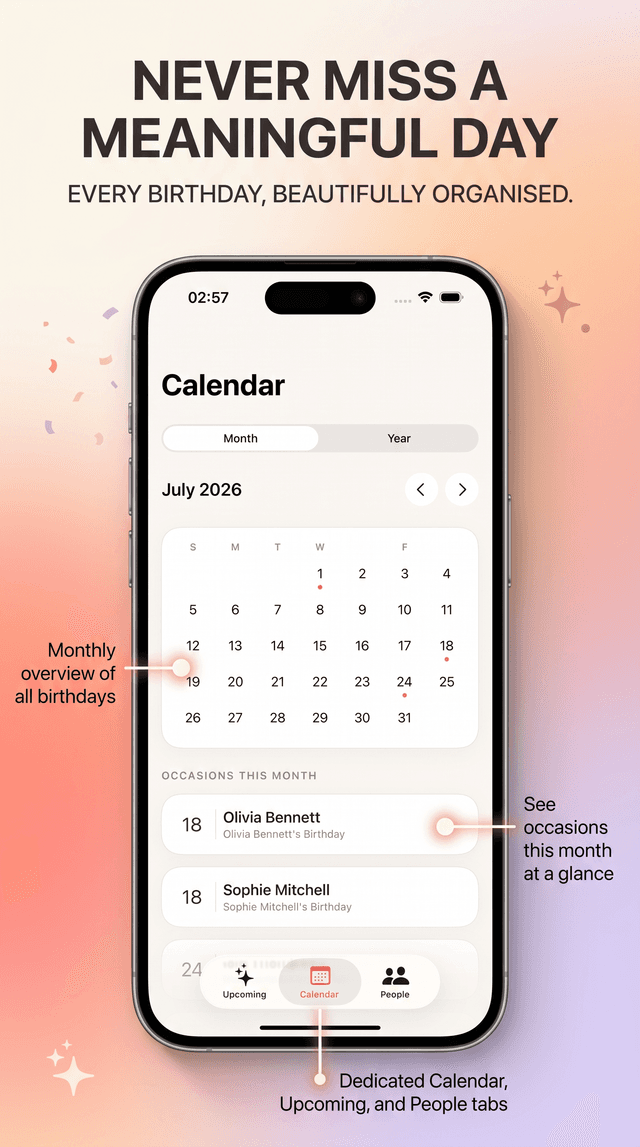
The birthday reminder timing guide recommends planning five to seven days ahead for a card. On iPhone, Birthday Reminder can keep the date, countdown, reminder timing, and a personal note together without requiring an account.
Apple’s Messages app also offers Send Later for iMessage, with scheduling up to 14 days ahead. That can help a prepared text arrive on the right morning, but it does not replace remembering a posted card or planned call.
Frequently asked questions
What is a good short birthday message for a father-in-law?
“Happy birthday, [Name]. I always enjoy our conversations about [subject], and I hope today treats you well.” It is brief but includes a recognizable point of connection.
What should I write if we are not close?
Use his name, offer a straightforward wish, and mention a safe detail if you have one. “Happy birthday, Martin. Hope you enjoy the family lunch and have a good year ahead” is considerate without pretending intimacy.
Should I call my father-in-law Dad in his birthday card?
Only if you already call him Dad or have discussed doing so. Otherwise, use his first name or the family title you normally use.
Should messages from daughters-in-law and sons-in-law differ?
No fixed difference is necessary. Your degree of closeness, normal speaking style, and shared experiences matter more than whether you are a daughter-in-law or son-in-law.
How should my spouse and I sign a joint card?
Use “we” for a shared observation, then sign both names. If one of you has the more personal memory, it is also fine to add a separate handwritten line.
How long should the message be?
One to three sentences is enough for most cards and texts. A specific detail creates meaning more reliably than extra length.
A father-in-law birthday message does not need to define the entire relationship. It only needs to acknowledge it honestly. Browse the Birthday Reminder blog for more guides to writing, planning, and remembering important birthdays.