To learn how to organize family birthdays, start by treating the project as a small family directory rather than another calendar. Decide who belongs on the list, collect dates one branch at a time, and create one trusted record for each person.
The system should answer three questions quickly:
- Whose birthday is next?
- Which household or family branch are they connected to?
- Who can confirm the date if something looks wrong?
That structure matters more than the tool you choose.
Define who belongs on the family list
Set a boundary before collecting dates. Otherwise, the list can grow from immediate family to every distant relative whose birthday someone happens to remember.
A practical inclusion rule is:
Add someone if their birthday would prompt you to call, message, send something, visit, or help coordinate a family celebration.
Begin with:
- Your household.
- Parents, siblings, grandparents, and children.
- Your partner's corresponding family branches.
- Other relatives you regularly acknowledge.
- New partners, babies, or relatives who should be included once their dates are confirmed.
You do not need to rank relatives by importance. You only need a clear scope that prevents an accurate list of 25 people from becoming an unreliable list of 100.
Choose one master home for every record
Pick one place where corrections are made. Calendars, widgets, and paper copies may display the dates, but they should not become competing master lists.
| Master system | Best fit | Important limitation |
|---|---|---|
| iPhone Contacts and the Birthdays calendar | Dates already maintained in contact cards | The special calendar is generated from Contacts, so corrections belong in Contacts |
| Manually maintained iCloud calendar | A family that wants shared visibility or editing | Each birthday must be maintained as a yearly calendar event |
| Dedicated birthday app | One organizer who wants countdowns, notes, and flexible reminders | It may not provide collaborative family editing |
| Spreadsheet | Collecting, sorting, and auditing a large family roster | It requires a separate reminder process |
Apple documents that a birthday can be added while editing a contact. Birthdays stored in iCloud Contacts can then appear in Apple's special Birthdays calendar.
A manually created iCloud calendar is a different system. Apple allows its owner to share it with other iCloud users and decide whether they may edit events. If several relatives need to maintain the list, that can work well.
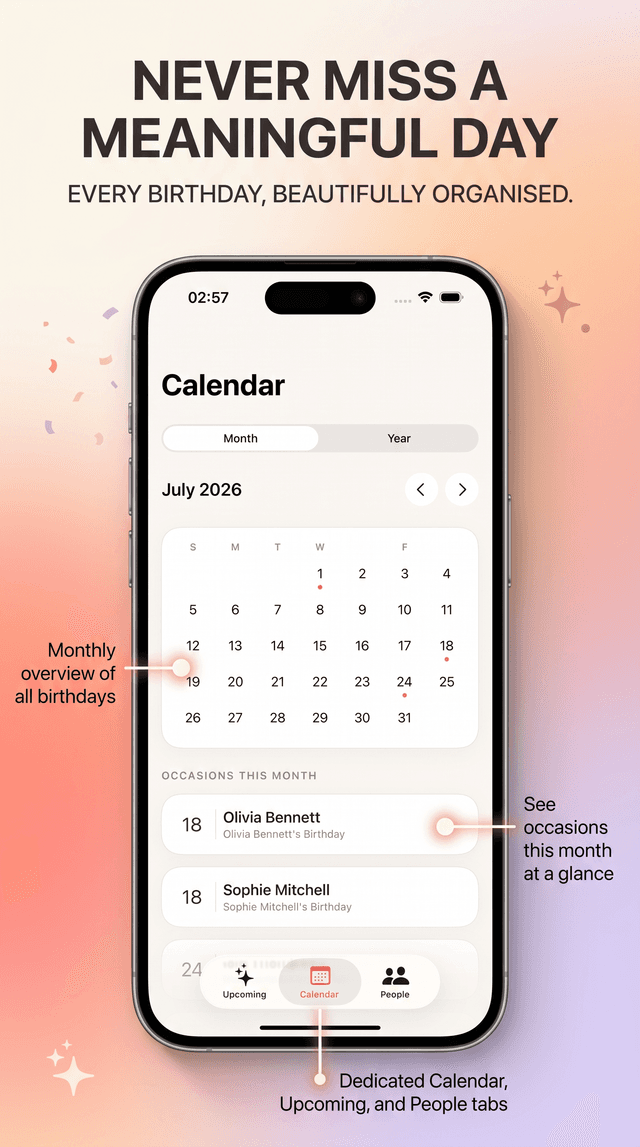
Birthday Reminder is better suited to a private organizer. Its current App Store listing documents countdowns, advance reminders, optional contact import, notes, gift ideas, a Home Screen widget, and no account requirement.
Collect birthdays branch by branch
Do not send one broad message asking the entire family to fill in a list. Responses will arrive in different formats, and nobody will know which gaps remain.
Work through one branch at a time:
- Make a roster of the people you expect to include.
- Ask one well-informed relative in that branch to check the names and dates.
- Record the month and day exactly as supplied.
- Mark missing years as unknown rather than guessing.
- Flag conflicting dates for confirmation.
- Note who supplied or confirmed each uncertain date.
- Move to the next branch only after recording the gaps.
For example, collect your mother's side, your father's side, your partner's branches, and your own household as separate batches. This gives you a visible completion check instead of a pile of unrelated replies.
If many dates already exist in Contacts, follow the guide to importing birthdays without creating clutter. Birthday Reminder lets you review available contact birthdays and select the people to add. Its public information does not promise continuous synchronization, so verify later corrections in both places after importing.
Give every person one clean record
A useful family birthday record needs little information:
- Preferred or familiar name.
- Month and day.
- Birth year only when it is known and useful.
- Household or family branch.
- Date status: confirmed or uncertain.
- One practical note, if needed.
- Reminder timing.
Use names that relatives will recognize. “Alex Morgan — Sam's household” is clearer than three entries named only “Alex.”
Do not create separate records because one person belongs to more than one branch. Choose one primary household or branch label and use a note for any additional relationship. The aim is one person, one date, and one place to correct it.
Avoid unnecessary personal information. A birthday organizer does not need family history, financial details, health information, or private disagreements.
Keep both a family view and a chronological view
A large alphabetical list is difficult to audit, while a branch-only list is poor at showing what comes next. Keep two ways to view the same records:
- Family view: grouped by household, branch, or generation.
- Upcoming view: sorted by the next birthday.
The family view helps you notice that one cousin or a new baby is missing. The upcoming view tells you what requires attention this month.
If your tool has no tags or groups, put a short, consistent label in the note, such as “Dad's side” or “Taylor household.” Do not create duplicate calendar events merely to place one person in two categories.
Decide who owns corrections
Shared access does not remove the need for an owner. If everyone can edit without a rule, duplicate entries and silent corrections become likely.
Choose one person to maintain the master list. Other relatives can send updates in a simple format:
- Add: name, date, and family branch.
- Correct: old date, proposed date, and who confirmed it.
- Remove or archive: name and reason.
- Uncertain: possible date and person to ask.
For a shared calendar, the owner can grant editing access only to relatives who will maintain it. Apple documents that editing permission can be turned on or off for each invited person.
For a private list, relatives can report changes by message while one organizer updates the record. This is often easier than asking every family member to adopt the same app.
Resolve conflicting dates without guessing
Family records sometimes disagree. A paper calendar may show 12 May while a contact card shows 21 May.
When that happens:
- Mark the date as uncertain.
- Keep the conflicting values in a temporary note.
- Ask the person directly, where appropriate.
- Otherwise, confirm with a close relative or a reliable invitation.
- Update the master record.
- Correct or remove old copies that could reintroduce the error.
Do not choose the date that appears most often. Several digital records may all have been copied from the same incorrect source.
If your dates currently depend on social-network notifications, use the private collection process in how to remember birthdays without social media.
Add reminders without creating family-wide noise
Once the roster is accurate, give reminders different jobs:
- An early reminder when you need to buy, post, book, travel, or coordinate.
- A birthday-day reminder for the final call, message, or visit.
Not every relative needs the same notice. A message may need no preparation, while a milestone gathering may require weeks. Use the birthday reminder timing guide for action-specific lead times rather than adding several identical alerts to every person.
For complex events, keep the birthday record stable and create separate planning tasks such as “ask siblings about the venue.” The general three-stage birthday planning system covers that workflow without turning the family directory into a task list.
Choose private or shared visibility deliberately
A shared calendar is useful when several people truly need the same schedule. It is less useful when everyone assumes somebody else will maintain it.
Use a shared calendar when:
- Multiple relatives actively coordinate celebrations.
- Everyone understands who approves corrections.
- Participants are comfortable sharing the selected dates.
- The family already uses iCloud calendars.
Use a private organizer when:
- One person usually prompts everyone else.
- Some relatives prefer not to circulate their dates broadly.
- Notes contain gift ideas or planning details.
- Other family members do not want another system to maintain.
The Contacts-powered Birthdays calendar and a manually shared calendar are not interchangeable. The first reflects birthdays stored in Contacts. The second contains yearly events created and maintained by the calendar owner.
For a more isolated setup, see how to create a private birthday calendar.
Review changes and protect the list
Once a month, scan the next six weeks and check for:
- A new family member who has not been added.
- An uncertain date that still needs confirmation.
- Duplicate records.
- A milestone that requires early coordination.
- An address or household label that has changed.
Perform a full branch-by-branch audit once or twice a year.
Also identify how the list will move to a replacement device. Apple supports iPhone backups through iCloud or a computer and says a backup can help transfer information to a new phone. However, information already synchronized through iCloud and locally stored app data are not the same thing. Check whether your chosen records sync, whether relevant app data is included in the current backup, and verify the list after migration.
The guide to backing up and exporting birthday reminders explains those distinctions in detail.
Frequently asked questions
What is the best format for a large family birthday list?
Keep one master record per person with a name, date, branch or household, confirmation status, and optional note. Use a family-grouped view for auditing and a chronological view for upcoming birthdays.
Should the whole family share one birthday calendar?
Only if several people need visibility and will follow the same correction process. If one relative normally coordinates birthdays, a private master list may be simpler and expose fewer personal details.
Do I need everyone's birth year?
No. Month and day are enough for annual reminders. Record the year only when it is known and useful for ages or milestones. Never estimate it.
What should I do when two relatives give different dates?
Mark the date as uncertain and confirm it with the person or a reliable close relative. Do not silently choose one value or leave conflicting copies active.
How should I organize in-laws and blended families?
Use neutral household or branch labels that make sense to your family. Keep each person in one master record, then use a short note when more than one connection needs to be represented.
Can Birthday Reminder organize a family list?
Birthday Reminder can hold selected birthdays with countdowns, reminder timing, notes, gift ideas, and a Home Screen widget. It is designed as a private, account-free organizer rather than a shared family calendar.
A reliable family birthday system has one master list, one record per person, a clear owner, and a respectful way to confirm changes. Visit the Birthday Reminder app page for a focused private option, browse all Birthday Reminder guides, or read our editorial policy to see how product and platform claims are checked.