Birthday reminder notification overload is usually a design problem, not evidence that you track too many people. The same date may be generating alerts from several places, or several alerts may be repeating information without prompting different actions.
Fix it in this order: identify every alert source, choose one owner for each birthday, set a small per-person budget, and only then adjust iPhone delivery settings. The goal is not silence at any cost. It is a system where an arriving alert still means something.
This guide focuses on auditing an existing setup. If you are choosing between widget-only, batched, and direct-alert arrangements, use the comparison of birthday reminder apps for people who hate notifications.
Build an inventory before changing any settings
Start with two or three people whose birthdays recently produced too many alerts. For each person, list every place where the date or task appears.
| Source | What to inspect | Possible alert |
|---|---|---|
| Contacts and the Birthdays calendar | Contact card and Calendar birthday settings | Calendar birthday alert |
| Ordinary Calendar event | Manually created yearly event | Event alert |
| Reminders | Yearly birthday or preparation task | Task notification |
| Dedicated birthday app | Imported or manually added record | Occasion reminder |
| Another calendar or app | Shared, subscribed, or older setup | Additional alert |
Record the scheduled time and wording beside each alert. This makes two different problems visible:
- Duplicate alerts repeat the same information from separate sources.
- Distinct alerts represent different actions, such as ordering a gift and making a birthday-day call.
Do not mute everything from one app yet. First determine which record should remain responsible for the alert.
Give each birthday one alert owner
An alert owner is the single system responsible for the primary birthday prompt. The underlying date may still appear in more than one view, but only one place should send the routine notification.
For example:
- Contacts can store the date while Calendar owns the alert.
- A birthday app can own both the date and its per-person reminder.
- Reminders can own a preparation task while another system owns the final birthday prompt.
Apple says its Birthdays calendar includes birthdays from Contacts. It also advises checking for multiple contact cards when one person produces repeated birthday events. A separate annual Calendar event or birthday-app record can add another alert even when the contact itself is correct.
When the source is unclear, compare the app icon and wording on the next notifications rather than dismissing them immediately. The full diagnostic process is covered in finding duplicate birthday entries on iPhone.
Set a notification budget by action
Once each birthday has an owner, assign a maximum number of alerts. Base the budget on what you intend to do, not on a vague ranking of relationships.
| Birthday plan | Default budget | Each alert's job |
|---|---|---|
| Message or short call | 1 | Prompt the birthday-day action |
| Card, gift, or meal | 2 | Prepare first, then complete the gesture |
| Travel, group event, or milestone | As needed | Represent separate booking, confirmation, or celebration deadlines |
| Passive awareness only | 0 push alerts | Use an upcoming list or widget |
A third alert is justified when it represents a third task. It is not justified merely because the app offers another countdown interval.
For example, “Birthday in 14 days,” “Birthday in 7 days,” and “Birthday tomorrow” are three versions of the same information. “Book the table,” “confirm the guest count,” and “bring the card” are three separate actions.
If you need help choosing the first preparation date, the birthday reminder timing guide covers messages, cards, deliveries, bookings, travel, and milestones.
Apply a keep, rewrite, reroute, or remove test
Give every alert one of four outcomes:
- Keep it when the timing and wording already prompt a useful action.
- Rewrite it when the alert arrives at the right time but merely announces the date.
- Reroute it when the information is useful but does not need immediate attention.
- Remove it when another alert already performs the same job.
Use one question to make the decision:
What will I be able to do when this alert appears?
“Send a message before work” has an answer. “Birthday next week” may not. If no practical action follows and passive awareness is enough, a widget or upcoming list is usually a better home for the information.
The distinction between passive visibility and a scheduled prompt is explained in birthday widgets versus notifications.
Do not make routine alerts artificially urgent
Apple defines four interruption levels for noncommunication notifications: Passive, Active, Time Sensitive, and Critical. Apps assign these levels when creating notifications; an iPhone user does not manually promote an individual birthday alert through Settings.
Only Time Sensitive and Critical notifications are designed to override scheduled delivery and break through a Focus. Apple says Time Sensitive notifications should concern something happening now or within about an hour. Critical notifications are reserved for rare health and safety situations.
That makes escalation the wrong cure for birthday alert fatigue. An ordinary birthday reminder generally belongs at normal urgency. If a call must happen at a particular time, schedule one precise prompt and configure your Focus appropriately rather than trying to make every birthday interrupt protected time.
Tune iPhone delivery after reducing the count
After duplicates and unnecessary alerts are gone, adjust how the remaining notifications appear.
In Settings > Notifications, iPhone offers three Lock Screen layouts:
- Count shows only the number of notifications and creates the least visible clutter.
- Stack groups notifications by app.
- List displays notifications individually.
These choices change appearance, not the number of alerts being generated.
Scheduled Summary batches notifications from selected apps for delivery at times you choose. It can suit an early “order the gift this week” notice. It is risky for a birthday-morning prompt if the next summary arrives after you intended to call or message.
A Focus can allow or silence selected apps. Its separate Time Sensitive Notifications control applies to alerts the sending app has classified that way. Allowing the birthday person under a Focus's People settings is not the same as allowing a notification generated by a birthday app.
Use platform settings as the final filter, not as a substitute for cleaning the underlying schedules.
Test the quieter system
Evaluate the next three birthday alerts, or use a two-week window if several dates are close together. For each alert, record:
- Did I notice it?
- Did I understand the next action?
- Could I act at that time?
- Did another alert repeat it?
- Did I dismiss it without making a decision?
Then apply a simple rule:
- Noticed and acted: keep it.
- Noticed but unclear: rewrite it.
- Useful but badly timed: reschedule it.
- Repeated elsewhere: remove the duplicate.
- Missed completely: check permission, Focus, summary timing, and display surfaces before adding another alert.
One missed alert does not automatically justify two replacements. First determine whether the problem was timing, wording, delivery, or an unreliable source.
Where Birthday Reminder fits
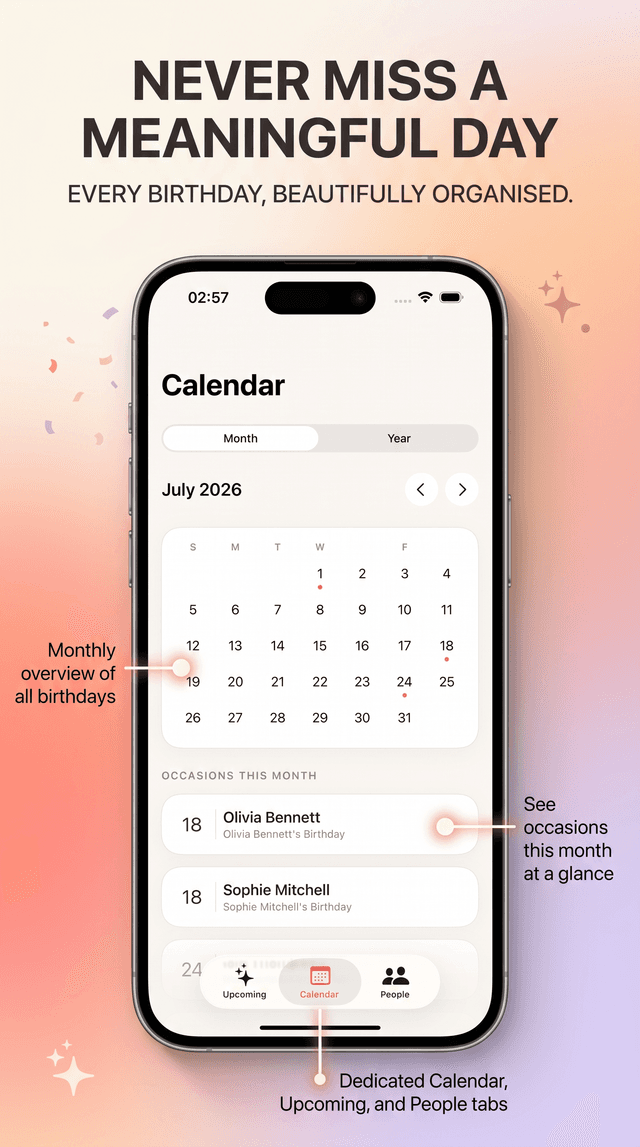
Daily Life Apps publishes Birthday Reminder: Tracker. Its current App Store listing confirms that each occasion can use chosen lead days and an alert time. It also confirms a Home Screen widget, optional Contacts import, countdowns, and use without a required account.
Per-occasion timing supports a notification budget because routine birthdays can remain simple while birthdays with real preparation deadlines receive earlier notice. Optional import also makes a duplicate check important: review existing records before and after importing rather than assuming two systems will merge them automatically.
Visit the Birthday Reminder app page for the current feature summary. Our editorial policy explains how product claims involving our own apps are checked.
Review the budget without rebuilding the system
Revisit the setup after a busy birthday month, a phone change, a contact import, or the installation of another calendar app.
The review can be brief:
- Find any birthday that produced more alerts than its budget.
- Remove alerts that repeated another source.
- Improve wording that failed to prompt an action.
- Add notice only where a genuine deadline was missed.
- Confirm which system remains the alert owner.
This is a focused maintenance step, not a new birthday-planning workflow. For the broader remember, prepare, and celebrate process, use the simple birthday planning system.
Frequently asked questions
How many notifications should one birthday have?
Use one for a routine message or call. Add a second when it represents a separate preparation task, such as ordering a gift or booking a table. Complex plans can use more, but every alert should correspond to a different deadline or action.
Does Scheduled Summary reduce the number of birthday alerts?
No. It changes when eligible notifications from selected apps are delivered. Remove duplicate schedules first, then use Scheduled Summary for notices that do not require immediate attention.
Why does the same birthday produce two notifications?
The date may exist in more than one source, such as the Contacts-powered Birthdays calendar, an ordinary recurring Calendar event, a yearly Reminders task, or a dedicated app. Compare the app icons and wording, then remove or disable the extra schedule at its source.
What if I keep ignoring a single birthday reminder?
Do not immediately add another. Rewrite the alert with a specific action, move it to a time when you can respond, and check whether Focus or Scheduled Summary delayed it. Add another alert only when it has a different job.
Will turning off an app's notifications delete its birthdays?
Turning off Allow Notifications changes the app's permission to send alerts; it does not uninstall the app. Stored records, widgets, sync, backups, and deletion controls are separate concerns, so review the app's documentation before changing or removing data.
A quiet birthday system is not measured by having no alerts. It works when every remaining prompt has one owner, one purpose, and a useful time.
Browse the other Birthday Reminder guides for related setup, troubleshooting, and planning advice.