If you need to remember birthdays in different time zones, do not convert every birthday into your own calendar date. Keep the date the person actually celebrates, record where they currently live, and plan your reminder separately.
For a whole international birthday list, the useful question is not simply “How many hours ahead are they?” It is “Which part of my day overlaps with a suitable part of their birthday?” Answer that once for each person, then verify the current time before making contact.
Keep the birthday date and reminder time separate
Every international birthday involves two decisions:
- Their local date determines when the birthday occurs.
- Your schedule determines when a reminder can help you act.
If a friend in Seoul celebrates on March 4, store March 4. Do not move the birthday to March 3 merely because their day begins while it is still March 3 where you live.
Your preparation reminder can still arrive on March 2 or March 3 in your location. Its purpose is to help you order a gift, write a message, or arrange a call. It does not redefine the birthday.
This rule prevents a common failure: shifting the stored date to solve one year's time difference, then forgetting why the record looks wrong later.
Build one international birthday list
You do not need a separate calendar for every country. Keep one list, but add enough context to interpret each international birthday correctly.
For each person, record:
| Field | What to save | Why it helps |
|---|---|---|
| Birthday | The month and day they celebrate locally | Keeps the record accurate |
| Current city and country | “Adelaide, Australia” | Gives World Clock a useful reference |
| Contact window | “Usually free 6–8 p.m. local time” | Describes when contact is welcome |
| Your likely slot | “Usually my morning; check first” | Makes the reminder actionable |
| Intended gesture | Message, call, card, gift, or visit | Determines preparation time |
A city is more useful than a permanent note such as “13 hours ahead.” The numerical difference can change after travel, a move, or a seasonal clock change. The city and preferred local window still tell you what to check.
If your birthday records are currently scattered across profiles and messages, first create one trusted list using how to remember birthdays without social media.
Group birthdays by how the days overlap
Countries and continents are useful for recognition, but they are not the most practical planning groups. Instead, classify each birthday by how the recipient's local day usually overlaps yours.
Their birthday starts before yours
For people whose local date begins substantially earlier, their birthday may already be underway during your previous evening or early morning.
A useful note might say:
Their day starts first. Message in my evening or call in my morning after checking London.
Your daytime overlaps theirs
These are the easiest birthdays to handle. A message or call during your normal waking hours is also likely to fall within theirs.
You still need a current-time check for a live call, but you usually do not need to think across two of your calendar dates.
Their birthday starts after yours
For people whose local date begins later, your morning birthday alert may arrive before their birthday has started. Your evening, or sometimes your following morning, may be the better contact window.
A useful note might say:
Their day starts later. Do not send from my morning alert without checking Honolulu.
These are planning labels, not permanent time-zone facts. Recheck them if you travel or the person moves.
Treat the birthday as a local-date window
A birthday is a full local calendar day, not one simultaneous global moment. With a large time difference, parts of the recipient's birthday may fall on either the previous or following date for you.
NOAA describes the International Date Line as the boundary between consecutive calendar dates. It roughly follows 180 degrees longitude but bends around political borders. The practical lesson is simple: your calendar date is not proof that the recipient's birthday has begun.
When choosing a contact time, consider three possibilities:
- Your previous date: useful when the recipient reaches the birthday well before you.
- Your same date: useful when your waking hours overlap.
- Your following date: occasionally useful when the recipient reaches the birthday later and their day is still underway.
Open World Clock and check both the time and date shown for the recipient's city. This is safer than trying to reason from the International Date Line or an old UTC offset.
Use reminders with different jobs
An international birthday may need two prompts, but they should not repeat the same information.
Preparation reminder
Schedule this for a useful point in your own day. Its wording should identify the next action:
- Confirm the current postal address.
- Order the gift.
- Ask when they are available for a call.
- Write the message.
- Check the delivery deadline.
Cards, gifts, reservations, and travel need their own lead times. The birthday reminder timing guide covers those preparation windows without mixing them up with time-zone conversion.
Contact-time reminder
Use a closer reminder for a live call, video chat, or time-sensitive message. Write it as an instruction rather than a fixed conversion:
Check Melbourne in World Clock. Call while it is 6–8 p.m. there.
A simple message may not need this second prompt. Send it once the recipient's birthday is clearly underway and they are likely to be awake.
If you agree on an exact video-call time, create a separate calendar appointment. The birthday reminder should preserve the annual date and preparation work; the appointment should manage that one scheduled conversation.
Check World Clock instead of reusing old arithmetic
Apple's Clock app includes a World Clock list where you can add, reorder, and remove cities. Add the locations you check regularly rather than searching for them again on every birthday.
Before making live contact:
- Open Clock and select World Clock.
- Find the recipient's current city.
- Check the displayed date as well as the time.
- Confirm that the birthday has begun.
- Check that the saved contact window is still suitable.
If the exact town is unavailable, use a nearby city only after confirming that it follows the same time-zone rules.
World Clock answers the current-time question. It does not replace a birthday list, preparation reminder, or agreed appointment.
Review the international entries together
A short recurring review is more reliable than solving each time zone under pressure.
Once a month, scan the next six weeks and ask:
- Does each international contact still live in the saved city?
- Is the birthday stored on the date they celebrate?
- Does the preferred contact window still apply?
- Does the birthday need a card, delivery, booking, or group call?
- Will the useful contact window fall on my previous, same, or following date?
- Do I need an exact appointment in addition to the birthday reminder?
This review fits naturally into the simple birthday planning system. The additional step is checking location and day overlap for people abroad.
For family-specific address checks, task ownership, and international deliveries, use the separate guide to remembering birthdays in a long-distance family.
Recheck alerts when you travel
Your own reference point changes when you cross time zones. Apple says an iPhone can set its date and time automatically and use the Setting Time Zone location service to determine the correct zone.
Apple Reminders uses the time zone of your current location by default. In iOS 26, it also offers a specific Reminders time-zone setting. Other apps control their own notification behavior, so do not assume every alert will respond to travel identically.
After a significant trip:
- Confirm that Settings > General > Date & Time shows the expected zone.
- Inspect the next few international birthday alerts.
- Reconsider notes such as “my morning” that depended on your previous location.
- Keep the recipient's birthday date and local contact window unchanged.
The existing guide to creating birthday reminders for different time zones provides the detailed iPhone setup for one person. This article's list method helps you apply that logic consistently across many contacts.
Put the system into Birthday Reminder
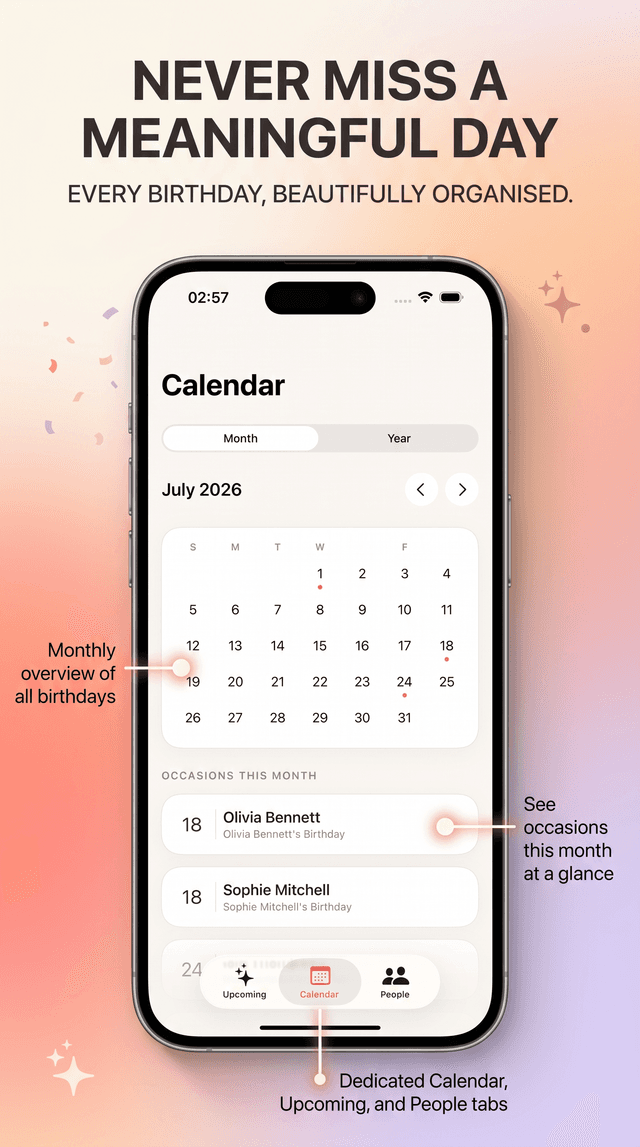
Birthday Reminder can keep each person's date, practical notes, flexible reminder schedule, and countdown together without requiring an account. Home and Lock Screen widgets can keep upcoming birthdays visible between reviews.
For an international contact:
- Save the birthday on the date they celebrate.
- Add the current city and preferred local contact window to the note.
- Choose an advance reminder based on the action you intend to take.
- Word the final prompt as “Check their local time,” not as a permanent conversion.
- Verify the city in World Clock before a live call.
The app's role is to surface the right person and context at a useful time. World Clock supplies the recipient's current local time.
Visit the Birthday Reminder app page to see how reminders, notes, countdowns, and widgets fit this workflow.
Frequently asked questions
Which date should I save for someone who lives abroad?
Save the month and day the person recognizes as their birthday in their location. Change the reminder timing, not the birthday itself.
Should I store their UTC offset?
A current city and preferred local contact window are usually more useful. A fixed offset can become stale after seasonal changes, travel, a move, or a change in local rules.
Should I keep separate birthday lists for different countries?
Usually not. Keep one source of truth and add a city and contact window to international entries. Use the three day-overlap groups to plan when you will contact each person.
Can my birthday alert fire before their birthday begins?
Yes. An alert scheduled in your local time can appear while the recipient is still on the previous date. Check the date shown in World Clock before sending a time-sensitive message.
What happens to reminders when I travel?
Your device may update its own time zone automatically, but apps can handle scheduled notifications differently. Inspect upcoming alerts after travel rather than assuming their timing is unchanged.
Do I need two reminders for every international birthday?
No. One reminder may be enough for an ordinary message. Add a preparation reminder when a card, gift, booking, delivery, or scheduled call requires earlier action.
A dependable international birthday list preserves the recipient's date, stores their current city, and describes a suitable local contact window. Your reminder tells you when to prepare; World Clock tells you whether it is time to make contact.
Browse the other Birthday Reminder guides for related planning and iPhone workflows. Our editorial policy explains how factual and product claims are reviewed.