A family can know every birthday and still miss the practical moment. The card goes to last year's address, the group call is arranged for the middle of someone's night, or three relatives assume somebody else has bought the gift.
Reliable long distance family birthday reminders therefore need more than a date. Keep enough context to answer four questions: where does this person live now, when are they available, what needs to travel, and who owns the next action?
Start with a distance-ready birthday record
Keep the birthday on the month and day the person recognizes locally. Beside it, record only the details that affect the plan:
- Current city and country.
- Preferred contact window in their local time.
- Mailing address status, such as “confirmed August 2026.”
- Usual gesture: message, call, card, gift, or group celebration.
- Family member responsible for any shared plan.
- One next deadline when preparation is already underway.
Save a city rather than a permanent difference such as “eight hours ahead.” Seasonal clock changes, travel, and moves can make a fixed offset wrong. A note such as “Toronto; call between 6 p.m. and 8 p.m. local time” remains useful because it tells you what to check.
Choose one master list and one coordinator
The family needs one place where corrections become official. That may be a private birthday app, Contacts, a spreadsheet, or a manually maintained family calendar.
An iCloud calendar can be shared with invited iCloud users, and its owner can allow or prevent editing for each person. Apple also supports a public read-only link, but that link should be used deliberately because anyone who receives it can subscribe through a compatible calendar app.
Shared access does not remove the need for ownership. Name one person to approve date and address changes. Everyone else can send corrections in a consistent form:
Priya moved to Manchester. Birthday unchanged. New address confirmed with her on 3 September.
The guide to organizing family birthdays in one place covers collecting and confirming the full family roster. For this system, the additional job is keeping location and delivery details current.
Create three reminders with different jobs
One birthday alert should not carry the entire plan. Use up to three prompts, depending on what you intend to do.
| Prompt | When to use it | What it should say |
|---|---|---|
| Detail check | Before any booking, order, or international post | Confirm city, address, availability, and task owner |
| Dispatch deadline | When something physical must travel | Post the card, place the order, or check the carrier deadline |
| Contact prompt | On or near the birthday | Check their current local time, then call or message |
A digital-only birthday may need just the contact prompt. A package and group call may need all three.
Choose the dates by working backward from the first real dependency. The birthday reminder timing guide provides starting windows for cards, gifts, bookings, and travel. The wording should identify an action, such as “Confirm Elena's Madrid address,” rather than merely announcing “Elena's birthday in three weeks.”
Apple Reminders supports notes, dates, times, recurrence, and early reminders. Those features can support the individual tasks even when the birthday itself lives elsewhere.
Plan contact in the recipient's local time
The birthday belongs to the person celebrating, while the reminder belongs to the person who must act. Treat those as separate decisions.
Add the recipient's city to World Clock and check it close to the birthday. Apple's Clock app lets you add, remove, and reorder cities, making a small family list easy to keep visible.
For a casual message, a suitable waking hour is usually enough. For a live call involving several relatives, agree on one time and state it in both locations:
Sunday, 7 p.m. Dublin / 2 p.m. New York. Check again before the call.
If the call must stay tied to a particular location, iPhone Calendar lets you assign a time zone to the event. Send the invitation to participants rather than expecting a birthday reminder to manage attendance.
The dedicated guide to birthday reminders for different time zones covers date boundaries, travel, and seasonal clock changes in more detail.
Use route-specific mailing deadlines
There is no universal international postage time. The answer depends on the origin, destination, carrier, service, item, customs requirements, and local delivery network.
For example, USPS currently lists a 6–10-business-day estimate for Priority Mail International to many major markets and says the number of days can vary with origin, destination, and customs delays. That is an estimate for a specific package service, not a promise for every international card or gift.
Use this process:
- Confirm the destination address and postal format.
- Identify whether you are sending a letter, card, merchandise, or another item.
- Check the carrier's current estimate for that route and service.
- Add a personal buffer for weekends, preparation, and uncertainty.
- Put the resulting dispatch date in the reminder.
When sending a USPS international package, check customs requirements before packing it. USPS says Priority Mail International packages need a complete computer-generated customs form. Its current customs guidance also requires detailed descriptions for package contents, not vague labels such as “gift.”
Starting three to four weeks ahead is a reasonable planning prompt for many cross-border gestures, but it is not a delivery guarantee. Verify the actual route every year. For a fuller posting workflow, see how to plan birthday cards before they become last-minute.
Assign every shared task to one relative
“Someone should organize a call” is not an assignment. Give each task one owner, even when several relatives will help.
| Role | Responsibility |
|---|---|
| Date steward | Maintains the confirmed birthday and current location |
| Physical-gesture owner | Handles the card, gift, customs form, or local order |
| Call host | Proposes the time, sends the invitation, and starts the call |
| Local helper | Handles a visit, collection, flowers, or another local task |
One person can hold several roles, but each role should still be explicit. Put the owner and deadline in the family message:
Marco has the gift and will dispatch it by 4 October. Leah will send the video-call invitation by Sunday.
The birthday record remains the stable source of the date. Collaborative updates can stay in the family's normal message thread instead of being copied into several competing calendars.
Review moves and changing preferences
Long-distance details age quickly. A student returns home, a sibling changes countries, or a grandparent starts preferring an earlier call.
During the monthly review, look six weeks ahead and ask:
- Does this person still live in the saved city?
- Is the mailing address confirmed recently enough to use?
- Does the preferred contact window still work?
- Has anyone agreed to handle a physical gesture or group call?
- Is a digital fallback needed if delivery becomes uncertain?
After the birthday, update only what changed. The simple birthday planning system provides a broader remember, prepare, and celebrate routine.
Keep a fallback gesture ready
A delayed parcel does not have to become a missed birthday. Keep the physical and same-day gestures separate.
If delivery becomes uncertain, send a voice note, digital card, photograph, or message during the recipient's birthday and explain that the package is still travelling. If a group call fails, let one person call individually rather than waiting for every participant to reconnect.
The fallback is not a replacement for planning. It prevents a carrier delay or technical problem from erasing the acknowledgment.
Example: one birthday across three countries
Suppose your aunt lives in Lisbon, one sibling is sending a gift from Canada, and you are hosting a call from the United States.
The record might contain:
- Birthday: 22 November.
- Location: Lisbon.
- Contact window: 6–8 p.m. local time.
- Address: confirm before ordering.
- Gift owner: sibling in Canada.
- Call host: you.
The first prompt asks for address confirmation. The gift owner then checks the Canadian carrier's deadline and reports the dispatch date. The call host creates one zoned Calendar event and sends it to everyone. On the day, each participant checks the event rather than recalculating the time from an old message.
Where Birthday Reminder fits
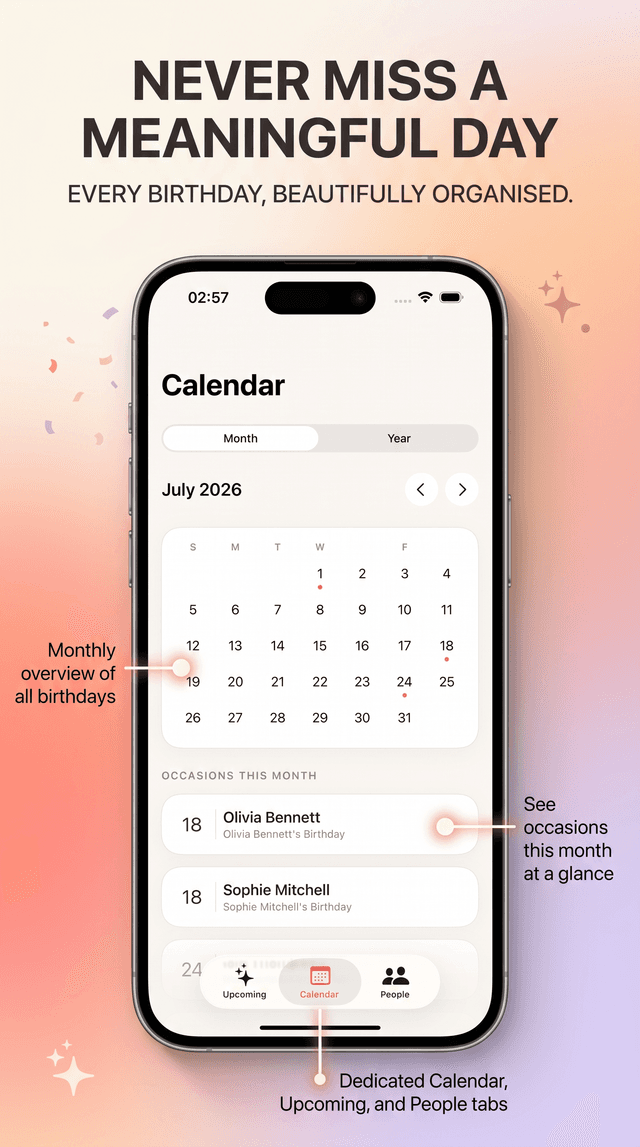
Birthday Reminder is a private organizer, not a collaborative family calendar. One coordinator can keep selected birthdays, countdowns, flexible reminder schedules, and practical notes together without creating an account. Home and Lock Screen widgets can keep upcoming dates visible.
Use a note for the current city, preferred contact window, or address-confirmation status. Keep group discussion and task handoffs in the communication channel the family already uses.
Visit the Birthday Reminder app page to see how its records, reminders, notes, countdowns, and widgets fit this workflow.
Frequently asked questions
Which date should I save for a relative overseas?
Save the month and day the person recognizes as their birthday in their location. Do not shift the stored date merely because their birthday starts earlier or later than it does where you live.
How early should I send an international birthday card?
Check the actual postal service and route. Cards and packages may use different services and have different customs requirements. Set an early prompt to confirm the address, then create the dispatch deadline from the carrier's current estimate plus a reasonable buffer.
Should every relative edit the shared birthday calendar?
Usually not. Give editing access only to people who will maintain the calendar carefully, and name one coordinator to approve corrections. A read-only view may be enough for everyone else.
Can a birthday reminder automatically choose the right time for the recipient?
Do not assume it will. Treat the reminder as your prompt, save the recipient's city and preferred local contact window, and check the current local time before calling or sending a time-sensitive message.
What if nobody knows the current address?
Do not send a package to an unconfirmed address. Ask the person or a close relative, mark the address as unconfirmed, and use a digital gesture if there is not enough time to verify it.
How do we avoid two people sending the same gift?
Name one physical-gesture owner and record the decision in the family conversation. Other relatives can choose separate gestures or contribute to the same plan once ownership is visible.
Long-distance birthdays become manageable when every reminder leads to a specific action: confirm the details, dispatch what must travel, and make contact at a considerate local time. Browse all Birthday Reminder guides for related workflows, or read the editorial policy to see how product and platform claims are reviewed.