To organize birthday gift ideas and reminders, give them different jobs. Keep possible gifts in an undated reference list. Put concrete actions in a reminder only when they have a real due date.
Use this test:
Can I write this as an action and say when it must happen?
“Maybe a pottery class” is an idea. “Choose between the pottery class and cookbook by October 10” is a commitment, even though the gift is not settled. “Book the Saturday pottery class by October 15” is another commitment.
This distinction keeps optional thoughts from generating noisy alerts and prevents real deadlines from disappearing inside a long gift list.
Why ideas and commitments need different homes
Ideas and commitments behave differently.
An idea:
- Records a possibility.
- May remain useful for months.
- Can be replaced without consequence.
- Does not require an alert merely because it was recorded.
A commitment:
- Names something you intend to do.
- Has a due date or decision point.
- May depend on delivery, availability, money, or another person.
- Can be completed, rescheduled, or consciously cancelled.
Mixing them makes both lists less trustworthy. If every possibility becomes a reminder, alerts start to feel optional. If every real task remains in a note, deadlines become difficult to see.
The separation is about status, not subject. “Blue running gloves, size M” and “Order the blue running gloves by Friday” concern the same gift, but only the second sentence describes a commitment.
Use the action-and-date test
Do not ask whether an idea feels important. Ask whether an action is due.
A useful commitment contains two parts:
- A verb: choose, ask, order, book, post, confirm, wrap, or call.
- A due date: the point when the action must happen, not merely the birthday.
If either part is missing, the entry probably still belongs in the idea list.
| Entry | Category | Reason |
|---|---|---|
| “Noise-cancelling headphones” | Idea | No action or deadline |
| “Ask Sam which headphones fit by Friday” | Commitment | A dated decision task |
| “Order the selected headphones by October 12” | Commitment | A dated purchase task |
| “Concert tickets if new dates appear” | Idea | A condition, but no current action |
| “Check the venue schedule on Monday” | Commitment | A specific action and date |
A purchase is not automatically an unfinished commitment. If the gift has arrived and nothing else must happen, complete the task. If it still needs wrapping or delivery, create that next action rather than leaving “gift purchased” as an open reminder.
Build one quiet idea home
Your idea home should be easy to add to and should stay silent until you choose to review it.
On iPhone, Apple Notes can support this setup in several ways:
- Create a Gift Ideas folder with one note per person.
- Add a tag such as
#giftideasand filter tagged notes across folders. - Pin the note for the next important birthday.
- Use a checklist when one person has several possible gifts.
Apple confirms that Notes supports folders, pinned notes, tags, and checklists. A checklist adds a new item when you press return and lets you mark an item complete.
Use a compact format:
Maya
- Pottery class, mentioned after visiting the craft market
- Cookbook by the chef she follows
- Small planter for her office
Dates can appear as context, such as “mentioned in June,” without becoming deadlines. Avoid attaching alerts to these entries.
For detailed guidance on limits, links, and stale ideas, see how to store birthday gift ideas without saving too much. For exact iPhone setup options, use the guide to adding birthday notes and gift ideas on iPhone.
Give every commitment a real due date
Once an action matters, put it in a system designed to surface dated work.
Apple Reminders supports notes, due dates and times, recurrence, and an Early Reminder that can appear before the scheduled time. Apple notes that some features require updated Reminders in iCloud and may not be available with every account.
Write the reminder as the work to be done:
- “Choose Maya’s gift by October 10.”
- “Book the pottery class by October 15.”
- “Confirm that the voucher arrived on October 20.”
- “Bring Maya’s card to dinner on October 24.”
Set the due date from the practical deadline. An order task should be due while delivery is still realistic, not on the birthday itself.
An Early Reminder can provide a buffer, but it does not repair a poor due date. If ordering must happen by Friday, make Friday the due date. Then use an earlier alert if you want time to compare options.
The birthday reminder timing guide provides starting ranges for cards, online orders, international delivery, bookings, and travel.
Promote an idea without losing useful context
Moving an idea does not have to mean deleting its source immediately. Use this short workflow:
- Choose the next action. Decide whether you need to research, ask, buy, book, or deliver.
- Find the deadline. Work backward from shipping, availability, or the birthday.
- Create the reminder. Write the action and due date in the commitment system.
- Carry over only useful details. Include the product name, size, link, or booking requirement needed to complete the task.
- Mark the idea as selected. Check it off or add “selected” so you do not create a second task from it.
- Clean up after completion. Remove or archive the idea once you no longer need it.
This creates a visible state change:
Possible → selected → scheduled → completed
You can also schedule a decision without pretending that the final gift has been chosen. “Choose one of Maya’s three ideas by Sunday” is a valid commitment. The ideas remain in their reference list until that decision is made.
Work through one complete example
Suppose a note for Daniel contains:
- Leather notebook
- Cooking class
- Tickets for the spring exhibition
Six weeks before his birthday, you learn that the exhibition may sell out. The ticket idea now needs a decision.
Create:
Check exhibition dates and decide by Thursday.
After checking, you choose the tickets. Mark that idea as selected and create:
Buy two exhibition tickets by Saturday.
Once purchased, complete that task. If the tickets must be printed or transferred, add a final action with its own date. Do not keep the completed purchase sitting beside undecided ideas as though all four entries have the same status.
This approach fits the broader remember, prepare, and celebrate workflow in the simple birthday planning system, but it solves a narrower problem: deciding exactly when a thought deserves a deadline.
Keep both lists clean without constant reviewing
The idea list does not need daily attention. Review it when attention can still change the outcome.
A practical routine is:
- Look at ideas for people whose birthdays fall within the next six weeks.
- Remove entries that are no longer relevant.
- Create a decision task when choosing cannot wait.
- Check that every selected plan has a dated next action.
- Remove duplicate reminders after plans change.
A brief monthly scan is enough for most people. The monthly birthday review guide gives that check a fixed time limit and a six-week horizon.
Avoid reviewing every idea for every person. The purpose is to notice approaching decisions, not to turn a birthday list into a permanent shopping project.
Avoid the most common category mistakes
Putting “maybe” in a reminder.
“Maybe buy a candle” remains an idea even if it has an alert. Either return it to the idea list or rewrite it as “Choose a gift by Tuesday.”
Using the birthday as every task’s due date.
Booking, ordering, and posting usually have earlier practical deadlines. The birthday is the event date, not automatically the action date.
Keeping a decision only in your head.
Once you have decided to act, create the dated task immediately.
Copying the full idea list into every task.
A commitment needs enough context to complete one action, not every possibility you considered.
Deleting the source before copying important details.
Preserve the correct size, model, link, venue, or preference first. Then mark the idea as selected or remove it.
Creating duplicate alerts for awareness and action.
A birthday alert and a preparation task can coexist because they have different jobs. Identical alerts in several apps merely create noise. The comparison of calendar alerts and preparation reminders explains that boundary.
Where Birthday Reminder fits
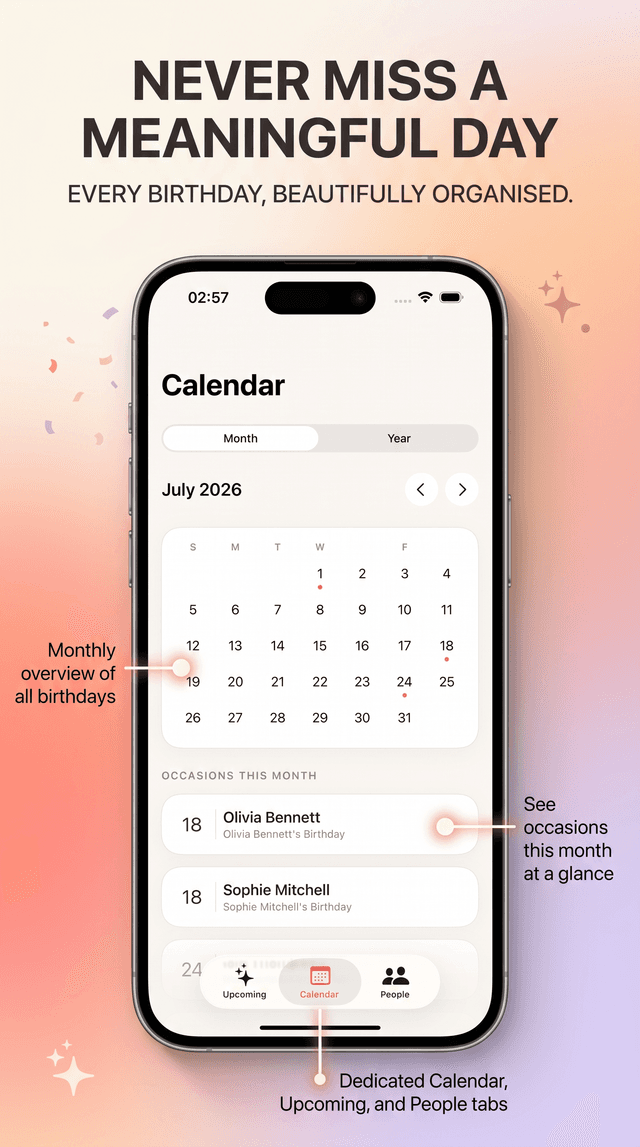
Birthday Reminder can serve as the birthday-focused side of this system. It keeps birthday records, notes, gift ideas, countdowns, and flexible birthday reminder schedules together.
That makes it useful for seeing who is approaching and preserving an idea beside the correct person. A general task app remains the clearer home for arbitrary actions such as “order by Friday” or “call the restaurant tomorrow,” because those commitments have their own completion state and deadline.
This is a natural division of work:
- Birthday Reminder: the person, birthday, countdown, gift ideas, and birthday alerts.
- Reminders: dated decisions, purchases, bookings, posting, and follow-up tasks.
Visit the Birthday Reminder app page to review its current features.
Frequently asked questions
Should every birthday gift idea get a reminder?
No. A possibility does not need an alert. Create a reminder when there is a concrete action and a date by which it must happen.
What if I need a deadline to choose the gift?
Create a decision task, such as “Choose Jamie’s gift by Sunday.” The gift candidates can remain in the idea list until you decide.
Can ideas and commitments live in the same app?
Yes, if the app gives them clearly different places and states. Keep ideas undated and keep commitments in a dated task list. Do not rely on wording alone if both appear in one undifferentiated list.
Should I delete an idea after creating a reminder?
First copy the details needed to complete the task. Then mark the idea as selected, archive it, or remove it. Avoid leaving an active idea and active task that look like separate plans.
Is Apple Notes enough for the idea list?
Yes. A folder, tagged note, or one checklist per person is sufficient if you review it before upcoming birthdays. Notes does not need to own the dated action as well.
How often should I review gift ideas?
Review ideas for birthdays in the next several weeks during a short monthly planning session. Also clean up the relevant person’s list after the birthday.
Ideas should be easy to capture and harmless to ignore. Commitments should be specific enough to complete and difficult to miss. Keeping those jobs separate makes both parts of the system easier to trust.
Browse the other Birthday Reminder guides for related planning workflows, or read our editorial policy for how product claims and technical instructions are reviewed.