
To sign a birthday card, finish your message, leave a line of space, write a closing that suits the relationship, and put your name underneath it.
A reliable default looks like this:
Warm wishes,
Avery
Use With love or Love always for someone close, Warmly or Warm wishes for a friend or relative, and Best wishes for a coworker or acquaintance. If the printed card already says everything necessary, signing your name clearly can be enough.
The signature is different from the main birthday message. If you still need help writing that part, use the separate guide to birthday wishes for a card.
Use a Simple Three-Part Ending
Most birthday-card endings need only three parts:
- A final message sentence, if you have one.
- A closing, such as “With love” or “Warm wishes.”
- Your name, written clearly.
For example:
I hope you have a brilliant day and plenty to look forward to this year.
With love,
Maya
The closing is not another full birthday wish. It marks the transition from your message to your signature.
If your final sentence already sounds complete, do not stack several closings beneath it. One is enough:
Can’t wait to celebrate with you!
Love,
Maya
For help composing the message before the closing, see the birthday card examples by relationship.
Choose a Closing That Fits the Relationship
The safest closing is one that sounds like something you would naturally say to this person. Do not use “Love” merely because it is a birthday card, and do not make a close relationship sound like business correspondence.
| Relationship | Useful defaults | More personal options |
|---|---|---|
| Partner or immediate family | With love, Love | All my love, Love always |
| Close friend | Warmly, Cheers, With love | Fondly, Lots of love |
| Relative you know less closely | Warm wishes, All the best | With love, if it feels natural |
| Coworker or manager | Best wishes, Warm wishes | Cheers, in a casual workplace |
| Acquaintance or formal relationship | Best wishes, All the best | Sincerely, if the card is particularly formal |
Parade’s article on card endings quotes mental health professionals who recommend Warmly as a caring but less personal alternative to Love. It also places Fondly with close friends and family and Sincerely with professional or less familiar relationships.
Postable groups its suggestions similarly, separating friendly and affectionate closings from formal choices such as Best, Sincerely, and Kind regards.
Treat those categories as guidance rather than rigid etiquette. “Cheers” may be entirely natural between friendly coworkers but unusual in another workplace. “Love” may be normal throughout one family and reserved for only the closest relationships in another.
Know When Your Name Alone Is Enough
A complimentary closing is optional. Your signature is not.
Signing only your name can work when:
- The card has a complete printed sentiment.
- You have written a very short greeting.
- A group card has almost no space left.
- You do not know the recipient well enough for an affectionate closing.
- Your usual way of signing notes to this person is simply your name.
For example:
Happy birthday, Nina. Hope you have a wonderful day!
Jordan
This still has a clear ending because the message is complete and the sender is identifiable. What feels unfinished is an abrupt message with no closing and no recognizable signature.
Parade’s experts warn that omitting an ending altogether can make a card seem rushed. The practical lesson is not that every card requires a formal sign-off. It is that the recipient should be able to tell where your message ends and who wrote it.
Sign From One Person, a Couple, or a Family
Use enough of your name to make your identity obvious.
From one person
A first name is usually enough for family and close friends:
With love,
Elena
Use a surname or last initial when the recipient knows several people with your first name:
Best wishes,
Jordan Lee
From a couple
Put both names on the same line when both people are genuinely sending the card:
With love,
Priya and Daniel
Do not add a partner’s name automatically if they have not seen the card or would not consider themselves part of the message.
From a family
For a small household, first names feel more personal:
Lots of love,
Maya, Theo, and Sam
For a larger household, a family label is clearer:
Warm wishes,
The Chen family
Avoid signing only “Mom,” “Uncle,” or another relationship label if the card could be passed around or the recipient has more than one person with that role. Add your name when clarity might be lost:
Love,
Aunt Rachel
Emily Post’s correspondence guidance emphasizes using the name or title a person prefers. That principle also applies inside the card: spell the recipient’s name correctly, and sign yourself in the form they will recognize.
Place and Punctuate the Signature Clearly
A common handwritten layout places the closing and signature below the message, toward the lower right. Postable recommends leaving one or two line breaks before the closing and writing the name on the following line.
That is a convention, not a reason to squeeze your name into a corner. On a small, illustrated, or heavily printed card, use the clearest available space.
For a traditional closing:
- Capitalize the first word: Warm wishes, not Warm Wishes.
- Put a comma after the closing.
- Write your name on the next line.
- Leave enough space that the ending does not run into the printed design.
- Use ink that will not smear through the card stock.
A sentence-style ending follows ordinary sentence punctuation instead:
Here’s to another excellent year!
Morgan
If you add a postscript, place it below the signature:
Warmly,
MorganP.S. Save me a slice of cake.
Sign a Group or Office Card Without Taking Over
In a group card, your main responsibilities are to sign clearly, use the available space fairly, and avoid repeating what is already there.
Before writing:
- Read the existing messages.
- Choose a blank area that leaves usable space for later signers.
- Keep your contribution to one or two lines when the card is crowded.
- Use your first and last name, or a recognizable last initial, if several signers share your first name.
A closing is often unnecessary after a one-line group message:
Hope you have a great birthday and a quiet afternoon!
Alex R.
If the whole team is sending one collective message, the organizer can use:
Best wishes,
The Design team
Individual names can then appear below or elsewhere in the card. For message examples and shared-space etiquette, use the dedicated guide to birthday messages for a group card.
Avoid These Common Signing Mistakes
- Using a closing that overstates the relationship. “All my love” may be uncomfortable in a professional or distant relationship.
- Turning the closing into another paragraph. Put longer thoughts in the message and keep the sign-off compact.
- Stacking several endings. “With love, fondly, and warmest wishes” sounds less natural than choosing one.
- Signing with an unrecognizable initial. The recipient should not have to identify the sender from the envelope.
- Using a private nickname in a public card. Group cards may be read by coworkers, relatives, or other contributors.
- Copying the signer above you. Read the card first and add a distinct line or simply sign your name.
- Forgetting who the printed card is from. Check that every person named in the signature knows about and agrees with the message.
- Using your email sign-off automatically. “Regards” or “Thanks” may feel routine rather than celebratory unless the relationship is formal.
The goal is not perfect etiquette. It is a closing that feels proportionate, clear, and recognizable as yours.
Prepare the Card Before the Birthday
If choosing a closing is usually a last-minute problem, save a short writing cue rather than a finished script. A note such as “sign warmly, mention the garden” gives you direction without making next year’s card sound copied.
Apple confirms that Reminders on iPhone can store notes, dates, times, recurrence, and early reminders. You could create a dated task called “Write Dana’s card” and add the intended tone or one detail beneath it.
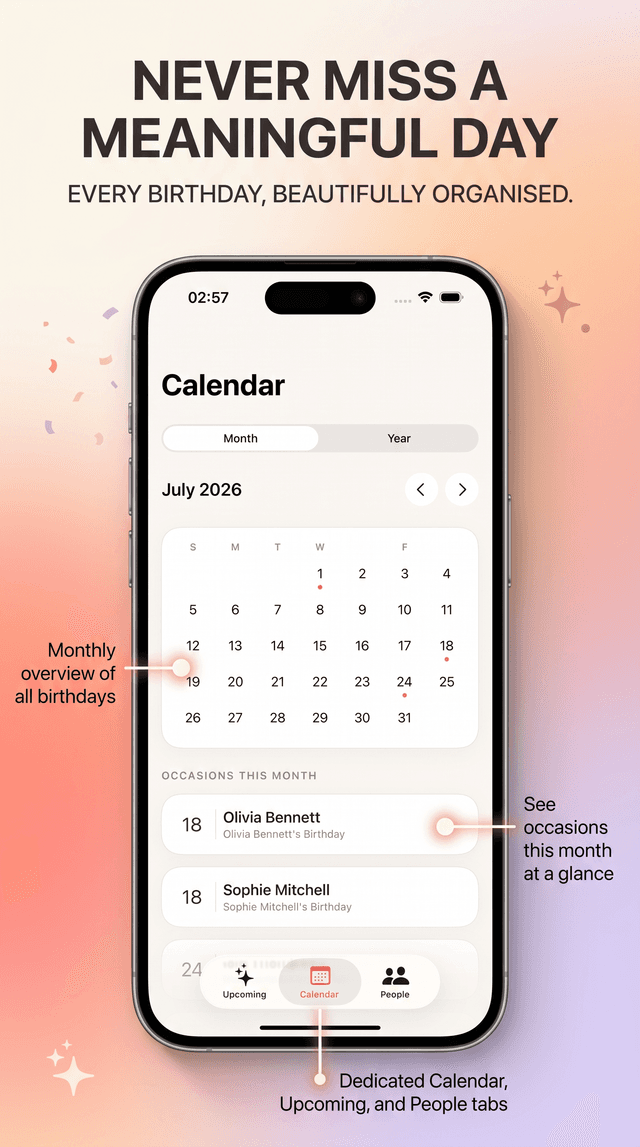
The current Birthday Reminder App Store listing confirms that the app supports personal notes, countdowns, and customizable reminder lead days and alert times. A short note such as “card: sign from both of us” can stay with the birthday record until the preparation reminder arrives.
For the full buy, write, address, and mail workflow, see the birthday card planning guide. The birthday reminder timing guide explains how much notice to allow for cards, gifts, deliveries, and celebrations.
Frequently Asked Questions
Is it acceptable to sign only my name?
Yes. Your name alone works when the printed card already contains the sentiment, your handwritten message is complete, or space is limited. Make the signature legible and use enough of your name to identify yourself.
How should I sign a birthday card for a coworker?
Use a warm but restrained closing such as “Best wishes,” “Warm wishes,” or “All the best,” followed by your name. In a crowded office card, a short message and clear signature are enough.
Should I put a comma after “Love”?
In the traditional layout, yes:
Love,
Sam
The same pattern applies to “With love,” “Warmly,” and “Best wishes.”
How do I sign a card from my whole family?
List first names when the group is small, or use a clear family label such as “The Chen family.” Use “and” before the final name rather than making the signature look like a list of unrelated signers.
Does a birthday-card signature go on the left or right?
The lower right is a common position for the closing and signature, but readability matters more than exact placement. Use the natural space below your message and avoid writing over artwork or printed text.
What if I do not want to write “Love”?
Use “Warmly,” “Warm wishes,” “Best wishes,” “All the best,” or simply your name. Choose according to the relationship rather than treating “Love” as required birthday-card etiquette.
A good birthday-card signature does not need to be clever. Choose one closing that matches the relationship, write your name clearly, and stop once the card feels complete.
Visit Birthday Reminder to keep birthday dates, countdowns, notes, and advance reminders together, or browse the other Birthday Reminder guides.