Boredom porn triggers respond to design better than to willpower. When the urge appears in unstructured time, fighting it at the moment is the hardest version of the problem. The easier version is upstream: confirm boredom is the real cue, then build a default for that specific empty window so the next step is already chosen before the urge arrives.
This article explains why boredom is such a reliable trigger, how to check it is not a cover for something else, and how to replace the automatic route with a prepared one.
Why boredom is such a reliable trigger
Porn is almost perfectly shaped to fill empty time. It is free, instant, private, and endlessly novel. When an evening has no plan, it asks nothing of you and offers immediate stimulation in return.
A 2022 study in Personality and Individual Differences adds a useful layer. In a sample of 179 adults in the UK and Ireland, people prone to boredom reported slightly more frequent pornography use, and the link between feeling that life lacks meaning and using pornography ran partly through boredom and through using porn to avoid uncomfortable emotions. The authors frame porn use, in this context, as a possible escape from the meaninglessness that boredom signals.
Treat that as emerging evidence, not a verdict about you. The study was cross-sectional and self-reported, so it cannot show that boredom causes use, and the correlation with frequency was small. What it offers is a practical hint: if boredom use is partly about escape and novelty, then a replacement has to offer something in that same moment, not just be good for you in the long run.
Check that boredom is the real trigger
“I was bored” is sometimes the whole story and sometimes a cover story. The empty hour may be carrying loneliness, stress, resentment, tiredness, or the simple fact that everyone else is asleep and the phone is in your hand.
Before redesigning anything, run a short check for a week or two. When the urge appears, note:
- the time and day,
- what had just ended (work, a show, a message, a meal),
- what you felt in one word,
- whether you were alone,
- what you did next.
Then ask one question of each entry: bored of what? “Bored” after a draining day is often exhaustion. “Bored” on a Sunday with no plans may genuinely be unstructured time. “Bored” after an argument is usually not boredom at all. The guide to mapping the cue without shaming yourself covers this kind of honest logging in more detail.
Keep entries that did not end in use. They show which conditions already protect you.
Understand the novelty loop
Boredom use has a trap built into it. Research published in 2024 in the Journal of Experimental Psychology: General found, across seven experiments with more than 1,200 participants, that rapidly switching between online videos or fast-forwarding through them made people feel more bored and less satisfied than watching one video through. The researchers suggest switching prevents engagement, which makes the content feel meaningless. They also note the samples may not represent every age group or population.
This was not a porn study, so do not stretch it into one. But the mechanism is recognisable to anyone who has clicked through clip after clip looking for the right one and finished the session feeling flatter than when it started. Chasing novelty to escape boredom can deepen the very state you were escaping.
Two practical consequences follow. First, “just watch less of it” keeps you inside the switching loop; leaving the loop entirely for the window is cleaner. Second, an alternative that holds your attention on one thing, even something ordinary like one film, one album, or one recipe, may relieve boredom better than another feed of short content.
Build a default for the empty window
A default is what happens when you make no decision. Right now, for the trigger window, the default is probably: sit down, phone in hand, autopilot. You replace a default by deciding in advance, once, when you are calm.
Pick the one window your log shows most often, and write a default with three parts:
- First step (under a minute): the physical move that starts the alternative. Shoes by the door. The book already on the pillow. The bike unlocked. If the first step needs effort at 11pm, it will lose.
- The thing itself: one absorbing activity, not a menu of twenty. It should fit the real conditions of that window: your energy, your flatmates or family, the hour, the noise level.
- The length: a defined span, such as “until the kettle boils” or “one episode, then bed.” An open-ended alternative competes badly with an open-ended feed.
Concrete examples, matched to real windows:
- Sunday afternoon, no plans: leave the flat within ten minutes of lunch finishing, with one destination already chosen. The default is the walk, not the sofa.
- The after-work slump: change clothes and start dinner before sitting down. Sitting down with the phone is the trigger posture, so the default postpones the chair, not the phone.
- Late night in bed: charge the phone in another room and keep a specific, low-stakes book on the pillow. The default object in your hand changes.
One window, one default. When it holds for a couple of weeks, prepare the next window.
Add friction to the old route
The new default gets a head start when the old route takes extra steps:
- keep the phone out of the bedroom and bathroom,
- sign out of accounts and clear saved sessions on the device you usually use,
- turn off the notifications that begin the drift toward the browser,
- use your device's built-in content restrictions as a speed bump, knowing they are a pause, not a wall.
None of this guarantees an urge will pass. It buys a few seconds in which the prepared default can win. If the whole pattern runs on autopilot rather than boredom alone, How to Stop Watching Porn When the Pattern Feels Automatic addresses that wider loop.
Track the hour, not just the streak
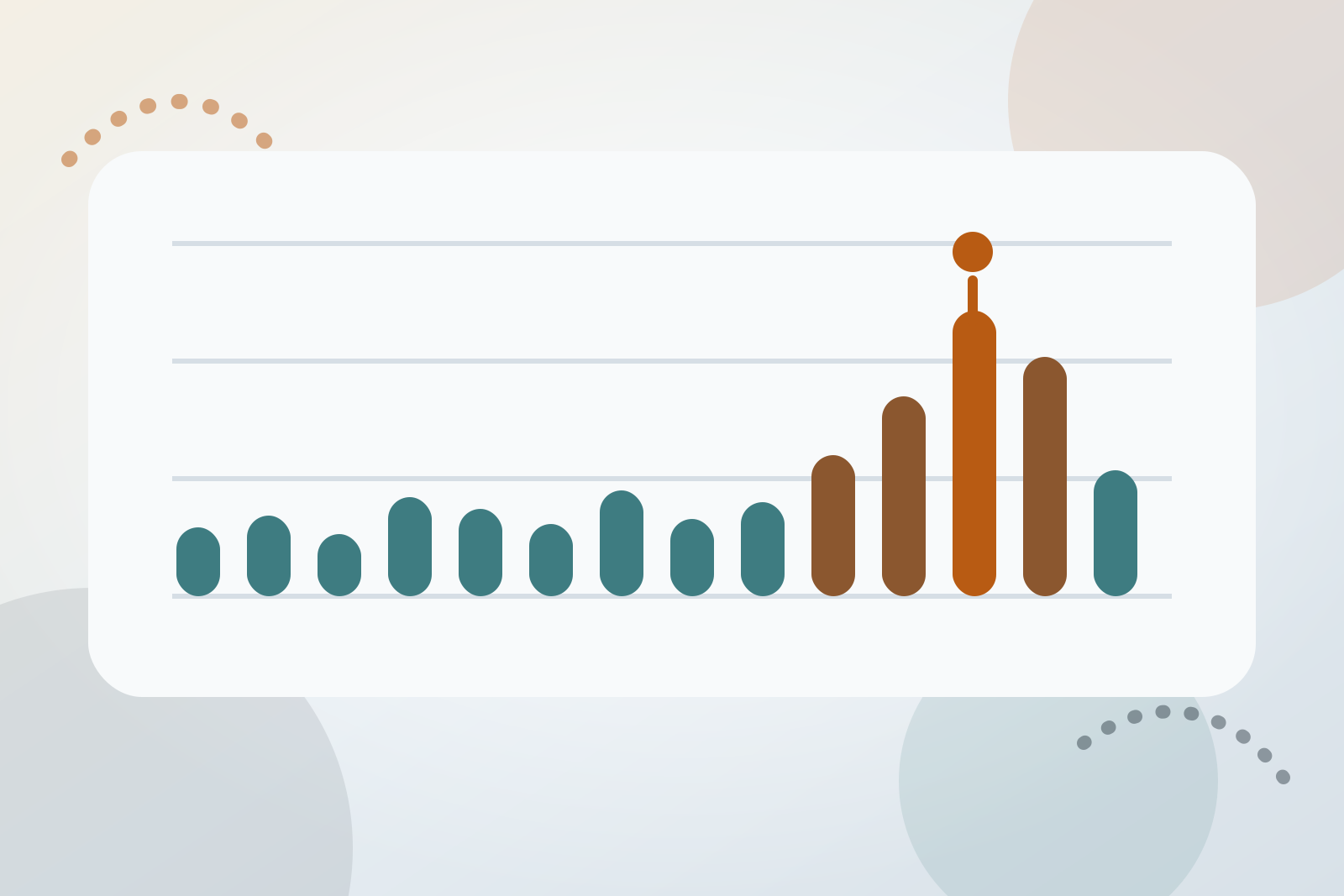
Boredom use is time-shaped. It tends to gather at the same dead hours: the post-lunch dip on days off, the gap between finishing dinner and feeling sleepy, the hour after everyone else has gone to bed. A streak counter tells you that you slipped; it does not tell you that it keeps happening at 10:40pm on Thursdays.
Log each urge or use with its hour, and review weekly. After a couple of weeks, a personal timetable usually emerges, and that is what the defaults should be built around. How to Track the Hours Porn Use Feels Most Automatic walks through this method.
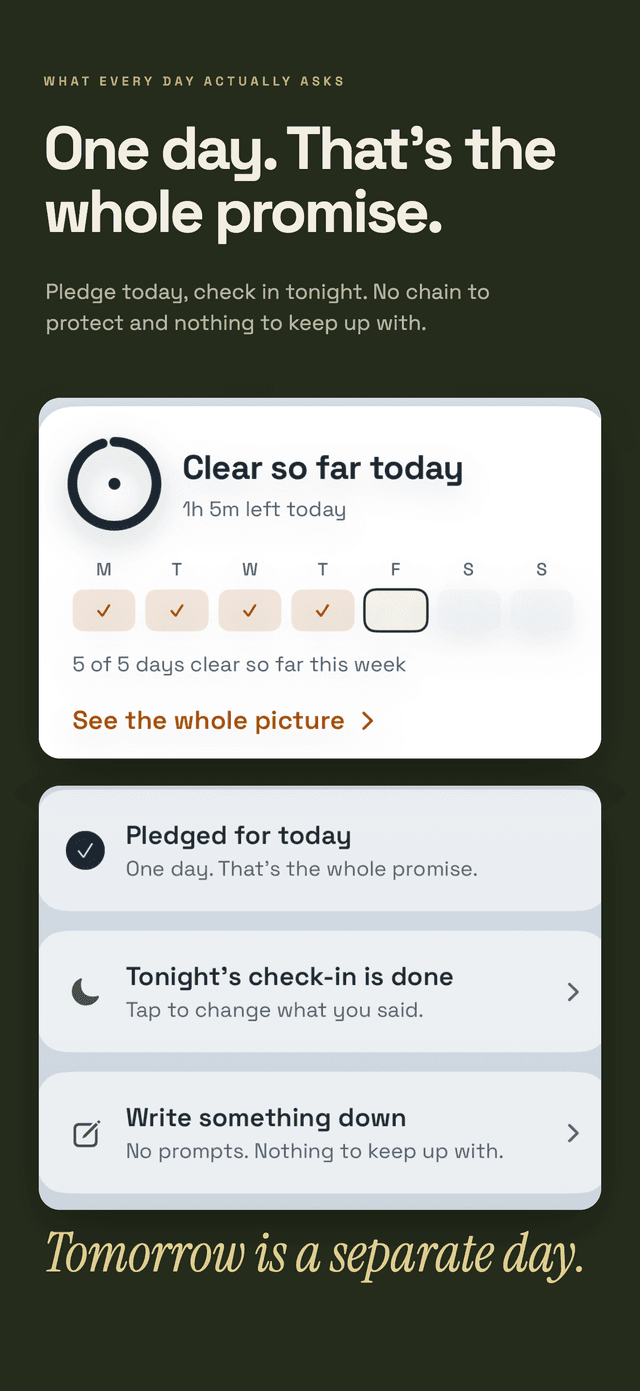
Hard Bit is built for exactly this job on iPhone. Each habit keeps its own counter, logs, and reason for stopping, and its subscription tier learns your difficult hour from your own entries and warns you before it arrives. The forecast makes no prediction below five entries and leans fully on your data at around twenty. There is no account and nothing leaves the phone unless you export it. The Hard Bit overview documents the current features. Paper works too; the app is one way to keep the record honest.
Plan for the flat weeks
Expect a stretch, after cutting down, where the empty hours feel emptier than before. The old activity reliably filled them, and nothing new has taken its place yet. There is no established timeline for when other things start to feel like enough, so do not treat week two's flatness as evidence the change is failing.
Lower the job of the default during this stretch. It does not need to be fulfilling. It needs to occupy the window: feed you, move you to a different room, put one person in your ear. Meaning tends to follow engagement rather than precede it.
When an urge still arrives despite the default, shorten the moment. A five-minute plan for the start of a craving gives a sequence for getting through the first minutes without turning it into a referendum on your character.
When boredom use may need more support
Boredom use is not a diagnosis, and most people changing a habit do not need clinical labels to make progress. But Mayo Clinic describes a pattern worth taking seriously: sexual urges or behaviours that feel beyond your control, repeated unsuccessful attempts to cut back, continued use despite serious problems in relationships, work, finances, or health, or use as an escape from depression, anxiety, or loneliness.
If that description fits, a self-tracking plan is not the right ceiling. Start with your doctor, who can refer you to a mental health professional with experience in compulsive sexual behaviour. What you tell a clinician is private, with narrow safety exceptions, and they have heard all of it before.
If porn use ever comes with thoughts of harming yourself, or you feel at risk of hurting someone else, treat that as urgent: contact emergency services or a crisis line where you are. In the US, you can call or text 988, the Suicide and Crisis Lifeline, at any hour.
Frequently asked questions
Is watching porn when bored always a problem?
No. The practical question is not whether boredom was the trigger but whether the habit has become your only answer to empty time and is displacing sleep, relationships, money, work, or things you value. If it is a problem for you, that is enough reason to change the default, regardless of what anyone else considers normal.
Why does everything else feel more boring than porn?
Two reasons are plausible. Porn delivers fast novelty with no effort, so most alternatives lose the immediate comparison. And research on digital switching suggests that chasing quick novelty can deepen boredom rather than relieve it, which keeps the comparison tilted. Alternatives often start to register once you stay with one thing long enough to become engaged, so give a default a defined span instead of judging it in the first three minutes.
Should I just keep myself busy all the time?
No. A packed schedule is a fragile plan, and some unstructured time is normal and healthy. The goal is not to eliminate empty hours but to make sure the emptiest ones have a prepared default, so boredom is an ordinary feeling rather than a trigger you must outlast.
What if the boredom is really loneliness or low mood?
Then a better default may help the hour without touching the underlying need. Persistent low mood, loss of interest in things you used to enjoy, or loneliness that does not lift deserve a conversation with a doctor or mental health professional in their own right, whether or not the porn habit changes.
Can a tracker fix a boredom trigger by itself?
No. A tracker shows you which hours and conditions repeat; it cannot choose the default or walk you out of the room. Its value is accuracy: it turns “I end up watching porn when I'm bored” into “it is usually this window, after this cue,” which is a problem you can actually design for.