If porn cravings keep arriving at moments you did not choose, the most useful first move is not more willpower. It is a map. For the next week, treat each urge as information: write down the time, the place, the device in your hand, what you were feeling, and what happened in the minutes before the urge started. Then review those notes once a week and look for the combination that repeats.
This article shows you how to build that map without turning it into a trial of your own character, how to read the pattern honestly, and when the pattern itself says it is time to bring in more support.
Why a cue can start a craving before you decide anything
Many people experience a porn craving as a sudden urge with no clear origin. Research suggests the trigger is often there; it is just quiet. A peer-reviewed brain imaging study published in PLOS ONE found that when people with compulsive sexual behaviour were shown sexual cues, they reported stronger desire, with greater activity in brain regions also involved in drug-cue responses. Notably, the desire was not matched by stronger liking.
That wanting-versus-liking gap is worth sitting with. A cue can make you want something without any conscious decision and without the result being something you even enjoy. This is emerging evidence from a small study, not a law of your brain, but it matches what many people report: the urge can arrive fully formed after a thumbnail, a notification, a mood, or simply a familiar hour.
The practical conclusion is hopeful. If cues help start cravings, then changing your relationship to cues, not just fighting the craving at its peak, is a legitimate strategy.
What a cue map is and what it is not
A cue map is a short, factual record of the conditions around each craving. Mayo Clinic's guidance on compulsive sexual behaviour makes the same recommendation in clinical language: identify the situations, thoughts, and feelings that trigger sexual urges so you can take steps to manage them. Their advice for a first appointment even suggests bringing notes about when the behaviour happens and what triggers or relieves it. Your private log is the same tool, used earlier.
A cue map is not:
- a scorecard of failures,
- proof that you have a disorder,
- a reason to hide from a doctor,
- or a replacement for professional care when you need it.
It is a description of weather, not a verdict on the climate of your character. The NHS describes addiction generally as not having control over something to the point where it may harm you, and stresses that help is available. Where you sit on that spectrum is a question for a professional, not for a notes app. The map simply helps you describe your own pattern accurately, to yourself first and to a clinician later if you choose.
Log five fields, close to the moment
Keep the record small enough that you will actually keep it. Five fields are enough:
- Time and day. Not just “evening”. Thursday, 11:40pm.
- Place and device. Bed, sofa, desk; phone, laptop, tablet.
- What happened just before. A row with a partner, a boring task, an advert, a match ending, closing a work laptop.
- What you felt. Bored, lonely, stressed, restless, rewarded, numb. One word is fine.
- What you did next. Including “watched” if that is what happened. An honest entry teaches more than a flattering one.
A typical entry might read: “Friday 11:50pm, bed, phone; finished a stressful week, felt flat and restless; watched.” Another: “Sunday 3pm, desk, laptop; alone after gym, felt wired; made tea and went for a walk instead.” Both are equally valuable, because the second one shows a condition that protected you.
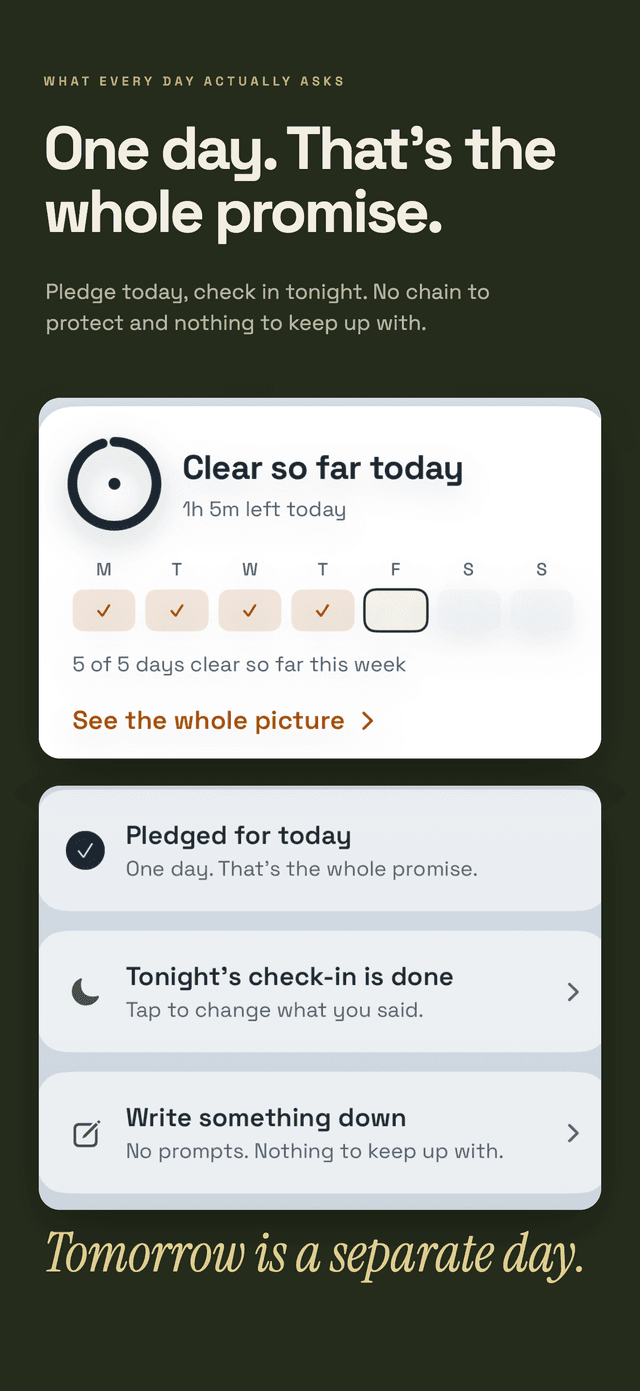
Hard Bit, the private iPhone craving tracker, is built for exactly this kind of record: each habit keeps its own log on your device, with no account, no feed, and nothing uploaded. Logging, the counter, and the hard-moment flow are free; the forecast and warning messages are part of a subscription. For a habit this private, that architecture matters. You can read how the record and forecast work in the Hard Bit overview, but paper or a locked notes app follows the same principle.
Learn your hours before your hours learn you
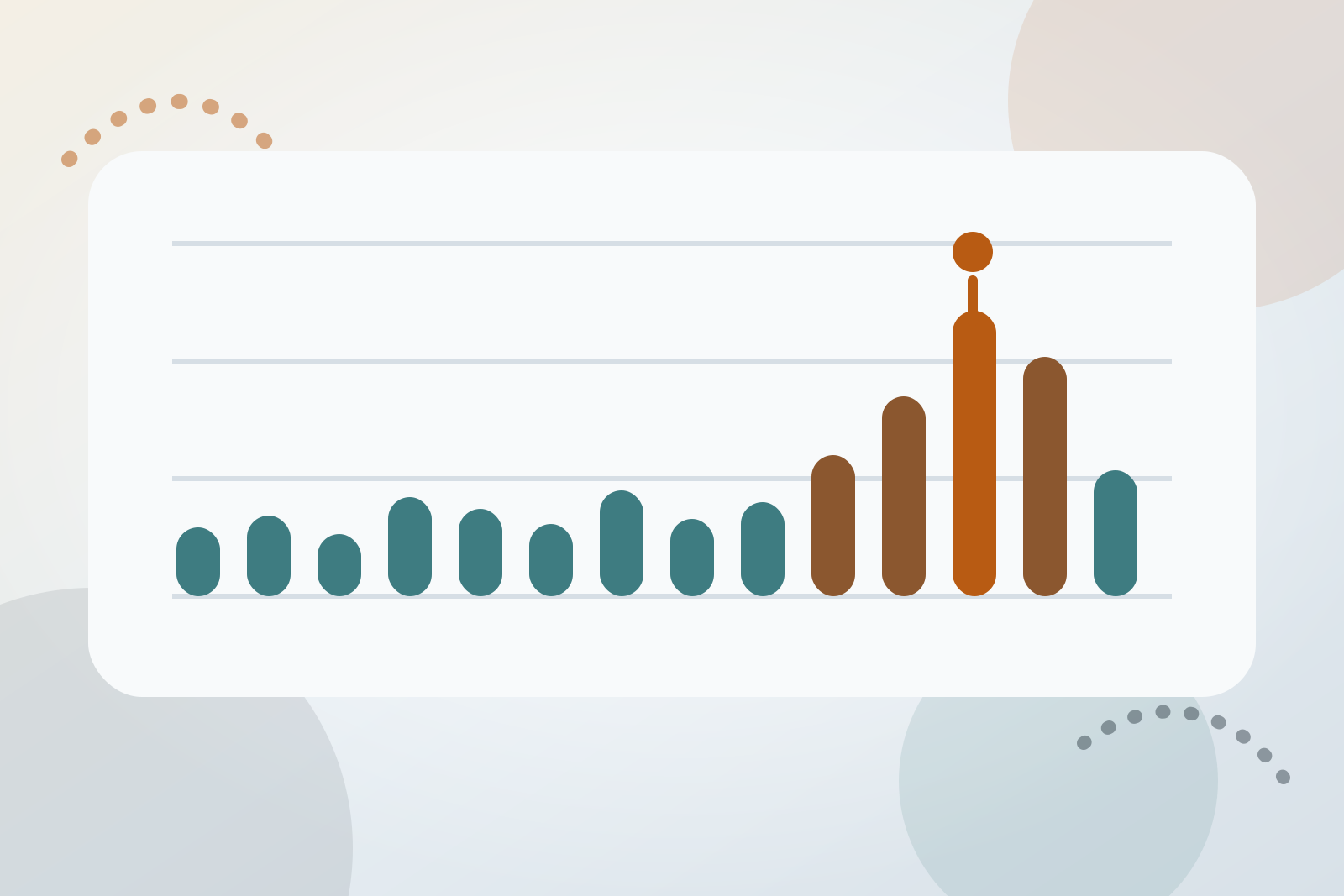
Time is the most underrated field in the log. Many people find, after a couple of weeks, that “the cravings are constant” is really “late evening after everyone is asleep, and Sunday afternoons when the flat is empty.” Those are two specific windows you can plan around.
Count your entries by broad window: morning, afternoon, early evening, late night. Then compare weekdays. Be cautious with small samples; three entries suggest a question, not a rule. Hard Bit applies the same restraint to its on-device forecast: below five entries it makes no prediction at all, and it only leans fully on your own history at around twenty.
For a deeper method on this, read How to Track the Hours Porn Use Feels Most Automatic. It pairs well with the trigger-mapping approach in How to Identify Your Craving Triggers and Difficult Times, which covers internal states like loneliness and tiredness alongside external cues.
Read the map like a researcher, not a prosecutor
The tone of your weekly review determines whether the map survives. A shaming review (“Why am I like this?”) produces avoidance, and an avoided log goes blank. A researcher's review asks better questions:
- Which combination of time, place, and feeling appears most often?
- What is the earliest point in the chain I could realistically change?
- What was different on the days the same hour passed quietly?
- Is my plan fighting the cue, or only fighting the final click?
Mayo Clinic's patient guidance explicitly tells people seeking help to set aside shame and embarrassment, noting that professionals are trained to understand rather than judge. Extend the same standard to your own notes. Shame is not a data field; do not let it act like one.
If the word “addiction” itself is part of what frightens you, park it for now. You do not need to settle a label to map a pattern. The World Health Organization's ICD-11 classifies compulsive sexual behaviour disorder as an impulse control disorder, but whether that diagnosis fits you is a clinical question. Labels can wait; observations cannot, because memory edits them.
Change one earlier point in the chain
Once a combination repeats, intervene as early in the sequence as you can. Resisting at the final click is the hardest and least reliable point. Practical editorial advice, adapted to what your own map shows:
- Change the device location. If the log says “bed, phone”, charge the phone in another room overnight. This one change removes the whole 11pm entry type for many people.
- Change the preceding event. If the cue is closing the work laptop, put a five-minute walk between work and the sofa.
- Change the state. If “tired and unfed” appears repeatedly, eat earlier on those days. Boring, but the log will tell you if it works.
- Have one response ready for the peak. When a craving is already loud, use a short sequence: name the urge, move away from the device, and do one prepared action. How to Handle a Craving in the Moment lays out that sequence, and What Is Urge Surfing and How Can You Practise It? explains the wave-riding technique some people find useful. Urge surfing is a coping technique, not a promise that a craving will pass on a schedule; intensity varies and urges can return.
Write your change as an if-then plan: “If I pick up my phone in bed, I will put it on the landing and decide in the morning.” If a broader reset is your eventual goal, How to Stop Watching Porn When the Pattern Feels Automatic builds on this same map.
When the map tells you to get more support
Sometimes the most honest reading of a log is that self-management is not enough. Take that seriously if you see:
- escalating frequency, time, or spending despite repeated plans,
- use continuing after clear harm to work, money, sleep, or a relationship,
- repeated failed attempts to cut down,
- or strong distress, hopelessness, or thoughts of harming yourself.
Mayo Clinic advises seeking help early, because compulsive sexual behaviour tends to worsen without treatment, and suggests starting with a GP or a mental health professional experienced in this area. Talking therapies such as CBT, and support groups, are among the established routes. In the UK, your GP is a normal first step, and the Samaritans are available free on 116 123 if you need to talk to someone urgently. In the US, the 988 Suicide and Crisis Lifeline is available by call or text if things feel that dark.
If urges ever involve children, non-consensual material, or another person's safety, step away from access and seek specialist professional help immediately rather than relying on self-tracking.
Bringing your cue map to a first appointment is genuinely useful. Clinicians ask exactly the questions your log already answers: when it happens, what triggers it, and what has helped.
Our editorial policy explains how this site separates sourced health information from product information.
Frequently asked questions
Is a porn craving a sign that I am addicted?
Not by itself. An urge is a common human experience. Concern grows when use feels difficult to control, continues despite harm, or causes real distress. A cue map helps you describe your pattern; a qualified professional helps you interpret it.
How long should I track before the pattern means anything?
There is no universal number. One week can reveal an obvious window, but treat early findings as hypotheses and keep logging. More entries make time-based patterns more trustworthy.
What if the cue is a feeling I cannot avoid, like loneliness?
You cannot delete an emotion, but you can change what follows it. Name the feeling in the log, prepare one alternative action for that state, and consider whether the underlying feeling deserves its own support, such as talking to someone or seeing a therapist.
Does tracking cravings just make me think about porn more?
A short factual entry usually takes under a minute and ends the rumination rather than feeding it. If logging ever increases distress or acts as a trigger for you, switch to writing entries later in the day, or discuss the pattern with a professional instead.
More source-reviewed guides are in the Hard Bit guide library.