If you are searching for how to stop watching porn and the pattern feels automatic, stop treating it as one decision made at the final click. Treat it as a sequence. Record what happens before the urge, identify the time or situation that repeats, change the earliest part of the sequence you can reach, and prepare a short response for the moment the urge still arrives.
If the pattern is distressing, difficult to control, or affecting sleep, work, relationships, finances, or safety, combine self-management with qualified support.
Understand what “automatic” means here
A familiar routine can move quickly. By the time you notice a decision, you may already be alone, tired, holding an unlocked device, or moving through the same sequence of apps and sites.
That does not mean the pattern is fixed or that it says anything about your character. It means there may be earlier decisions that are easier to change than the last one.
Watching pornography by itself does not establish an addiction or mental health disorder. The ICD-11 description of compulsive sexual behaviour disorder involves a persistent failure to control repetitive sexual urges or behaviour over an extended period, with marked distress or impairment. It is classified among impulse-control disorders, not disorders due to addictive behaviours.
The diagnostic guidance also says distress based only on moral disapproval is not enough for the diagnosis. People who call themselves “porn addicts” may not meet the clinical criteria. Only a qualified clinician can assess whether a diagnosis fits your circumstances.
Map the sequence backwards
Start with the last occasion and work backwards. A sequence might look like this:
- An evening plan was cancelled.
- You scrolled on the sofa until after midnight.
- You took the phone and headphones to bed.
- You opened a familiar social app.
- You moved to a pornography site.
The final step may be the hardest place to intervene. Earlier, you could decide where the charger stays, whether the phone enters the bedroom, or what fills the cancelled hour.
For each step, write down what made the next one easy. Possibilities include privacy, boredom, tiredness, stress, loneliness, an argument, alcohol, an empty hour, or unrestricted device access. Do not choose an explanation in advance. Record what actually happened.
Keep a small record for a week or two
Use a private notebook or tracker and collect six details:
- day and time,
- place,
- what happened immediately before,
- how you felt,
- urge strength on a simple scale,
- what you did next.
An entry could say: “Wednesday, 11:50pm; bedroom; scrolling after a tense work call; restless; 7/10; watched, then went to sleep late.”
Record clear days too. They may reveal protective conditions, such as being around other people, leaving the phone elsewhere, going to bed earlier, or having something planned.
A week or two is a practical starting period, not a clinical threshold or a promise that a pattern will appear. Review the notes without turning them into a verdict about yourself. How to Identify Your Craving Triggers and Difficult Times explains how to compare entries compassionately.
Find the difficult window
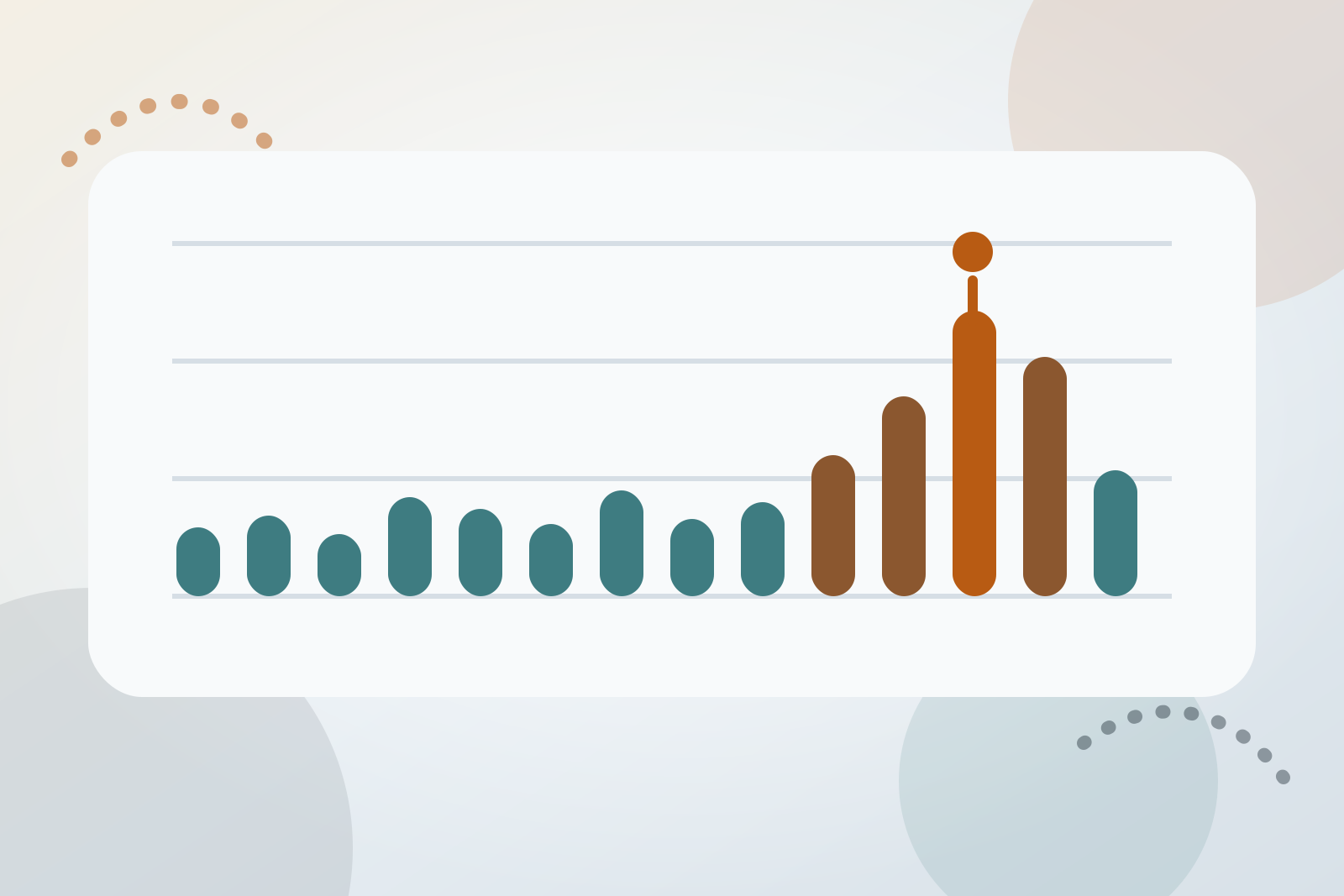
Group entries by weekday and broad time period as well as by cue or feeling. “Evenings are difficult” is hard to prepare for. “Sunday and Wednesday between 11pm and 1am, when I take my phone to bed” is more useful.
Treat an early pattern as provisional. Travel, illness, shift changes, and unusual weeks can alter it. A few entries suggest a question; they do not predict what you will do.
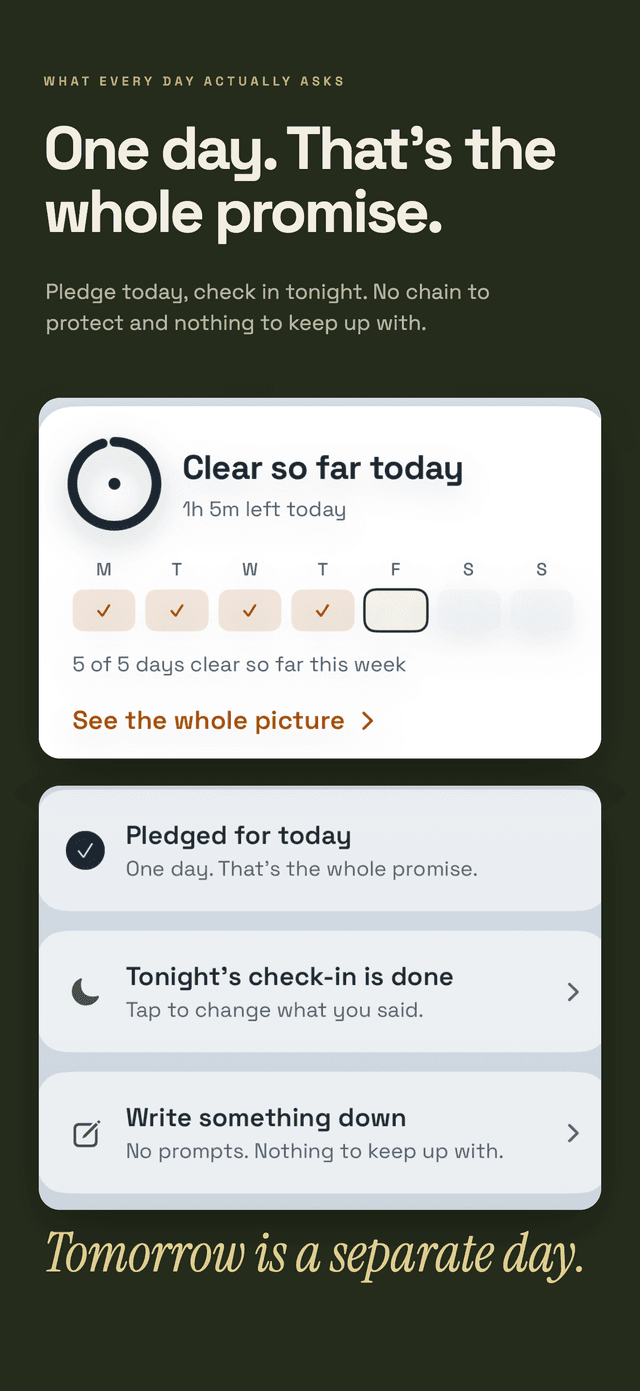
Hard Bit applies this same restraint on iPhone. It keeps each habit’s history separate and calculates its difficult-hour forecast on the device. It makes no prediction below five entries and relies more fully on personal history at around twenty. Nothing is uploaded, and no account is required.
Logging, the counter, journal, and hard-moment flow are free. Forecasts and warning messages require a subscription. The Hard Bit overview explains the product and privacy boundaries. A paper record can support the same review process without an app.
Change the earliest reachable link
Choose one change that occurs before the difficult window:
- charge the phone outside the bedroom,
- use a separate alarm clock,
- leave the laptop packed away after a set time,
- remove saved links and sign out of accounts,
- enable device content restrictions,
- ask a trusted person to hold a restriction passcode if that feels appropriate,
- plan a realistic activity for the empty hour,
- arrange a call before the time that repeatedly appears.
Filters and blockers can make access less immediate. They do not address every reason you may want to watch, and many can be bypassed. Treat them as one layer rather than a complete solution.
Make the change fit the actual hour. A late-night plan should not depend on an open gym, high concentration, or someone who will probably be asleep.
Prepare one response for the urge itself
Decide in advance what the next few minutes will look like. Smokefree.gov recommends actions such as switching activity, moving somewhere smoking is not possible, breathing slowly, reviewing reasons for quitting, and contacting someone. That guidance concerns nicotine cravings, not pornography, but some of its practical ideas can be adapted cautiously.
A device-based version might be:
- Sit up and turn on the light.
- Put the phone on charge in another room.
- Move to a shared or well-lit space.
- Drink water and take five slow breaths.
- Read one page or begin one short task.
- Message the person named in your plan if the urge remains difficult.
There is no reliable fixed duration for every urge. Use the delay to create decision space, not as a timer that guarantees the feeling will disappear. For a fuller response, read How to Handle a Craving in the Moment.
Decide what happens after a slip
A slip does not erase the clear days before it. It does provide information about where the plan failed.
Write your response now:
- record what happened without insulting yourself,
- note the earliest link you could change next time,
- make an immediate repeat less convenient,
- contact support if needed,
- return to the next ordinary part of the day.
Hard Bit preserves the history after a logged use and changes the counter wording rather than pretending previous clear days vanished. What to Do After a Slip Without Erasing Your Progress covers this approach in more detail.
Know when self-management is not enough
A log, blocker, or prepared activity is not treatment.
A 2025 meta-analysis covered 20 psychotherapy studies with 2,021 participants. People receiving psychotherapy, most often cognitive behavioural therapy or acceptance and commitment therapy, improved more than controls on measures of problematic pornography use, frequency or duration, and sexual compulsivity. The measured effect on craving was smaller.
These findings are promising, not settled. Every included study had a high or moderate risk of bias, most participants were men, and relatively few studies were randomized controlled trials. Ask a qualified professional what approach suits you rather than expecting a guaranteed result.
Seek professional support if the behaviour is escalating, repeated attempts to control it are unsuccessful, or it is harming your mood, sleep, work, relationships, sexual functioning, or daily responsibilities. The NHS advises contacting a GP or an organisation that specialises in the relevant problem. In the UK, Samaritans is available free on 116 123 for anonymous emotional support.
If you might harm yourself or someone else, contact emergency or crisis services now. If urges involve children, non-consensual material, or another person’s safety, seek specialist professional help immediately rather than trying to manage the situation only with a tracker or blocker.
Our editorial policy explains how sourced health information is separated from product information.
Write four lines before the next difficult hour
Put this somewhere private but easy to reach:
- My window: the weekday and hour that keeps appearing.
- My earliest change: the link I will alter before that hour.
- My next five minutes: what I will do if the urge arrives.
- My support: who or what service I will contact if the plan is not enough.
Rehearse the plan once while calm. If it repeatedly does not fit the situation, change the conditions or add support instead of simply demanding more willpower. More practical articles are available in the Hard Bit guide library.
Frequently asked questions
Does watching porn mean I am addicted?
No. Watching pornography alone does not establish a disorder. Clinical assessment focuses on persistent difficulty controlling repetitive sexual behaviour and resulting distress or impairment. Moral disapproval alone does not meet the ICD-11 diagnostic guidance.
How long do porn urges last?
There is no dependable duration that applies to everyone. Intensity may rise, fall, or return around familiar cues. Use a short delay to create room for another decision, not as a guarantee that an urge will end at a fixed minute.
Do blockers and filters help?
They can make access less immediate, especially when you are tired or following a familiar device routine. They can also be bypassed and do not address every cue or need connected to the pattern. Combine them with environmental changes, a prepared response, and support where needed.
Do I also need to stop masturbating?
Not necessarily. Masturbation and pornography use are not the same behaviour, and masturbation by itself is not evidence of a disorder. Define the behaviour you want to change and the reasons for changing it. A qualified, non-judgmental therapist can help if the boundary remains difficult to set.
Should I tell my partner?
That depends on your circumstances, safety, relationship agreements, and what you want to change. Avoid making a major disclosure impulsively during a difficult moment. A therapist or counsellor can help you plan the conversation. If telling a partner does not feel safe or appropriate, consider another trusted person or professional source of support.