To track drinking without shame, set the record up as information rather than judgement from the very first entry. Log each drink with its time and context, use neutral wording, keep your clear days in the count when a difficult night happens, and review the pattern on a calm schedule instead of in the middle of regret. The method below builds that kind of record, whether you use a notebook, a spreadsheet, or a private app.
Understand why tracking so often turns into punishment
Tracking itself is well supported. The NIAAA's Rethinking Drinking programme tells people who want to cut back to start by keeping track of every drink, because tracking makes you aware of patterns, and awareness is a key step in planning a change. Its printable tracker even suggests marking each drink down before you have it, which can slow the evening down on its own.
So why does a habit that health services recommend leave so many people feeling worse? Usually the problem is not the counting. It is the frame around the counting:
- the app or journal speaks in streaks, so one drink erases everything,
- entries get written only after bad nights, so the log becomes a gallery of failures,
- the review happens the next morning, at the exact moment shame is loudest,
- the numbers get read as a character score instead of a description.
Each of these is a design choice, and each one can be changed. That is the good news in this article: you do not have to fix yourself before the record becomes useful. You have to fix the record.
Decide what the record is actually for
Write one sentence at the top of your log: “This record exists so I can see my pattern early enough to plan around it.” Not “so I can prove I am improving,” and not “so I can hold myself accountable.”
That sentence matters more than it looks. A record built for proof gets edited. A record built for punishment gets abandoned. A record built for planning wants honest entries, including the uncomfortable ones, because a missing Tuesday makes next Tuesday harder to prepare for.
It also settles a question that derails many trackers: whether you are allowed to keep tracking if you are not sure you want to stop. You are. The NHS cut-down guidance and the NIAAA both treat tracking as something you do while deciding, not something that requires a declared goal first. You can log for a few weeks with no target at all and let the pattern tell you what goal is realistic.
Choose measures that describe, not judge
Shame thrives on vague totals. “I drank too much again” contains no usable information. Replace it with measures that describe the drinking itself:
- Drinks and size: what it was and roughly how much. In the UK, the NHS refers to a low-risk guideline of no more than 14 units a week, so units give you a shared reference point.
- Drink-free days: the NHS suggests having several each week, and they count up rather than resetting.
- Time and day: when the first drink happened and when the last one did.
- Context: where you were, who you were with, and what happened just before.
- The morning after: one plain line about sleep, mood, or cost. Facts only.
Notice what is missing: words like “bad,” “failed,” or “weak.” A measure you can write without flinching is a measure you will keep writing.
Log the drink and the context, never a verdict
The entry that protects you from shame is boring on purpose. “Thursday, 9:40pm, at home alone, finished a stressful work call, two large glasses of wine, slept badly” is useful for years. “Disgusting again” decays into nothing.
Two habits keep entries neutral:
- Log close to the event, in the third person if it helps. Writing “she opened the second bottle after the call” creates a little distance between you and the event, and distance is what turns judgement into observation.
- Include what came before, not just the drink. The earlier part of the sequence, the skipped dinner, the difficult email, the empty evening, is where your future plan will live.
If evenings follow a repeatable shape for you, the method in How to Track the Hours You Are Most Likely to Drink shows how to turn a week of context entries into a personal timetable. Hard Bit is built around exactly this kind of entry: each drink or drink-free day gets logged with its hour, and the app learns your difficult hour from that history on your device rather than from any judgement about you.
Keep the count honest after a difficult night
This is where most trackers manufacture shame. A single streak counter makes one logged drink feel like demolition, and plenty of people respond by quietly not logging, or by deleting the app for a week.
Two things belong in your setup instead.
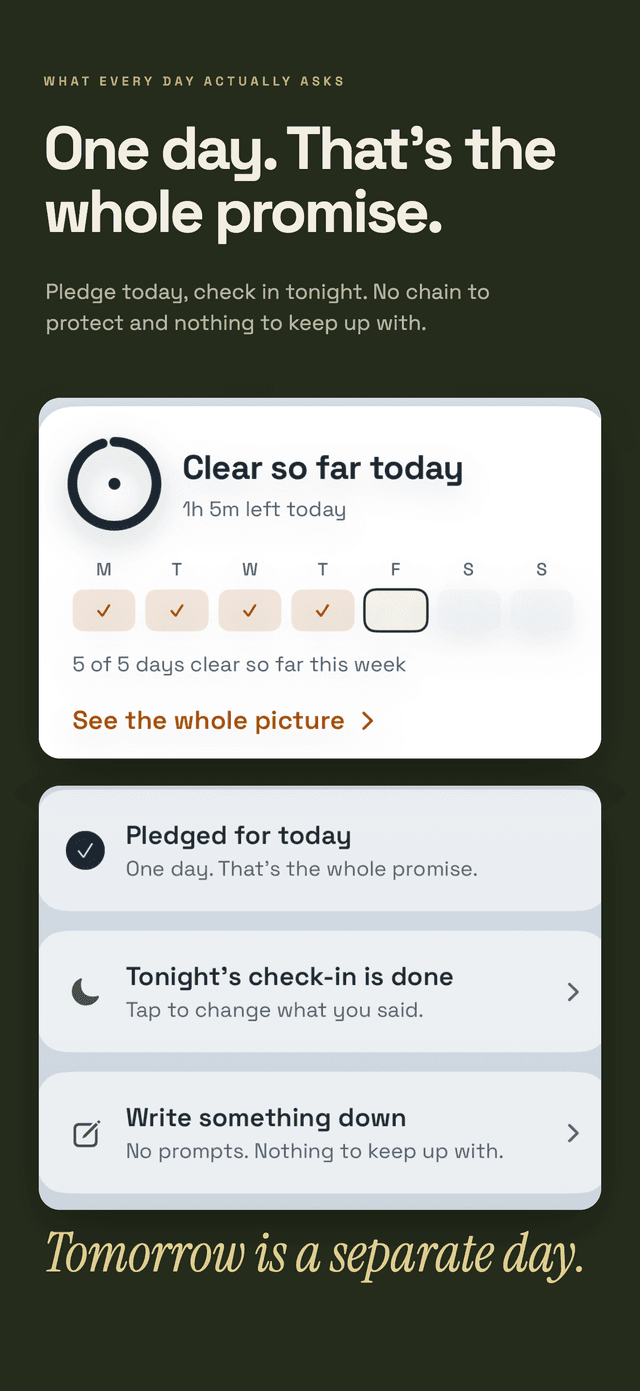
First, keep the full history. “81 of 84 days clear” keeps the three difficult days visible without erasing the other 81. Hard Bit's counter works this way deliberately: logging a use changes the wording, and the record stays intact, because a log you hide things from cannot show you anything true. You can do the same in a notebook by counting clear days out of the total rather than restarting at zero.
Second, expect the wave of next-morning shame and plan around it. A review of 37 studies, summarised by the Australian alcohol-change charity Hello Sunday Morning, found that people higher in self-compassion drank less often and reported fewer alcohol problems, and that guilt often pushes people toward more drinking, not less. This is an association found across many studies, not a guarantee for any one person, but it points the same way as the practical experience of many people: the harsh morning lecture is not a safety feature. It is part of the cycle.
When a night goes differently than you hoped, What to Do After a Slip Without Erasing Your Progress walks through how to record it honestly and change one condition for next time.
Review on a schedule, not in a mood
Pick one calm slot a week, Sunday morning with coffee, for example, and make that the only time you study the record. Ten minutes is enough. Look for:
- which day and hour appeared most often,
- what context kept repeating before the first drink,
- which clear days were easy and what protected them,
- one thing to change in the coming week.
Then close the log and leave it alone. Unscheduled reviews, especially hungover ones, almost always turn into rumination, and rumination feels like accountability while producing none of it.
When the weekly pattern is clear, the next step is preparing for the specific hour rather than the whole of your life. Alcohol Cravings: A Practical Plan for the Difficult Hour covers how to build that preparation.
Keep the record private enough to stay honest
A log only stays honest if you never have to imagine an audience for it. If your notebook could be found, you will start writing for the finder. If an app uploads your history to a server or shows it to anyone else, some entries will quietly never happen.
So choose storage you fully control: a notebook that lives somewhere genuinely private, an encrypted note, or an app with no account and no cloud copy. Hard Bit takes that second route: there is no account, no feed, and no server-side history, and the forecast of your difficult hours is calculated on your iPhone from your own entries. Below five entries it makes no prediction at all, and it leans fully on your own data at around twenty. The Hard Bit overview explains how the logging, counter, and forecast fit together. Whatever tool you use, the test is the same: would you log a genuinely bad night in it? If not, change the tool before you change yourself.
Know when a tracker is not enough
A log is a way of seeing. It cannot assess medical risk, and no amount of honest tracking makes an unsafe reduction safe.
The NHS is explicit that if you have become physically dependent on alcohol, stopping overnight could be harmful, and that you should get medical advice about doing it safely. Signs that you should speak to a GP or local alcohol service rather than simply tracking harder include needing a drink to steady morning shakes or anxiety, other people raising concerns, repeated failed attempts to cut down, or drinking that is causing problems with work, money, or relationships. In the UK you can also call Drinkline free on 0300 123 1110 in confidence. If you ever have severe withdrawal symptoms such as hallucinations, severe tremors, or seizures, call 999.
Bringing your log to that conversation helps. A factual record of amounts, times, and patterns is exactly what a clinician will ask about, and it is easier to hand over than a memory filtered through shame. More practical guides sit in the Hard Bit guide library.
Frequently asked questions
Does wanting to track my drinking mean I have a problem?
No. Tracking is a way of gathering information, and health bodies such as the NIAAA recommend it to anyone who wants to cut back, including people with no diagnosis at all. If the record, or the difficulty of changing it, starts to worry you, that is a reasonable thing to raise with a GP rather than a verdict to deliver on yourself.
Should I log units or just drinks?
Either works, but units give you a common scale, because a large glass of wine and a small one are not the same drink. In the UK, labels show the ABV, and the NHS low-risk guideline of no more than 14 units a week is the usual reference point. If units feel like too much work at first, log the drink and its size and refine later.
What if opening the log makes me feel worse?
Change when and how you review it. Entries made close to the event and reviewed once a week at a calm time rarely sting the way a hungover scroll through the history does. If any honest look at your drinking reliably produces intense shame or distress, that feeling is itself worth mentioning to a GP or a support service.
Is it safe to cut down on my own?
For many people who drink within or moderately above guidelines, a gradual, planned reduction with drink-free days is a standard self-management approach. If you may be physically dependent, though, stopping suddenly can be dangerous, and the NHS advises getting medical guidance first. When in doubt, ask before you stop, and treat severe withdrawal symptoms as an emergency.